Tuesday, 30 December 2025

The Year of Jane: or, a personal account of my first time reading through all the novels of one of the greatest novelists

I never read Jane Austen as a teenager. I was a voracious reader, but a lot of it was sci-fi & fantasy, I found nineteenth-century fiction slow, and I was affected by a prevailing sexism which regarded them as "Women's Books". My loss. In my 20s I saw and loved the 1995 movie of Sense and Sensibility (I've always had a bit of a crush on Emma Thompson) and subsequently read the book, and in the past few years saw the 2005 movie of Pride and Prejudice, but that was it.

But this year I've rectified that, and read my way through all six of Austen's complete novels. It felt a good year to do so: this year of 2025 has been the 250th anniversary of her birth (16 Dec 1775), and at the start of the year we visited Winchester for a brief trip and saw her grave in the cathedral. Early in the year we also saw a TV drama about Austen's life, centred on her sister Cassandra (Miss Austen) and a multi-episode documentary about her life and work with discussion by experts and lots of extracts from TV and movie versions (Jane Austen: Rise of a Genius). 

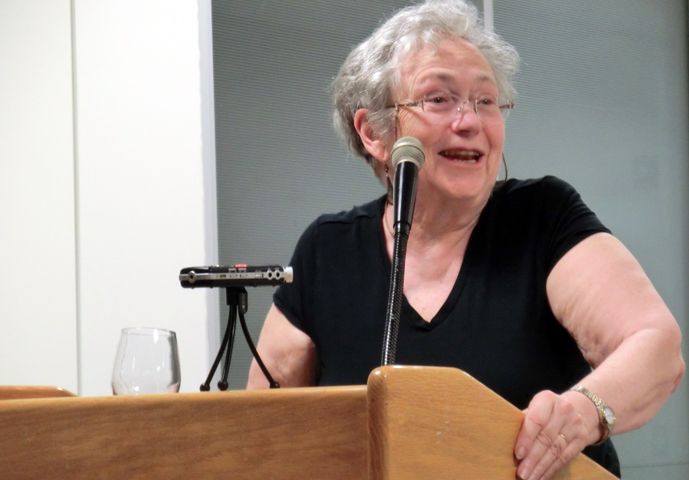
Photo by Rebecca Calcraft

I started the first novel on 25th February, and ended the last one on 29th December (reading lots of other novels in between). I read them in the following order: Pride and Prejudice, Persuasion, Mansfield Park, Emma, Northanger Abbey, Sense and Sensibility. I didn't keep any kind of notes after I finished each one so I'm going from memory now. Caveat: one read-through does not a Janeite make, and I'm a middle-aged cis male (not an under-represented group in the novels but never the central character), so I'll bow to many others' much greater knowledge and passion - but I'll try to say what struck me. 

First, the social setting. Throughout the books I was amazed how utterly unfamiliar the society depicted felt. Although it's a world much depicted in costume dramas, the complete financial dependence of women upon either inheritance or marriage, and the dependence of many men upon inheritance, is quite unlike how we live today. Of course, patriarchy and unearned wealth haven't gone away in the least, but they've changed their patterns from that seen in the novels. The focus is mostly on the wealthy or fairly wealthy, but society is so stratified that others are seen to exist to support these people - class and social status are present throughout these novels. And everyone is really young: marriage takes place around the age of 20 for most women, and most of the key protagonists are around this age, sometimes younger. Anne Elliot in Persuasion is the oldest heroine of the novels: she is 27 years old. 

Second, the gender perspective of the novels. So so so much fiction is about male lived experience, about men's concerns in the world, about the things which matter to men. Austen's world focuses on the female lived experience of her time, meaning that its focus is on domestic and family life. Male characters only really matter where they have roles within these spheres. Off-stage, some of them have jobs to go to, or fortunes to maintain, but we don't see these happening and they seldom matter that much to the story - except where they relate to how potential marriage partners can afford to live. Austen lived most of her adult life in a country at war with France, but apart of there being a lot of regiments and colonels around, you'd hardly know. (Gender in the world she describes is entirely binary and immutable; sexuality is entirely between men and women. We know from history that other patterns existed elsewhere in Britain at the time, but they don't appear here.)

Third, the geographic setting. Although only 200 years ago, Austen's world is almost entirely pre-industrial and agrarian, has only horses and carriages for transport, and is largely confined to the southern part of England - travel is slow so it's harder to go further. Most of the interesting places are one of the following: large country estates with surrounding villages where their county affiliations are really important; the occasional large towns for holidays or leisure (especially Bath but also Lyme Regis in Persuasion); and of course London which looms above everything. We go no further north than Northampton(shire), plus a trip to Derbyshire in Pride and Prejudice. Only once is there any real sense of town life beyond London, in the scenes in Mansfield Park set in Portsmouth, and that is an unhappy part of the story from which the protagonist has to be rescued. 

The fact that all the above factors are quite different in our society are a surprise for us, but they are simply the nature of the world for Austen. The outward trappings are not the important thing in the books, but rather the relationships and social structures, even if it's the balls and costumes that come out in the tourist industry in Bath and Winchester. Her purpose is not to celebrate that world but to satirise its conventions and expectations, comment on their problems, and show what mischief can be done when rogues break them. And she does it so very well. 

Photo by Alice Calcraft (in Bath)

Austen is a supreme social commentator, at least within her area of interest as described, of culture, class and gender relations. Mansfield Park is her most political novel - the sole work where she addresses questions of slavery (the slave trade was abolished when she was 32 and writing actively though slave-holding remained legal for twenty-five years more), but only in a few places in the novel - and the place where there is the greatest sense of poverty in England as well. But the novel was not well received critically on publication, and is still often low down the list of popularity among contemporary Austen readers. 

A mini-review of each novel from my perspective (in my reading order).

  • Pride and Prejudice: for many people, the most beloved so I read it first. And really it's a delight, in the characters and settings and the plot. The opening line and the ending are so familiar, but the way Austen reaches the ending is very satisfying. 
  • Persuasion: her final novel, and often said to be her most well-crafted. I really want to like this the most (the presentation in Miss Austen was very compelling) but perhaps I read it at the wrong time because it fell just a little flat. One to read again.
  • Mansfield Park: my favourite of them all, I think, partly because of the political angle mentioned above, but also the variety of geographical and class settings. Even then I wanted to see more! But I found it a thoroughly interesting work. 
  • Emma: I struggled with this a bit, because I found the main character really irritating and self-centred, which was intended by Austen but it didn't make for easy reading. More than I think any other novel, it's very tight geographically, hardly straying from one village.
  • Northanger Abbey: Much more clearly a parody of other novels than her other work. Although it was published posthumously, it was written early, and her ability to recognise and comment on the other novels is so strong. Disappointed in the ending though which felt very rushed.
  • Sense and Sensibility: The only one I'd read before, and I did enjoy reading it again. Lots of action, lots of characters. While the two contrasting sisters are the clear literary device, I was struck how nice they both are, and how horrible so many of the other characters are!
And so as 2025 ends, I can say with pleasure that I've rectified my failing and have now read all of Jane Austen's complete novels (other short and unfinished works also exist). And I'm content to concur with the popular view that she is indeed one of the greatest novelists ever. A thoroughly well-spent year of reading. 

Monday, 1 September 2025

A quarter-century at The Open University

Twenty-five years ago today, I walked into the Venables building at the Open University for the first time as a staff member, was greeted by my new head of department with a hug and a jar of home-made honey, and started to build my new working life. Today, I still have the same office in the same building, though most of the people I then worked with have left the university.

I love working for the OU. It's one of the treasures of the UK, often said to be the idea of which Harold Wilson was proudest in his time as prime minister (though the hard work was done by Jennie Lee). It's full of people who really believe in its mission of social justice through the expansion of high-quality education to as wide a range of people as possible. Like all the best UK institutions, it is quirky, innovative and idiosyncratic. It is also slow to change, frustrating bureaucratic and at times saddled with poor leadership. 

Five years ago I wrote a very comprehensive post on this blog on my work in twenty years at the OU: Reflecting on twenty years at the Open University. I can't really improve on that as a description of the work I've done, but I wanted to reflect a little bit on what's happened since and what might come next. 

Three ways in which the OU has changed since 2020 and/or my own big tasks:

  • I've spent a lot of time working on EDI (Equity, Diversity & Inclusion) projects. I was school EDI lead from 2016 onwards, but mostly focused on gender equality through Athena Swan, and we gained an Athena Swan Silver award in 2021. The OU as a whole has progressively shifted EDI work to a wider focus on other areas of equality (especially around ethnicity, disability and economic disadvantage), notably through a focus on awarding gaps. In our school we've had a really active awarding gaps group (led by a couple of other colleagues) which has contributed to lots of other aspects of EDI. My own contributions were mostly in looking at data, and in a really successful EDI professional development series for our faculty. More radically I was involved in a long scholarship project on how to decolonise the curriculum in Computing & IT, which didn't quite answer the core question but did really good work in scoping out decolonisation work. 
  • Writing on two big production projects has occupied much of the past few years - a substantial rewrite of the module I've long chaired on IT Systems: Planning for Success, just in time for the huge publicity on the Post Office Horizon scandal that we discuss as an IT systems failure; and a new postgrad systems module on which I authored, Codesigning interventions with systems thinking in practice. The latter of these took a lot of effort by myself and even more by the module chair, produced a really well-written module with some genuinely new ideas about 'systems thinking from the margins' ... and ended up being cancelled along with the apprenticeship programme of which it was a part. A sad business, but we still hope to find a home for the ideas.
  • My reflections from five years ago were written a few months into the Covid pandemic. The OU long had a rather weird attitude to places and offices. Of course our students are home-based, and so are our associate lecturers (tutors), our single largest staff group. But staff based at the Milton Keynes campus were largely expected to be in the office most days - academics a bit less so (and with plenty of flexibility), junior professional & clerical staff very rigidly so. Then Covid happened, we very quickly shifted to home working, and many of us haven't gone back. We're told that the typical campus attendance midweek in 2019 was 3500; now it is about one-third of that. It's been a massive cultural change, with real benefits for flexible working and for introverts, but real downsides for community and those who need others around them. For myself: I used to be on campus about three days per week (my journey to work is about an hour by train and bike). Now it's usually one day per week at best, often not that. 
Like a lot of universities, the OU has had a financial crisis in the past two or three years, which all feels a bit grim. I've seen it up close as an ongoing member of Senate; and will see it closer still, along with lots of other decisions, as I've just joined the university Council (its governing body) as an elected member. That alone should lead to an interesting few years ahead - along with work to produce a new module on the ethics of artificial intelligence as part of a new AI programme. 

Where the university will go in the next five years, or the next 25, is really hard to see. The OU still feels like it has a vital social mission, and it still has a large body of people who are keen to do that. 

The OU logo when I first joined
(via TVark)

How that's achieved has changed hugely in the past 25 years - when I first arrived we largely sent out books supported by audio and video tapes (I mostly missed the days of broadcast television of programmes for OU modules). The first module that I chaired, in 2001, was one of the first largely online modules with some great discussion tools built into the website and interactive videos for learning about systems thinking. Now every module has a really good website using standardised tools, and only some modules send out printed books. We used to have residential schools at university campuses across the UK, with monthly tutorials. I chaired the last systems thinking residential school in 2008 and only a handful of modules still have them, and our tutorials have long since gone online. Some of this feels like a loss, some of it an inevitable change. 

What seems very likely is that the way that our social mission is achieved will continue to change just as much - through technological changes, through changes in what we teach, through the way we interact with students. There's much talk at the OU of various ways that things might change in the next few years - we will see how those work out, and changes in society will impact upon us as well, for good or bad. It will be very interesting to see and hopefully I will continue to be a part of it.

One last thing to say. The text above is too focused on 'I' language. The correct pronoun for almost all OU activities is 'we'. All our work is done in teams - every module, every project, every task is team-based. If I've done anything useful, it's been with others. All the stories above have other people behind them (sometimes one person, sometimes lots) who I worked closely with for a few months or a few years. That's been a complete delight, and remains the case. It used to be said (because of the social justice focus and its history) that most people working at the OU were either Christians or socialists, and while that might not be so true today, the communitarian ethos is still really important. The key to the OU's success is the team.

Sunday, 12 January 2025

Change anxiety

Today in Quaker Meeting for Worship, some ministry came to me, around change in the world and my associated anxiety. After some deliberation (we are urged to wait to see whether ministry is just for us or for the whole meeting), I spoke - I suspect not entirely coherently. To avoid being over-long and because it didn't seem relevant enough, I didn't speak to the full context behind my thoughts. But while they're still in my head, I wanted to capture them here, for my own sake if no-one else's.

Three sources, two of them related. First, in our meeting's book group, we're reading the novel A Single Thread by Tracey Chevalier. The book is set in 1932, and is about the experiences of a single woman in the years after the First World War, and she (and society more broadly) changed in the aftermath of that terrible conflict. 

Second - and this might seem tenuous but was real for me - as part of my service to the meeting, I keep a mental record of the number of people present (which I later store in a spreadsheet to analyse patterns of attendance), and to keep it in my head I remember it in the form of a date. Today when I counted there were 19 adults in person, 2 children, and 3 people attending via Zoom - thus forming the date 1923. 

That reinforced the book's setting, and made me think: how do individuals respond to the most terrible of changes? Millions died in that war (from 1914 to 1918), millions more in the terrible aftermath as populations shifted across Europe, and yet more millions in the influenza pandemic that came immediately after the war and has never been as well remembered. How do societies recover? Do they try to return to something like the time that had been before, or do they end up creating something new? 

In our own time, we have seen terrible wars in Gaza, Ukraine, Sudan and Syria (among others), causing destruction and considerable human displacement; we have seen an economic catastrophe in 2008 which led to economic and ongoing political turmoil which is still poorly explored; and a pandemic which caused large numbers of deaths and disruption in the short term which has led to longer term social consequences around working patterns. All significant, though none as terrible in its scale as the First World War. All however are examples of very large scale external changes, and attempts by society and individuals to respond. 

My third source came from my working context. In September of this year, I shall have been working for the Open University for 25 years, something that seems just extraordinary to me. When I first joined, to teach systems thinking, we didn't at the time have a systems department but a systems 'discipline' within a kind of federal department grandly called the Centre for Complexity and Change. I remember telling this to someone I knew who told me that perhaps we ought instead to have a Centre for Simplicity and Stability. Of course, we sought to understand complex systems, and we were situated in a time of great change - as well still are. But since Quakers very much value simplicity, this old story did make me think this morning: do we over-value change? Is there a place in our world for stability? What would that actually look like?

I tend to think of myself as being quite good at change - coping well with large-scale discontinuities. But as the meeting progressed, I realised that in at least three areas of external life, I am currently quite struggling with change. In each of these areas, I don't feel as though I have much sense of agency. In each case, I don't like the direction I see things moving; I don't like the sense that I personally feel ill-equipped to handle the change; and I don't like the sense that institutions I care about also feel ill-equipped to handle the change. These changes (which are all connected in various ways):

  • Climate emergency: Last year (2024) was the hottest on record and reached the dread 1.5C above the pre-industrial average; there are currently wildfires in California in January; there are constant floods and massive storms. And society not only seems unable to respond, but in many places is actively going backwards. 
  • Right-wing populism: Societies around the world are currently succumbing to political movements which value excessive nationalism, extreme social conservatism, cruelty in the treatment of one's enemies, xenophobia and anti-immigrant hate, and leaders who speak to the deprived of their self-interest but govern for the economic elites. Eight days from today, the United States will inaugurate a president of this kind, but they hold sway in Hungary, and could soon have significant power in France, Germany and perhaps one day the UK. They are supported by rich owners of technology firms who can amplify their message. And centrist governments (whether leftish or rightish) really struggle to counteract their appeal. 
  • Generative AI: In a way, I have a more self-centred concern here. My job, based on skills which I have honed over decades, is one of writing high-quality texts. The technologies of ChatGPT and comparable tools make that skill look outmoded, perhaps even unnecessary. At an ethical level, I despise the sense of dishonesty which these tools introduce - of passing off automated words as one's own writing. I despise the enormous resources required to produce these fictions, in energy and water usage; and the massive human cost to workers in the Global South who examine the training data. And I despise the potential impact on public discourse from deepfakes, on education from students scraping through education through submitting fake assignments, and on the economic impact to artists who might also lose their livelihoods. Yet the bandwagon rolls on, lots of people (including sometimes other academics) who should know better are using these tools, and tech firms who have invested billions are trying to make them an inevitable part of search engines and office suites. 
How will these change society? How will I respond to these? Is it simply a sign of privilege that I've spent 54 years on this earth without being challenged by change at this level? And where (as a friend asked me after the meeting) is God in all these considerations? I don't know the answers. I simply feel uncertain and anxious. Change is inevitable as a process (though any given change can be resisted and is definitely not inevitable), but my goodness it's sometimes unsettling. 

Friday, 21 July 2023

Gaps in translation: Babel, information and colonialism

Recently I've been reading the novel Babel by Rebecca Kuang, and found it both highly enjoyable and thought-provoking. Very much an academic's view of a good fantasy story: set in Oxford, heroes and villains alike are academics, the magic that the book describes only works with a thorough study of language and etymology, and the novel is full of footnotes. 

Moreover, the setting is a very interesting period of history in the 1830s, when the second British Empire was still taking shape, with its rapacious attention shifting from the Americas (fifty years after US independence and with slavery finally abolished) to South and East Asia. The backdrop of the book is the smuggling of opium by British agents linked to the East India Company into China, and the run-up to the first Opium War. At the same time, industrialisation was taking place in large-scale within the UK, with the building of railways as well as factory machinery, and the consequent struggles for jobs and for democracy. Most of the novel presents this history faithfully, but laced with some fantasy elements.

In lots of ways I'd have been quite happy with this as a historical novel - the details are fascinating. When we meet leftwing demonstrators, they talk of the Chartists, of the Luddites, Peterloo and the 1832 uprising in Paris that is the centrepiece of Les Miserables. The effects of industrialisation on people, already working rubbish jobs which they lose due to more technology. The taking-over of subject peoples around the world but the unwillingness to accept people from those places within British society. And the true wickedness of the opium trade, when a supposedly civilized people got a great nation (China) hooked on drugs to make money and to subjugate them further, and when they protested. 

Some of these details led me down fascinating rabbit-holes. At one point the characters travel to Canton to 'negotiate' on behalf of a Mr Jardin and Mr Matheson who are trying to bring opium into China. So I learnt about their story, of becoming rich through drug smuggling, taking on Lot Number 1 in Hong Kong and growing into a company that is still rich today, but wouldn't have started without the creation of drug addicts. Meanwhile at home, James Matheson became an MP, governor of the Bank of England, and bought the island of Lewis from which he cleared large numbers of people to build a castle. Oh, and both were Scottish, as sadly was too often true with the British Empire.

But really all this is background for the book, which is about translation and its issues. The blurb begins with the Italian phrase traductore, tradditore - roughly, translators are traitors, or in the more elegant version of the blurb, "an act of translation is always an act of betrayal". Because in this world, the heart of power in Oxford, fuelling the British Empire, is the Royal Institute of Translation - the eight-floor tower known inevitably as Babel. The focus of much of the book is on a group of undergraduate students entering that institute, as people as the academics who teach them and others who also work in the tower. In that tower, silver bars are endowed with a special form of magic - a word in English (typically) is written on one side, while on the other side is a version of that word in another language. 

The magic comes in the gaps in translation - in the subtleties of meaning that one language captures but another misses. Sometimes the words are similar - the difference between French triacle and English treacle is the basis for healing from cholera in the first few pages. Sometimes they're different in appearance despite the languages being similar, such as German heimlich and English clandestine (used to create secrecy in the home, given that the German shares the same root as the English home). And sometimes the languages are quite different. 

That translation never captures the full meaning, however good the translator, is well-known. How can it, when languages are different in their grammar and syntax, and the words have different histories and implications? 

Any reader of translated fiction knows this. I'm going on holiday to northern Italy next month, and a colleague recommended that I read I promisi sposi (The Betrothed) by Alessandro Manzoni, a 19th century classic of Italian fiction though not much known outside Italy, and set in the region where we're going. But at least three translations into English are widely available, all in different styles, and the reading experience varies a lot depending on which I pick. In the same way, I recently read Thomas Mann's celebrated novella Der Tod in Venedig (Death in Venice), in a 1930 American translation which after reading it I learnt is regarded as somewhat censorial, toning down the homoerotic themes considerably for the American audience.

The same is true in non-fiction. I vividly remember as a PhD student reading German sociologists and philosophers such as Hans-Georg Gadamer and Jurgen Habermas, in English translations full of little translators' footnotes on why they'd picked certain readings of words and their full implications in the original. Every Biblical scholar and most preachers spend much of their time explaining the difference between Greek words and their common English renditions (I have myself constructed big chunks of sermons on why 'eternal life' and zoe aionios have very different implications, and heard many on the different possible readings of logos beyond the simple 'word').

It was for this reason that the field of hermeneutics (the study of interpretation) developed initially in Christian theology, before moving to other areas. It can never be neutral - it is deeply dependent on the positionality of the interpreter, as well as their understanding of the text. As the radical Biblical scholar Ched Myers wrote:

Claims that the meaning of the text is ‘obvious’, requiring no interpretation, or that someone interprets without bias, are no longer credible. Hermeneutics takes seriously the burden and responsibility of the interpreter as ‘translator’, trying to bridge two vastly different worlds. Moreover, interpretation is a conversation between text and reader, requiring not detachment but involvement. … [I]f we are genuinely listening to the text, we will allow it to influence how we understand and what we do about our situation (it ‘interprets’ us). Until the circle from context to text and back to context is completed, we cannot be said to have truly interpreted the text.

(Binding the Strong Man, 1988, p.5)

And so to information. These gaps in translation have much to do with the nature of information. Gregory Bateson famously described information as 'the different that makes a difference', and a gap in translation that can be used for magical purposes is surely exactly a difference that makes a difference. 

Gaps in translation are also an illustration of my colleague David Chapman's claim that information is provisional - we can never be certain whether it is accurate or not at any one moment. This is because, as David and I wrote together: "it is impossible to know, with complete certainty for all time, whether something is true, and, according to Floridi’s veridicality thesis of information, information has to be true otherwise it is not information". When our information relies upon translation, it cannot be otherwise than provisional: because its fundamental meaning is always uncertain. 

One further thought on information and translation. When communication technologies are analysed, they often are shown in successive layers within the sender, converting the message into a simple form (such as 1s and 0s on a phone line) which can then be relayed to the recipient where it is built up into a different form. In the paper on information being provisional, David Chapman used this technique to analyse information. However, where translation is concerned, there is no simple form into which the words are first of all converted before being built up in the other language. The spoken or written words go as a whole unit from one individual to another. At best they are held in the same sort of neurones within the brain, but not in a way available to human consciousness. In my view (and maybe others would see this differently), translated words move as a whole from one language to another, without an intermediate form.

And so to return to Babel and betrayal. At some level it is undeniable that translation is betrayal - the meaning behind the words changes, ideas are lost or added. For the most part, this is not a deliberate betrayal. Fascinatingly, in the novel there are further layers of betrayal - because the students that the novel focuses upon have mostly come to Oxford from other countries, chosen for their fluency in other languages to make the translation magic work effectively. And because their work powers the British Empire, they are thus put in a position of choosing either to betray their country of origin, or to betray their fellow-students within Babel. 

Which option they choose would be a spoiler for the novel - but it mirrors the choices that colonised peoples, and their successors as the descendants of colonised peoples (whether or not citizens of post-imperial states such as Britain) have always faced and always continue to face. In the style of early 19th century novels, the book has several subtitles, one of which is 'the necessity of violence', and what it means to do violence in such a situation (even if that violence is to things and institutions rather than human beings). As a pacifist, I found this really troubling, but also thought-provoking in the light of debates on decolonisation but also groups such as Just Stop Oil which use forms of violence against property (though not people) as has been the case for campaigning groups such as the Suffragettes in the past. 

Because ultimately Babel is a book about power; and translation is always an issue of power. The question is who holds the power, and what use they put it to.

Thursday, 5 January 2023

Christmas and the mystery of practice

Today is Twelfth Night, the 12th day on from Christmas day, and in some churches the end of the liturgical season of Christmas. Traditionally it's when decorations come down, and it has me reflecting on my experience of Christmas this year. 

I have long found the run-up to Christmas (i.e. most of December) to be exhausting, stressful and depressing. I feel considerable effort involved in buying presents, writing and sending cards, planning food. I often experience sensory overload from the bombardment of lights and sounds in shops and on streets. Society demands excess consumption. The time is suffused with memories and nostalgia, which can be pleasant but also painful. And there's a considerable degree of emotional labour - as a parent, one has to perform Christmas for the sake of children, but also to show a degree of enthusiasm (even joy) for the season to avoid spoiling it for others, whatever one's own feeling. 

I won't continue in this vein for fear of being equated to Ebeneezer Scrooge or The Grinch, but you get the idea. I do really like spending time with my family in a relaxed and celebratory way, and the repetition of happy rituals (watching The Polar Express, singing the final verse of O Come All Ye Faithful on Christmas morning and so on) can be very special. And I have a genuine fondness for mince pies, mulled wine and lebkuchen. But there really is just so much of it all.

My negativity about all this has often been tempered by religious practice - the series of special services, prayers, liturgies and songs which have been devised for the Christmas season. They do interweave with the secular Christmas events - some people would make little division between them - but they give meaning and purpose to the season. The midnight Christmas Eve service has long been a particular favourite, from attending it with my family as a child, through my father leading services in various churches, to a couple of times when I led them myself. And there are a wealth of church resources which argue for a reduced emphasis on the material Christmas in favour of a more relational one, such as Advent Conspiracy. The concept of incarnation, that God should take on human flesh and be born in poverty, is one that inspires so much of the best of Christian theology (my own graspings on the topic are best found in a sermon that I gave five years ago on a much-misused passage in the gospel of John). In a somewhat dualistic fashion, I sometimes have contrasted the religious Christmas with the secular Christmas, to the detriment of the latter. 

However, my somewhat meandering spiritual journey has led me back to Quakers, after ten years in the United Reformed Church (I've reflected on this in blog posts on 'sojourning in silence and systems' and 'on being a nomad'). Quakers are lovely people, with deep spirituality that expresses itself in often very radical action, profoundly inclusive values, and a form of silent worship that is different every time and (at its best) extremely profound. But they/we also have a 'testimony' (a collective practice) against following the traditional church practice of setting aside particular 'times and seasons' as special or different. We should be open to the religious message of Christmas every day, just as we should be open to every day being Easter or Pentecost. Janet Scott wrote thirty years ago that: 

We might understand this as part of the conviction that all of life is sacramental; that since all times are therefore holy, no time should be marked out as more holy; that what God has done for us should always be remembered and not only on the occasions named Christmas, Easter and Pentecost.
Although Janet Scott observed in 1994 that the testimony seemed to be dying of neglect, it has changed somewhat: practically every Quaker will celebrate Christmas in its secular form, but I know few Quaker meeting houses with Christmas trees and none with special acts of worship. One might or might not hear people speaking in December in our meetings for worship about themes relating to Christmas. This year, Christmas Day was a Sunday; in my meeting, there wasn't even a normal meeting for worship held at the meeting house because not enough people were available, though a few gathered on Zoom. The huge emphasis on the religious aspects of the Christmas season is absent in most of Quaker practice.

Of course, I could go to other churches; I did so when I was previously a Quaker, and both this year and last, I was at an Anglican service on Christmas morning with family. But I wouldn't be getting the same steady experience of publicly exploring and celebrating the incarnation week by week, unless I chose to spend all of December at another kind of church. 

But religious experience is all about embodied practice - people coming together as a community to live their faith and explore it through forms of ritual behaviour. The great scholar of religion, Karen Armstrong, observes that this goes back at least as far as the 6th century BCE, and the Greek rituals known as 'mysteries'. Of these mysteries, she observes: "it was not something that you thought (or failed to think!) but something that you did" (The Case for God, 2009, p.60). Moreover, it is clear from Armstrong's work that these actions only make sense in the context of communal practice: we make sense of the world together, and express our faith together, through action. 

So one can only practice Christmas (as a religious form) in combination with others, as part of a religious community. The individual believer can surely dip in and out of Christmas rituals (many a church minister has enjoyed ironically saying "see you next year" at a Christmas service to those in their congregation they won't see until next Christmas) but their experience is very different from those who participate in many Christmas services over a period of weeks. And thus if one is part of a religious community that does not practice Christmas services in an explicit form, then one has the choice of either absenting oneself from that community, or going along with this practice. 

In the coming year, I will be writing on a new module about Systems Thinking in Practice, and specifically ways to become a better practitioner. And as someone who has spent a lot of time in faith communities, I find religious practice to be an example I keep coming back to (although perhaps not in teaching materials, for fear of putting students off). My colleague Martin Reynolds (quoted by another colleague, Ray Ison) defines practice as:
human interfaced activities – processes, including speech, conversation and knowing – that effect transformation in situations (what people, or groups, do when they do what they do – a state of “doing”).

In other words, practice - whether it is systems practice, religious practice, or another form of practice - is made up of processes that change situations. By being part of a religious practice that explicitly emphasises Christmas, or one that keeps it tacit, changes the situation in which we find ourselves - into one which treats the Christmas season very differently. 

I can't say how this will affect me in the next Christmas season. It is certainly my hope that I might find the way to express the mystery of the incarnation throughout the year. For a believer in the Christian understanding of God, this ought to affect one's own life, to change one's own practice. The medieval German mystic Meister Eckhart wrote:

What good is it to me if Mary gave birth to the Son of God 1400 years ago, and I do not also give birth to the Son of God in my time and in my culture? We are all meant to be mothers of God. God is always needing to be born.

So perhaps when December next arrives, I'll be better prepared to experience both the religious Christmas and the secular Christmas through an appropriate form of practice. May it be so.

Sunday, 6 February 2022

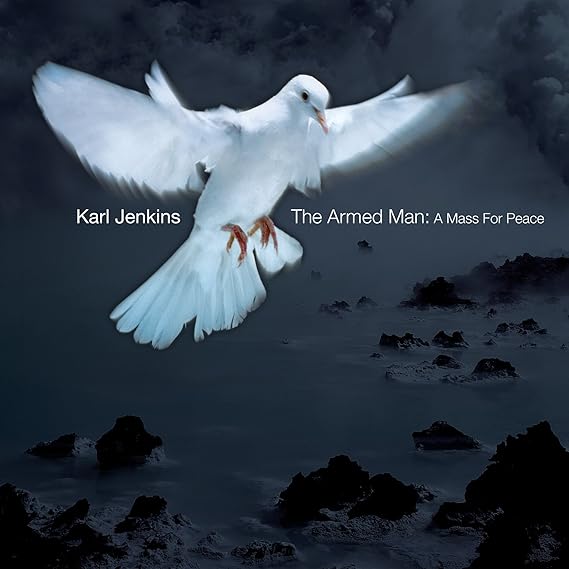
Cantus Firmus, The Armed Man and the love of God

Image: CD cover of
The Armed Man
Today I've been singing The Armed Man by Karl Jenkins, as part of the Northampton Bach Choir (and alongside the Royal Philarmonic Orchestra). It's only actually the second time I've sung the whole piece, but it's one of my very favourite pieces of classical music, partly because it was the first concert my wife Becky heard me perform and we played the Benedictus as a settling-down piece at our wedding; but also because of the very fine themes of peace and war that it portrays in a really vivid and accessible way. 

Rehearsing it again over the past two months, I've learnt a lot about the piece from the choir's main conductor Lee Dunleavy and our guest conductor Adrian Partington who actually conducted the piece in concert. In particular, from Adrian I learnt about a piece of musical theory that's important to understanding one of the movements: the idea of a cantus firmus. This was described by BBC Music Magazine as "a fixed tune around which polyphonic choral music is developed" - an existing tune or phrase which is typically sung or very slowly and by low voices, underneath other parts to form a foundation. For centuries, one such tune was the medieval song L'homme armĂ©e, which is also the basis of The Armed Man. 

Image by Lee Dunleavy,
Northampton Bach Choir [via Facebook]
In the Kyrie of The Armed Man, there's a couple of minutes of unaccompanied plainsong to the words 'Christe eleison', based on a setting of Missa de l'homme armĂ©e by Palestrina, and the second tenors (of which I am proudly one!) sing a cantus firmus - a very slow and sonorous version of the main theme which sits as an underlay to the rest of the plainsong. Adrian flattered the second tenors at one of our rehearsals by saying that we had the most important part in that section of the movement, and the more I think about it, the more I can see that musically.

But I was also really interested to learn (tbh from Wikipedia in the first instance, but subsequently from other sources) that the concept of a cantus firmus has been used metaphorically by various thinkers. Perhaps most notably, it was used by the great German theologian Dietrich Bonhoeffer as a metaphor for the love that a believer should have for God and how it relates to our love for the world and other humans (in all the different forms of love):

God, the Eternal, wants to be loved with our whole heart, not to the detriment of earthly love or to diminish it, but as a sort of Cantus Firmus to which the other voices of life resound in counterpoint. One of these contrapuntal themes, which keep their full independence, but are still related to the Cantus Firmus, is earthly love. ... Where the Cantus Firmus is clear and distinct, a counterpoint can develop as mightily as it wants. The two are ‘undivided and yet distinct,’ as the Definition of Chalcedon says, like the divine and human natures in Christ. Is that perhaps why we are so at home with polyphony in music, why it is important to us, because it is the musical image of the Christological fact and thus also our Christian life? [Extract from Letters and Papers from Prison, pp. 393-4, available online via Cantus Firmus Ministries] 

This idea of the cantus firmus and our love for God was much in my mind during the Quaker meeting for worship that I attended this morning immediately before our concert-day rehearsal for The Armed Man. My experience of singing the cantus firmus in the Kyrie is that it has the following characteristics:

  1. It is massively slower than the parts in the other voices
  2. It sits below those other parts, giving them foundation and depth
  3. It can be hard to hear by itself, but if you're able to listen hard for it, it's then difficult to ignore (my ability at picking out individual lines on a recording is only average but the cantus firmus on the Armed Man recording is very clear)
  4. It is not easy to sing, and requires a lot of concentration but once you try, it can be really rewarding
  5. It is something that especially works through sharing - at one point today I was part of a group of just three second tenors and that was especially hard, but when the choir was reconfigured so that a larger group were together, the cantus firmus was much easier to pick up
I think all of these can be said of God's love for God's creation - it is more fundamental than human love, and happens at a different pace; once you know it, it's not hard to see but it requires work to do so; and that love can best be experienced along with others. In my own experience, Quaker stillness is an especially good way to experience God's love, but others have found it through many other contemplative practices within Christianity and other faiths. And the same processes can be said to be true of other response to God and our love for God - it requires effort, and to be foundational underneath other loves, and it can perhaps best be learnt and shown in a group of others.

As St Paul wrote in the letter to the Romans:
And I am convinced that nothing can ever separate us from God’s love. Neither death nor life, neither angels nor [rulers] neither our fears for today nor our worries about tomorrow—not even the powers of hell can separate us from God’s love. (Romans 8:38, New Living Translation)

Saturday, 10 April 2021

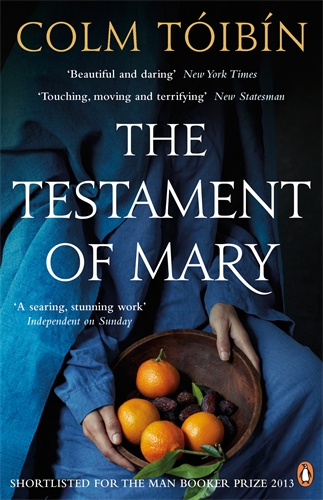
On hunting and being hunted: the role of narrative in The Testament of Mary

Until lions have historians (it is said), history will always be written from the perspective of the hunter. This was my overwhelming feeling on finishing reading Colm TĂ³ibĂ­n's excellent short novel, The Testament of Mary. It's very much a book about narratives, and how alternative narratives are constructed.

The book presents Mary (the mother of Jesus) at the end of her life, reflecting both on the tumultuous events which took place around her son's death, and her own subsequent life in hiding. She's doubly hunted: by the agents of the Roman Empire, who would like to see her silenced; and by Jesus' followers, two of whom act as her protectors and who feed and house her, but in return for a constant stream of reflections and questions about her experiences of her son. The name of Jesus never occurs in the book - at one point Mary says that she can't bring herself to speak his name, so great is her grief - so it's always "my son" or "him". But he's present throughout the book, his words and his deeds. 

Tradition suggests that Mary fled to Ephesus, on the coast of Asia Minor (now part of Turkey) where she lived out the rest of her life, and Colm TĂ³ibĂ­n follows that tradition; thus one of her protectors may be taken to be John, the 'beloved disciple', whose oral tradition formed the basis of the Gospel of John. Given my comment above about Mary being hunted, it's striking that Ephesus was the site of the major temple to Artemis, the hunting goddess, which Mary is described in the book as visiting.

Mary's recollections of a number of the key events in Jesus' life that are central to John's gospel - the wedding at Cana, the death and rebirth of Lazarus, the crucifixion - are somewhat different both to the story as we have it in the gospels, and to the story as the disciples are gradually reconstructing it from Mary's accounts. It's very clear that they want to create a story about Jesus as someone supernatural, as the Son of God, and that they see his death as something very distinctive and important.

It's true that the process of creating any sort of biography, even by modern historical standards, is one of selection of which facts to present and how to present them; and this was even more the case in the ancient world. Nonetheless, the way in which the disciples are shown as shaping the narrative around Jesus is striking. It's doing a certain amount of damage to Mary's perception of herself and her life with her son - using both of these to create something new. 

They're doing this for enlightened reasons, to reshape the world's understanding of itself, and in the process to bring hope to the oppressed within the Roman Empire. And narratives are inexorably tied up with power - as David Chapman and I have written, "narratives of information are constructed by those in power, sometimes in ignorance of the less powerful and sometimes deliberately to exclude those with less power". Nonetheless, the book ends sadly, with Mary left alone and with her self-perception of her life considerably harmed by those who have supposedly written about her.

The novel reminded me at times of Philip Pullman's book The Good Man Jesus and the Scoundrel Christ, which also shows the developing narrative around Jesus. While Pullman is an avowed atheist, it's tempting to say that TĂ³ibĂ­n is presenting a secularised version of Mary's story, but that would be unfair. There's a constant sense of Mary's spirituality - she regularly prays, goes to the temple (Jewish and that of Artemis), and is shown having multiple spiritual experiences. Her version of the narrative - and of course she too is constructing a narrative - is at odds with the conclusions of John's version, but it is no less religious. 

Ultimately, all experiences are shaped by narrative, and all narratives are derived from experiences. The only question is what we seek to do with those narratives, and how close we want them to be to the literal truth of our experiences.

Sunday, 14 February 2021

On being a nomad: multiple experiences of spiritual community

(I think that 'words that I might have offered in ministry but didn't quite feel appropriate' must be a distinctive Quaker literary form. Here is one such.)

This morning in Meeting for Worship we were reminded of the words of Caroline Stephen, written in 1908, that "the presence of fellow-worshippers in some gently penetrating manner reveals to the spirit something of the divine presence" (Quaker Faith & Practice 2.39). So I spent much of the meeting thinking about my experience of spiritual community.

Group of linked hands from several people, forming a heart shape between them
Image: Jewish Journal

I've recently been reading a recent wonderful collection of short articles on sexuality and religion, The Book of Queer Prophets (ed. Ruth Hunt), appropriate for LGBT History Month. Among many lovely pieces is one by Padraig O'Tuama, who writes among other things about community among LGBT people and compares their (and his) experience to that of the Israelites being persecuted in Egypt, and the way that persecution shaped their community. He writes: "A people became a people because of their shared need to move out from a system that abhorred them. ... 'Let my people go', someone said to a person in power, and those under the power realised they were a people."

That experience of being persecuted for one's difference, and then that persecution leading to the formation of community, is one that many groups have found around the world. Some scholars suggest that the ancient Israelites were not a single ethnic group (notwithstanding the origin story of Jacob and Joseph in the book of Genesis), but rather were a disparate group who formed around their slavery, escape from Egypt, and journeys in the wilderness. The story of gay men finding a common identity through persecution and death in the 1980s is told beautifully in the recent TV series It's a Sin. Successive generations of African-Americans have built supportive community in the face of white supremacy and found ways to fight for justice (during slavery, the Jim Crow period in the southern states, in the Civil Rights movement, and more recently in Black Lives Matter). And Quakers too formed and were shaped through persecution, in the early decades of their movement when their theological and political radicalism was so threatening to the state that many were imprisoned and sometimes Quaker meetings were kept alive by their children.

For myself, my life experience haven't led to that sort of persecution or that sort of community. I'm white and middle-class. I've never been persecuted for my faith, whether as a Quaker or as a liberal/progressive participant in Presbyterian churches (I've occasionally been accused of not being a true Christian by evangelicals, and even left one church when it became too evangelical, but that's hardly persecution). And while I've been on the fringes of the LGBT community for many years, I've largely been sufficiently straight-acting not to attract hostility from anyone. 

And yet I found myself realising that I have a deep yearning and need for spiritual community, to join with others to explore what it means to be in relationship with God, what it means to be human, what it means to seek after truth, what it means to have love for others, what it means to live in harmony with the natural world, what it means to seek justice. 

I've found some of that sense of spiritual community through Quaker meeting, sometimes through local meetings (I've been a close part of at least eight local meetings, though none for more than a few years as life took me to different places) but just as much through national Quaker groups. I've found some of it through churches in the United Reformed Church and the Church of Scotland (again at least four of those, but more loosely with a number of other churches where I've preached). I've found it through the Iona Community, in Glasgow and on Iona but just as much in our local and regional groupings; and by attending the Greenbelt festival for a decade. I've found it through conversations with family and friends. And in a way I've found it through a community of ideas around progressive Christianity, in books and podcasts where I'm more of a recipient than a generator of ideas, but of which I certainly feel a part and which inform some of the other spaces.

This long and disparate list of spiritual communities shows the difficulty in some ways of my spiritual journeys - I've very much been a nomad rather than a settler, and even though many of the ideas and experiences have a lot in common, the people and the groupings are quite distinct. I've had a deep sense of connection with many people through these communities, but not always for very long. This is a very different experience both from the person who's been part of a single spiritual community (such as a church) for many years, and it's also very different from the people I discussed above who have been joined together in community through persecution. My experience is richer for perhaps being quite broad, but poorer for perhaps being more more shallow. There's a lot more 'I' in this piece than 'we'. Sometimes I feel that I would like to settle in a single spiritual community. Sometimes I've felt that I had found one, and then life changed in various ways. 

And maybe this nomad form of community is its own form of spiritual experience, as I've met and encountered others with the same pattern from time to time, who find their way through travelling rather than arriving. In a hymn by Joy Dine that has spoken to me for some years are the words: "When we set up camp and settle / to avoid love’s risk and pain / you disturb complacent comfort / pull the tent pegs up again". Perhaps there is calling in this way of peripatetic spirituality. But I do value depth in community as well as breadth. So my own search for community continues.

Wednesday, 13 January 2021

Life in the midst of death

Death is so present at the moment. Covid-19 deaths in the UK (and other countries) are sky-rocketing, in quite scary ways. Within our church communities, we know a number of people who have lost loved ones recently. 

And yet there is always a tension between death and life. There is death in life, and life in death. I have no firm belief about what an afterlife might look like, but I find comfort in traditional Christian imagery around the life to come, even if it seems more like poetry than prose to me. Indeed, I think such words and images exist to comfort the grieving rather than to provide anything like a model of the nature of the universe. Certainly I learnt much more about the words of Brahms' Requiem "What then do I hope for? my hope is in thee" after I said goodbye to a colleague who shortly afterwards died; and I learnt more about the statement in Revelation 21:4 that "Death will be no more; mourning and crying and pain will be no more" when I read it at my father's funeral.

And these words are especially encapsulated in music for me. In John Rutter's Requiem, there is a wonderful setting of the Agnus Dei, the traditional words from the Requiem Mass in Latin, that read "Lamb of God, who takes away the sins of the world, grant us peace" (Agnus Dei, qui tollis peccata mundi, dona nobis pacem). Those words are given to the high voices, who sing in a hopeful, but tense and anxious way. At the same time, the low voices sing under them words from the Anglican Book of Common Prayer: "In the midst of life, we are in death". 


And the combination is breathtaking, and achingly hopeful and sad at once. There is death in life, and there is life in death. 

Image: American Society for Cybernetics
This combination was one of the many themes found in the writing of the anthropologist and systems thinker Mary Catherine Bateson, who died a week ago on 2nd January 2021 at the age of 81. I was very fond of her work - in my book Systems Thinkers (with Karen Shipp), we wrote of her "strong respect for the individual with an awareness of wider forces to which they relate" and described her as "an individual who has taken systems ideas so deeply into herself that they influence all of her thinking and writing, and who has written at length about that process". 


Since her death I have been reading a lovely piece she wrote in 1993 entitled 'Into the Trees' (written for an anthology which can be found online, but also republished in her excellent collection Willing to Learn). She writes at length about forests as embodiments of this tension between death and life: 
Walking through the woods, I am reminded that there is as much death here as life. It is a mistake to think the word forest refers only to the living, for equally it refers to the incessant dying. It is mistake to speak of preserving forests as preventing the death of trees. Forests live out of the deaths of toppled giants across the decades, as well as the incessant dying of microscopic being. Without death, the forest would die. Ultimately, it is only the removal of trees that can deplete the forest. ... Death is apparently not a failure of life, but a mode of functioning as intrinsic to life as reproduction. To see life without seeing death is like believing that the earth is flat and matter solid - a convenient blindness.
Mary Catherine Bateson was a committed member of the (American) Episcopal Church, so she would have known the old Book of Common Prayer, and I see in her words their insight that in the midst of life, we are in death. One of her much-loved articles discusses the death of her father, the anthropologist Gregory Bateson, under the evocative title 'Six Days of Dying'. In a marvellous interview for the podcast On Being, originally recorded in 2015 but rebroadcast just days before her death, she said about her insight from writing about her father's death:
death is a very important part of life that we shouldn’t deny, that in spite of our terrible hubris and greed and competitiveness, that we can learn to see ourselves in proportion and realize that we’re small and temporary and don’t understand as much as we need to. And we live in a time of real urgency, where we have to mine the insights of the past.

Mary Catherine Bateson wrote extensively about life - perhaps her most widely-read book (and the theme of the much of the On Being interview) was entitled Composing a Life, on how we learn to live as a form of improvisation, and progressively find meaning in our lives as we go. Eventually life ends, but that brings me to one last piece of her wisdom from her memoir of her parents, With a Daughter's Eye, p.269 (thanks to my colleague Kevin Collins for finding the reference - there's a searchable version on Amazon):

The timing of death, like the ending of a story, gives a changed meaning to what preceded it.

I appreciate that wisdom as a historian of people with ideas, whose ideas can only really be understood once we them in full after their death (and sadly I've often understood systems thinkers best through their obituary and memorial articles in journals). But I also appreciate that wisdom as a person, still coming to terms with the death of my father just over a year ago, as we all need to take time to reflect on the lives of those we have known and those we have loved. Even if their stories have ended, our reading of those stories goes on for a long time to come.

In the midst of life, we are in death. But hope can be found in life, and hope can be found after death.

Sunday, 11 October 2020

All are welcome at the feast: a sermon on food and inclusion

Sermon preached at Duston United Reformed Church on 11th October 2020. Texts: Isaiah 25:4-8; Luke 14:15-24.

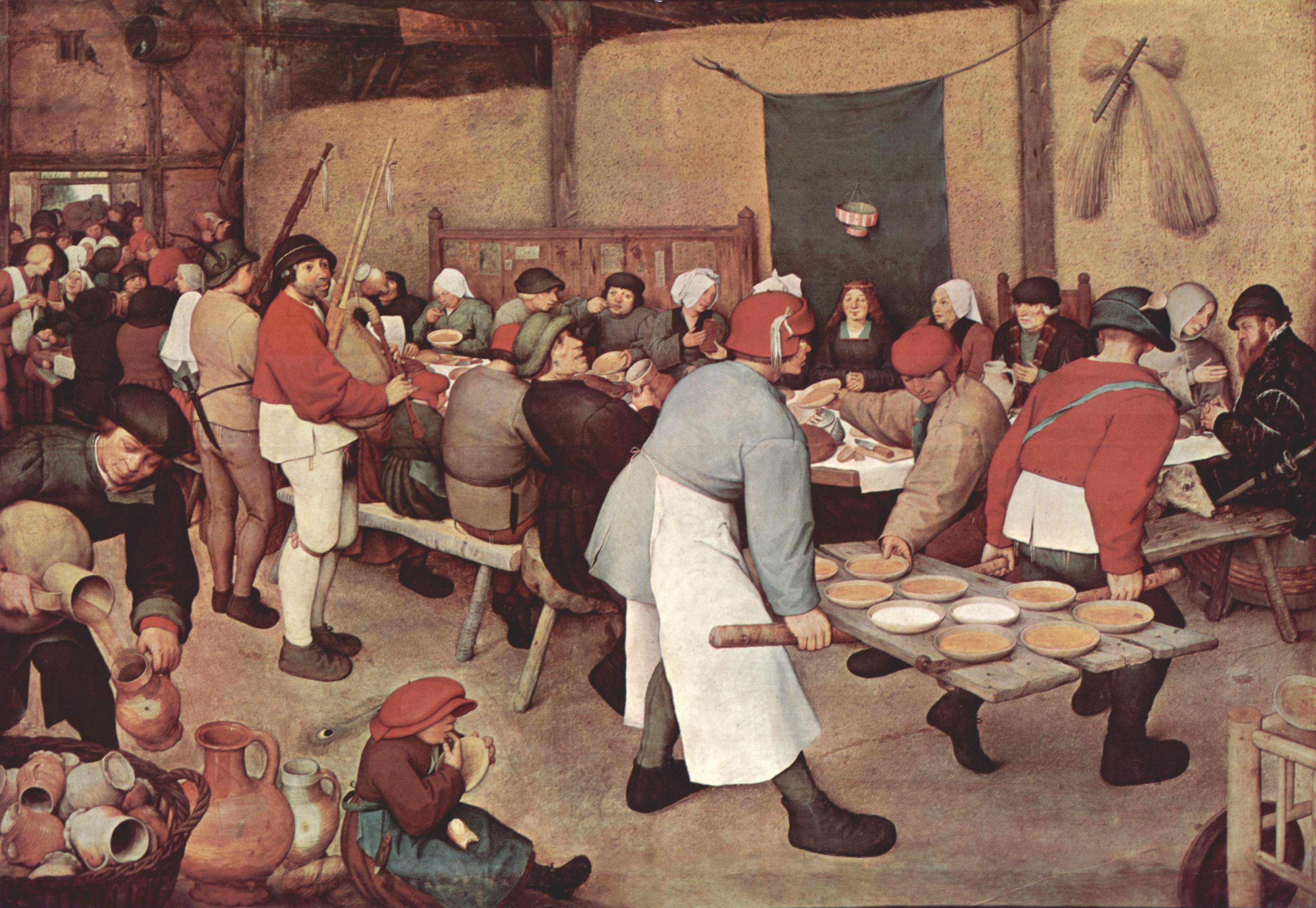
All the passages we’ve heard today – from Psalm 23, from Isaiah, and from Luke – are to do with feasting. The word feast is perhaps a little old-fashioned now. It conjures up images of Oxford colleges or medieval banquets, it belongs to the world of Henry VIII or Hogwarts. Indeed, there are many memorable feasts in the Harry Potter books. Here’s how JK Rowling writes about the first one that Harry encounters, fresh from his unhappy cupboard under the stairs:

"Harry’s mouth fell open. The dishes in front of him were now piled with food. He had never seen so many things he liked to eat on one table: roast beef, roast chicken, pork chops and lamb chops, sausages, bacon and steak, boiled potatoes, roast potatoes, chips, Yorkshire pudding, peas, carrots, gravy, ketchup and, for some strange reason, mint humbugs."

Harry’s reaction is an important one, because although he was never starved at his terrible aunt and uncle’s house, he never had quite enough and never got the nicest things. In the same way, in a poor society where people are just scraping by, feasting on special occasions, every now and then, becomes really important. It’s a time to put away your everyday poverty and go wild for a brief time. 

Image: The Peasant Wedding by Pieter Brueghel, via Psephizo.com

Let’s talk about food poverty in the world today for a moment, to put this in context. According to the most recent estimates, more than 800 million people across the world, roughly 1 in 9 of the world’s population, are undernourished – they don’t have enough food to live a normal active everyday life. This figure had been declining as a result of many international efforts, but it’s started to rise again in the past few years. 

As you might have heard, the United Nations’ World Food Programme has just been awarded the Nobel Peace Prize. They give direct assistance to the very poorest people in the world, more than 100 million people, and their work has been all the more important during the coronavirus pandemic. Food and hunger really matter. The World Food Programme’s director, David Beazley, said the following after the announcement of the prize:

"Where there is conflict, there is hunger. And where there is hunger, there is often conflict. Today is a reminder that food security, peace and stability go together. Without peace, we cannot achieve our global goal of zero hunger; and while there is hunger, we will never have a peaceful world."

Nor is this just a problem of so-called less developed countries elsewhere in the world. In our own rich country, according to Oxfam, more than two million people are undernourished, and half a million people are reliant on food parcels. This is a national and a global scandal. Helping individuals such as happens here with the food bank is really important, but ultimately we need deep changes to the systems which allow so many people to go hungry.

Returning to the world of ancient Israel, they lived in an agricultural society where many people were only one harvest away from starvation. The wider middle eastern area from Iraq to Egypt, including Israel, was known as the Fertile Crescent for its benign climate for growing crops, compared to many other areas, but there were frequent famines and disasters. In that world,  feasting took on a deeper symbolism. It was a rare and special event. You couldn’t rely on it, and it felt like a gift from God. 

As a result, many societies have ritualised such feasts, built them into religious traditions of all sorts, and ancient Israel had plenty of those. It also had a deeper significance, in that feasting was a key image of what they looked forward to when God brought about a better world in the future, in the end times. Thus the prophets are full of accounts of the future time when God will make a great feast, a banquet of rich foods and fine wines, in the way that we saw from Isaiah. There’s no sense of this being a different place – this is a new earth rather than heaven – but it’s a world transformed, a world of justice and peace, a world where everyone is welcome and everyone is fed. 

And it’s that sort of feast that Jesus was talking about in his parable of the great banquet. It’s quite a complex story, of people being invited and refusing and then others put in their place. I have to confess that I’m not using the version of the parable that’s in the lectionary for today. We should be hearing the parable from the gospel of Matthew, which tells roughly the same story but adds layers of violence, exclusion and pretty blatant anti-semitism. Luke’s version is neater, has fewer layers, and is a lot less problematic. But there’s still a lot going on. 

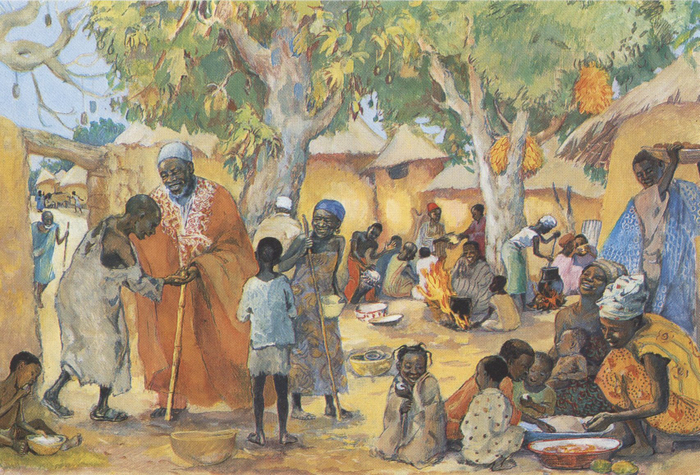
Image: Jesus Mafa, via Vanderbilt University

Now it’s not obvious from the text, but invitations in the time of Jesus were quite unlike in our time. Today when you’re invited to a dinner or a celebration, you’re told the time and place. In Jesus’ time, the guests were invited well in advance, agreed to come, and only later would they be told when the celebration was actually happening. So those excuses are partly because something else had come up in the mean time, those people who’d bought land or oxen, or who’d just got married. They’re partly to do with the time that had elapsed between the initial invitation and getting the details. I’ve done that myself at work – said I was free for a meeting on a range of dates, then had some of those dates fill up. It’s not necessarily that you don’t want to make the date, but it’s certainly a matter of priorities. The people invited simply don’t find the dinner as important as the other things they’ve got on. Now this parable has often been read allegorically, with lots of different groups reckoned to be the various people who reject the invitation, but I suggest that a simpler reading is easier: some people were invited to the feast, but they couldn’t make it any more because they had more important things to do.

And understandably, this would be pretty hurtful to the person giving the feast. They’d put in lots of effort and money planning this feast, and their guests don’t want to come. That’s a pretty horrible feeling. I’ve organised various events, in churches or at work or socially, and the start time was approaching, and people weren’t turning up, and my heart began to sink. 

So I can readily imagine how the organiser of the feast might have felt by all those rejections. I think we can assume that he was a person of some high standing, so that all those rejections would have impacted on his social status as well, made him look less important. 

He begins to sound pretty angry about the whole thing. “Go out at once into the streets and lanes of the town and bring in the poor, the crippled, the blind, and the lame” and then later when that’s not enough, “Go out into the roads and lanes, and compel people to come in, so that my house may be filled”. There’s a fair amount of grumpiness in that, but also a great deal of generosity. If we reckon that this man is rich, and was expecting lots of important guests at the feast, then it’s quite a shift to bring in the poor, the crippled, the blind and the lame. In a typical large social event of the time, those are the people who’d be at the far end of the table from the host, perhaps with less good food, if they got an invitation at all. But immediately before this parable, Jesus instructs those holding a feast to invite the poor, the crippled, the blind and the lame rather than relatives or rich neighbours, as those people can’t repay you through a return invitation. And the treatment of people like these who the Hebrew prophets constantly held up as the example of justice in society – doing God’s work is to care for widows, orphans, refugees and the disabled. It turns a typical middle eastern banquet for the privileged into what one commentator, Leith Fisher, called “the rugged folk’s banquet”.

Image: The Additional Needs Blogfather

So I think this parable is a call to generosity for those who have power and money and privilege, both individuals and society, to consider first those people who are disadvantaged. Stronger than that, it’s a statement that this is the way of the kingdom of God, to welcome all and to include all. The kingdom of God upends the structures of society. The rich, the leaders, the privileged in private jets and expensive houses – they come last; the poor, the downtrodden, the marginalised – they come first in God’s kingdom.  

It’s a call to the church as well, to be a place of inclusion rather than exclusion. The hymn we heard before the sermon says that ‘all are welcome in this place’. It’s so wrong, indeed it’s breaking the clear word of Jesus in this parable, when churches turn away from their doors those who are disabled, or young children, or old people, or gay people, or people with autism, or transgender people, or people who don’t live locally, or people who aren’t enough like those in the existing congregation. The last hymn we’ll hear today begins “come all you vagabonds, come all you ‘don’t belongs’” and it was written based on this parable. Because that’s what the church is, or at least that’s what the church should be – the home of those who don’t belong, the home of the marginalised and the excluded.

And to me that’s a message of great hope. Because these are really rubbish times for a lot of people, but in those times that signs of hope are needed, and where messages like the feasts shown by Isaiah and by Jesus are so important. But they say: if you’re marginalised, if you’re on the edge of society in whatever way – then YOU are welcome at the table of the Lord. YOU are the invited guest at the great banquet. And YOU are beloved by God, in this time and in the world to come. 

Amen.


Sunday, 13 September 2020

Forgiving others, as we are forgiven

Sermon preached at Duston United Reformed Church, 13/9/2020. Text: Matthew 18:21-35.

In the past couple of months, we’ve been mildly obsessed as a family with the musical Hamilton, the big-ticket show in New York and London which was released in a filmed version on Disney Plus this summer. We’ve watched it three times and listened many times to the music. For those who don’t know, it’s a mostly historically accurate portrayal of Alexander Hamilton, a key figure in the American revolution and the founding of the United States as an independent nation. It’s full of brilliant music and lyrics, and some very powerful moments. One of the most emotional scenes is concerned with forgiveness, so it’s directly relevant to this passage.

In a terrible series of events, Hamilton had an affair when he was a prominent politician and his wife Eliza was away. He was subsequently blackmailed by the husband of the woman he’d had the affair with, which for complicated reasons left him open to charges of public embezzlement. To clear his name of those charges, he wrote a public pamphlet confessing to the affair, ruining his reputation and breaking his wife’s heart. His young adult son was then killed in a duel defending Hamilton’s honour, leading to a huge rift between Hamilton and Eliza.

In a beautiful song, Eliza burns all of Hamilton’s letters, writing herself out of his future narrative. And then they move together to a quiet part of New York, where they grieve and Hamilton sings how sorry he is, and where eventually Eliza is able to forgive him – and as Hamilton weeps, the chorus sing the word “forgiveness” over and over again. Another character refers to Eliza’s forgiveness as “a grace too powerful to name”.

Because that’s the thing about forgiveness. It’s really hard - really really hard. It takes time and it takes real work to forgive someone who’s done you wrong. Seventy-seven times, or seven times seventy times, as Jesus puts it. And for the one that gets forgiven, it’s experienced as an act of supreme grace. 

Forgiveness is a central theme in Jesus’ ministry, from start to end. He came proclaiming a baptism of repentance for the forgiveness of sins. When he healed, he often told people that their sins were forgiven. And as he died, according to the gospel of Luke, he said “Father forgive them, for they do not know what they are doing”. 

Jesus also taught about forgiveness in two important places in Matthew’s gospel. This is one, but the other we’ve spoken already in this service – the Lord’s Prayer, where he said the disciples should pray “forgive us our sins, as we forgive those who sin against us” ['forgive us our debts' in the Gospel], or “trespasses” as it’s often prayed in English churches, and went on after the prayer to say: “For if you forgive other people when they sin against you, your heavenly Father will also forgive you. But if you do not forgive others their sins, your Father will not forgive your sins”. That’s his only commentary on the Lord’s Prayer – forgiveness is literally the most important part of the prayer according to Jesus.

The Unforgiving Servant by James Janknegt 

And so to the parable. It’s really quite complicated with its different servants. First thing to say is that it’s full of hyperbole, with details that are made deliberately stronger than they need to be. The amount the first servant is said to owe is so large to be impossible – in our money today it would be perhaps £4 billion. That’s the national debt of a small country. But it shows the sort of person the servant would have to be – someone huge and powerful in a life of the kind of hierarchical society pictured in the parable. That would make him a great lord, owing many obligations to his king but in turn owed many obligations by those in the many layers of the pyramid beneath him. And if the king forgave the debts of someone at the top of the pyramid, all the people below him also had their debts forgiven. So in refusing to forgive this much smaller debt – roughly worth £7000 in today’s money – the rich servant was not being mean and selfish, he was actively going against the whole point of forgiveness. By having his own debts forgiven, he was supposed to have forgiven those of others; he was breaking the rules, not passing on the good thing he had received. And debt is precisely the word found in the Lord’s Prayer, still said in Scotland as “forgive us our debts”, but as sins or trespasses here.

And it’s not hard to see why Jesus tells this story, why he links it to the life of the church community. Because forgiveness really matters in keeping any sort of community going. Consider conflict within churches. Conflict can simmer and remain around for many years, because people stay in the same churches for many years, even sometimes generations. I was part of a church once, in a town far from here, where thirty years earlier there’d been a big argument over the use of the building, a group of people had left to worship in another part of town, and progressively the people who had left got old and died off, with just a small number of them remaining. But the rift hadn’t healed. And it was still a hurt that people didn’t want to talk about. They really needed to forgive one another, but they simply couldn’t do so.

Archbishop Desmond Tutu is a man who has dedicated much of his ministry to forgiveness. In South Africa after the end of apartheid, he chaired the Truth and Reconciliation Commission, which enabled an entire society of people to forgive those who had done unbelievable harm to them. Tutu has spoken and written at great length about the necessity and the power of forgiveness. He wrote that “without forgiveness, there can be no future for a relationship between individuals or within and between nations”.

We’ve all done so many things that we need to ask others to be forgiven, and many of us have had things done to us that are so hard to forgive. This is a subject that’s pretty difficult to confront. For some people, there are things that are too hard to forgive, or which take a very long time. It’s simply wrong to tell abuse victims, or families of those murdered, or people who have persecuted and hurt by institutions, that it’s their duty to forgive. One of the nasty and insidious ways that this passage has been used has to be try to force victims to come to terms with those who have hurt them, suggesting that otherwise they’re not fulfilling God’s will. Nobody should tell someone who’s been terribly wronged that they have to forgive.

And yet there are so many amazing stories of people who are willing to forgive those who have done them terrible harm. Desmond Tutu’s daughter, Mpho Tutu van Furth, herself an ordained priest, has written extensively of her experience in forgiving someone who murdered a person close to her. I heard her speak about this once, at the Greenbelt festival. She says that there is no one who cannot be forgiven – nobody is beyond forgiveness. Moreover, it is possible to forgive someone even if they show no remorse, and indeed by not forgiving someone you allow the one who injured you to dictate who you are. Forgiveness releases you to let go of the hurt and to move on. Or it might do so eventually.

Image: The Other Press

Nor is forgiveness just an individual thing. As a society we have committed so many acts that require forgiveness. The wealth of this nation for so many centuries was built on colonialism and on the slave trade, the exploitation of other people’s bodies to enrich people here. We can cast Edward Colston into Bristol Harbour, and quite right too, but our whole nation requires forgiveness. 

Right now, we are damaging our planet on a level that is wholly unsustainable, through the profligacy of our lifestyle, with its pollution and its destruction of natural resources. We need to seek forgiveness from the earth, but just as much we need to seek forgiveness from future generations, those who are young right now like the school strikers, but also those generations as yet unborn whose lives may never have the same richness of the natural world that all of us here currently enjoy. This is an individual matter – we could all drive less, fly less, use less plastic, eat more sustainably and so on; but more so it’s a collective matter, and we need to change it collectively. 

And I could go on about things we do, individually and collectively, that require forgiveness. I’m sure everyone here can think of many such things. But we have Jesus’ example to follow, in the forgiveness he gave to so many people through his teaching and through his life. The parable presents the negative side, of what happens if we don’t forgive. But Jesus offered forgiveness to so many, and continue to offer forgiveness to us today. God through Jesus forgives us of all our sins, however terrible; it’s simply asked of us to do likewise. In the Iona Community’s prayer of confession in their daily liturgy, the words of forgiveness read:

May God forgive you, Christ renew you, and the Spirit enable you to grow in love.

May it be so for all of us today, and may we find that forgiveness reflected in the way we forgive others. Amen.


The Year of Jane: or, a personal account of my first time reading through all the novels of one of the greatest novelists

I never read Jane Austen as a teenager. I was a voracious reader, but a lot of it was sci-fi & fantasy, I found nineteenth-century ficti...