This is the fourth of a series of blog posts on the book of Revelation. There's an introduction to the series. Previous reading: ch 4, John before the throne of God. Where I quote from the Bible, it's generally the New Revised Standard
Version unless I say otherwise. The numbering covers the chapters of the
book, not the days of the reading.
I'm reading one of the Harry Potter books to my son at bedtime at the moment (so far his dreams are free from Dementors, and I hope it continues), so in that spirit I'm beginning to feel a little like Hermione Granger in reading some of these chapters from Revelation. I have this urge to read and understand everything before I can possibly say a thing. But: I'm reading a chapter (or two) per day, and have plenty of other things to do with my time; and the commentaries I've found are either very complex or rather strange; and besides, the texts demand more of an emotional reaction than a scholarly one. That said, I did read the Oxford Bible Commentary on the chapter, and the text in an interlineal Greek-English version, and I've said previously that understanding the symbolism is important with this book.
Nonetheless, I'm more inclined tonight, reading chapter 5, to go with an emotional reaction. And here it is: song. We have two songs in this chapter and it happens that I've sung both of them. A bit of context of the story. John is still in the throne room, and sees the hand of God holding a scroll (subject not mentioned) which is sealed with seven seals. Nobody is worthy to open the scroll, John is distraught, until one of the 24 elders who says that the Lion of Judah has conquered and can open the scroll. And John sees not a lion but a lamb who had been slaughtered, and now has seven horns (of power) and seven eyes (of wisdom). The lamb takes the scroll and the four living creatures and the elders bow down before it.
The lamb hasn't been mentioned previously in the book. However it's used as a symbol of Jesus once in the gospels, "the Lamb of God who takes away the sin of the world" and a few times in the Acts of the Apostles and the letters. It's a reference to the Passover sacrifice of a lamb, and the idea of Jesus' death as a sacrifice. Here these things are present, but in the background, except that we're reminded three times in the chapter that the lamb was slaughtered.
And so to the first song. In the NRSV this begins "You are worthy to take the scroll". In the King James Version of the Bible it begins "Thou art worthy to take the book". In that form I remember it well as the culminating song of the musical Bind Us Together, a series of praise songs which is largely forgotten as a collection although some of the songs are still sung. In my memory this song is slow and sonorous, as befits a song to be sung by a group of elders.
The second song is better known, and is described as being sung by "thousands of thousands" of angels. The text begins "Worthy is the Lamb that was slain" and it forms the culmination of Handel's magnificent Messiah, where the text "blessing and honour, glory and power, be unto him" is a majestic fugue. It's a wonderful ending to a wonderful piece (and it gives the lie to the idea that the piece belongs just to Christmas time).
And lastly the song comes from every creature on earth and heaven: "to the one seated on the throne and to the Lamb be blessing and honour and glory and might for ever and ever". I don't know of a setting of that one, but we can say amen to those words!
We'll find out more about that scroll, but here the emphasis is on the lamb, and the song sung to the lamb. This is a message deep in Christological ideas of sacrifice and glory, following on from the praise given to God, and sitting within the throne room. Within the throne room, praise to God happens for ever; but now something has changed, something new is happening. The lamb is here, the lamb was slain, and the lamb receives song.
Next reading: ch 6. six seals and four horsemen
Monday, 14 November 2016

Sunday, 13 November 2016
Revelation before Advent 4: John before the throne of God
This is the third of a series of blog posts on the book of Revelation. There's an introduction to the series. Previous reading: ch 2+3, John blogs to seven churches. Where I quote from the Bible, it's generally the New Revised Standard
Version unless I say otherwise. The numbering covers the chapters of the
book, not the days of the reading.
So we're on to chapter 4. Reading this tonight, I was heard to say "I need to read it in more than one translation, this is a strange one". Well it is, but then it's not unique in this book! (And, for what it's worth, there are few differences between the two main translations I use, the New Revised Standard Version and the New International Version.)
I'm not a huge fan of section titles in Bibles - they often conceal as much as they reveal - but in this case the NRSV's title for this chapter is about right: "The Heavenly Worship". John sees a door into heaven (in passing, following a question from my wife Becky, traditionally John who wrote Revelation was identified with John who wrote the fourth gospel and John who wrote three letters found in the NT, but modern biblical scholars are divided and many doubt these to be the same person). He passes through the door "in the Spirit" - perhaps in some sort of visionary state rather than physically - and finds himself in a throne room, in front of the throne of God. This in itself is a sort of vision, of power and worship.
There is no description of God as such except that he has the colour of jasper and cornelian (two jewels), but we're told about the surroundings - a rainbow, a sea of glass, seven flaming torches (described as the seven spirits of God), lightning and thunder. Around the throne are twenty-four other thrones, each occupied by an elder dressed in white. And on each corner of the throne there are four living creatures, of the sort that might be seen in a vision - six wings, eyes all around them, each looking like a different creature (lion, ox, human, eagle).
Clearly there's deep symbolism here (again). Traditionally the four creatures have been equated with the four gospel writers (which would be odd if John himself is seeing them) and used as the symbols of the four writers, but there's no mention of that here. The number twenty-four is twice twelve, and twelve is a crucial number in Jewish faith, being the number of the tribes of Israel (hence its recurrence in the twelve apostles of Jesus); but who exactly who are the twenty-four elders is unclear.
It feels a bit like a royal court, ruling the heavens as advisors to God. There are several Old Testament passages with visions of God on his throne which resemble this text closely - Isaiah 6, Ezekiel 1, Daniel 7 - and in some of these the court is explicitly identified. The details are very close to those earlier visions, which isn't so surprising - Jewish literature often draws on earlier texts, and spiritual visions of all kinds draw for their interpretation on the visionary's experiences.
But this is a court where power is not the point. The point is worship. The four creatures are said to be singing constantly "holy, holy, holy, the Lord God the Almighty, who was and is and is to come". The twenty-four elders give praise to God as worthy "to receive glory and honour and power". Whatever their own power or authority, their first concern is to give honour to God, not to celebrate their own power.
Before everything else, worship and praise of God comes first. There are strange sights to be seen, but worship of God comes first. And that phrase "who was and is and is to come" shows the eternal nature of the experience. It existed in the past, exists now, and will continue to exist for ever. There have been times in our history when Jerusalem, or perhaps Constantinople, were called the centre of the world, the navel, the eternal place. In this text, it is the throne of God which is the eternal place.
Today is Remembrance Sunday, a day to think about death and life and peace and war. I have any number of issues with the politics of the day, but I respect the death of so many people in so many pointless wars. War is an abomination, and it arises from struggles over power. Here we see the ultimate source of power, and it has no room for violence or war. It has room only for worship, and for the love of God.
Moreover, I'm writing this in front of the television, half-watching a programe about a wonderful humanitarian, a Sikh man who has travelled from the UK to Iraq to bring aid to people in terrible suffering. The people who inflict that suffering are not of God. There is no room for hate or destruction in front of the throne of God. Nor is there room for the petty differences between faiths - good people, doing the will of God, are the same everywhere, whether called Sikh, Muslim, Christian, Jewish, or atheist. All those who live out love are worshipping God, calling holy, holy, holy to the one who was, and is, and is to come. And may it be so.
Next reading: ch 5, Song to the Lamb
So we're on to chapter 4. Reading this tonight, I was heard to say "I need to read it in more than one translation, this is a strange one". Well it is, but then it's not unique in this book! (And, for what it's worth, there are few differences between the two main translations I use, the New Revised Standard Version and the New International Version.)
I'm not a huge fan of section titles in Bibles - they often conceal as much as they reveal - but in this case the NRSV's title for this chapter is about right: "The Heavenly Worship". John sees a door into heaven (in passing, following a question from my wife Becky, traditionally John who wrote Revelation was identified with John who wrote the fourth gospel and John who wrote three letters found in the NT, but modern biblical scholars are divided and many doubt these to be the same person). He passes through the door "in the Spirit" - perhaps in some sort of visionary state rather than physically - and finds himself in a throne room, in front of the throne of God. This in itself is a sort of vision, of power and worship.
There is no description of God as such except that he has the colour of jasper and cornelian (two jewels), but we're told about the surroundings - a rainbow, a sea of glass, seven flaming torches (described as the seven spirits of God), lightning and thunder. Around the throne are twenty-four other thrones, each occupied by an elder dressed in white. And on each corner of the throne there are four living creatures, of the sort that might be seen in a vision - six wings, eyes all around them, each looking like a different creature (lion, ox, human, eagle).
Clearly there's deep symbolism here (again). Traditionally the four creatures have been equated with the four gospel writers (which would be odd if John himself is seeing them) and used as the symbols of the four writers, but there's no mention of that here. The number twenty-four is twice twelve, and twelve is a crucial number in Jewish faith, being the number of the tribes of Israel (hence its recurrence in the twelve apostles of Jesus); but who exactly who are the twenty-four elders is unclear.
It feels a bit like a royal court, ruling the heavens as advisors to God. There are several Old Testament passages with visions of God on his throne which resemble this text closely - Isaiah 6, Ezekiel 1, Daniel 7 - and in some of these the court is explicitly identified. The details are very close to those earlier visions, which isn't so surprising - Jewish literature often draws on earlier texts, and spiritual visions of all kinds draw for their interpretation on the visionary's experiences.
But this is a court where power is not the point. The point is worship. The four creatures are said to be singing constantly "holy, holy, holy, the Lord God the Almighty, who was and is and is to come". The twenty-four elders give praise to God as worthy "to receive glory and honour and power". Whatever their own power or authority, their first concern is to give honour to God, not to celebrate their own power.
Before everything else, worship and praise of God comes first. There are strange sights to be seen, but worship of God comes first. And that phrase "who was and is and is to come" shows the eternal nature of the experience. It existed in the past, exists now, and will continue to exist for ever. There have been times in our history when Jerusalem, or perhaps Constantinople, were called the centre of the world, the navel, the eternal place. In this text, it is the throne of God which is the eternal place.
Today is Remembrance Sunday, a day to think about death and life and peace and war. I have any number of issues with the politics of the day, but I respect the death of so many people in so many pointless wars. War is an abomination, and it arises from struggles over power. Here we see the ultimate source of power, and it has no room for violence or war. It has room only for worship, and for the love of God.
Moreover, I'm writing this in front of the television, half-watching a programe about a wonderful humanitarian, a Sikh man who has travelled from the UK to Iraq to bring aid to people in terrible suffering. The people who inflict that suffering are not of God. There is no room for hate or destruction in front of the throne of God. Nor is there room for the petty differences between faiths - good people, doing the will of God, are the same everywhere, whether called Sikh, Muslim, Christian, Jewish, or atheist. All those who live out love are worshipping God, calling holy, holy, holy to the one who was, and is, and is to come. And may it be so.
Next reading: ch 5, Song to the Lamb
Saturday, 12 November 2016
Revelation before Advent 2+3: John blogs to seven churches
This is the second of a series of blog posts on the book of Revelation. There's an introduction to the series. The previous reading was ch 1, the gift of prophecy. Where I quote from the Bible, it's generally the New Revised Standard Version unless I say otherwise. The numbering covers the chapters of the book, not the days of the reading.
So I guess just as John was influenced by his context, so
are his contemporary readers… My reading of chapters 2 and 3 (which belong
together) are strongly influenced by having spent the day at the Premier Digital Conference in London.
I spoke about what we might call ‘informational mission’ –
the way in which information can be understood in church contexts. I drew, of
course, on our work in the Difference That Makes a Difference research group, and
Bateson’s definition of information, as well as the work of the URC’s Blended LearningTask Group.
There was much talk about reaching out to others online (as
well as reaching in, and reaching God). As befits a digital event, there was a hugely
busy backchannel on Twitter. Perhaps my single favourite quote from the day
comes from Pete Phillips of Durham University: “Church should be digitally
savvy, digitally connected, but always incarnational”.
But enough of the conference, because that brings me neatly
to Revelation chapters 2 & 3. In the last episode, we saw John’s calling as
a prophet, to speak to the seven churches of Asia (mostly now in modern-day
Turkey). And here we see John writing a letter to each of those churches (under
prophetic inspiration, the text tells us – in my online Bible the entire
chapter is marked in red, the traditional way of denoting the words of Jesus).
There’s something strikingly
modern, even rather digital, about these letters. They could have come from an
online email generator. They’re short. They’re to the point, and well
structured. All the letters share the same structure:
- there’s an introduction “To the angel of the church in X write:”;
- then a text that begins “These are the words of him who…” with a description from the prophetic vision;
- then some kind of specific message of praise or warning for that churches;
- lastly a summary which begins each time “Let anyone who has an ear listen to what the Spirit is saying to the churches” followed by a take-home message, a promise of what might happen (in some cases these two elements are reversed).
In other words, John was using the communications technology of his time, writing to the seven churches but with an eye to other readers, writing in a stylised format that could easily be understood and interpreted by others.
What of the content of the messages to the churches? Each of these could be interpreted at length (I once heard a sermon series which took a week on each mini-letter) but I’ll only discuss them briefly:
- The church in Ephesus - praised for their endurance, and that they haven’t grown weary. But they’re also told they’re lacking in love – perhaps that an enthusiasm they once had has been lost over time. They’re also warned off a group called the Nicolaitans, who John clearly objected to (little is known of this group). They promised the right to eat from the tree of life.
- The church in Smyrna – praised from their afflictions and poverty. They receive little criticism, but are warned that they have great suffering and persecution to come. They’re promised that they will not “be harmed by the second death” (of the spirit as well as the body).
- The church in Pergamum – these words, they are told, come from one who holds a double-edged sword (seen in chapter 1). They are reassured that they live in the place where Satan reigns, and praised for their faithfulness, even when one of their number was put to death. But they’re still criticised for false beliefs – the teachings of Balaam and again the Nicolaitans. Their promise is stranger still – hidden manna and a secret name written on a white stone.
- The church in Thyatira – they are praised for their deeds, faith and perseverance, and that they are “doing more than you did at first” (NIV). But they’re greatly criticised for a female prophet known as Jezebel, who is said to mislead the faithful into immorality. I imagine this text has been used at times by misogynists to speak against any women in leadership; it doesn’t say this, but rather speaks against a single person. This letter feels especially harsh.
- The church in Sardis – they are warned to wake up, as they are spiritually dead. This closely resembles the wisdom literature which often talked of people or groups being spiritually dead; but it continues in a passage reminiscent of Jesus’ parable of the watchful slaves, told to keep watch as they do not know when the Son of Man will return. Not everyone in Sardis is like this, they are reassured, and those people will walk with the Son of Man, dressed in white.
- The church in Philadelphia – they are reassured rather than criticised, as ones with little power yet who kept God’s word. They are distinguished from the “synagogue of Satan” (constantly this book is full of strong language), and reassured that the Son of Man is coming soon.
- Lastly the church in Laodicea - the most critical letter of all. They are described as lukewarm, neither hot nor cold. They are personally rich, but do not realise how spiritually poor they are – “wretched, pitiable, poor, blind and naked”. They are told that he (the Son of Man, or Jesus) stands at the door and knocks, a much-loved verse (though with clear echo of “knock, and the door will be opened to you” in the Sermon on the Mount), but they need to respond if they want him to come in to eat with them.
So the details of the letters seem to me less important than the form and the style. John writes in a timely and interesting style - whether the message has much to say to us today is a different question, but we can certainly learn much from his means of communication. Such letters to individual churches from a local bishop or other regional church leader would certainly get attention!
Next reading: ch 4, John before the throne of God
Friday, 11 November 2016
Revelation before Advent 1: the gift of prophecy
This is the first of a series of blog posts on the book of Revelation. There's an introduction to the series. Where I quote from the Bible, it's generally the New Revised Standard Version unless I say otherwise.
Chapter 1 of Revelation begins with a bang. First, we get a greeting of the kind that's found in many of the letters of the New Testament - from an elder to the various churches he's writing to. Except that he doesn't say it's from himself, but rather that he's speaking on behalf of "him who is and who was and who is to come" (God) and also from Jesus. So immediately we have a claim of prophecy - that the author, already identified as John, is speaking on behaf of God and Jesus.
Then we have a couple of brief statements of faith, of which one (v7), "Look! He is coming with the clouds!..." is important in the church's understanding of the coming of Christ, and is the basis of Charles Wesley's hymn "Lo he comes with clouds descending".
And then we're into the prophetic vision, where the prophet is given their commission by the divine. The Old Testmanent is full of these encounters - Isaiah, Daniel, Ezekiel and many others had an experience, often described very vividly, of the presence of the divine telling them to speak. John is in the same position. He tells us of his location (the island of Patmos), his condition (persecution for the sake of God & Jesus) and then his experience.
He has an encounter of the Son of Man, in white but with eyes of fire, feet of bronze and a voice of the waters, holding stars and surrounded by lampstands. A vision of power, though not the enthroned figure that Daniel saw of the Son of Man. The mystical number seven, which will recur throughout the book, makes it first apperance here, at least to refer to seven churches to whom John is commanded to send the message. The Son of Man, a mysterious figure from Daniel ch7 popular in Jewish apocalyptic literature of the time, is not identified here with Jesus (and Jesus is mentioned elsewhere in the chapter), but others have chosen to read him in that way. And in the usual way of these prophetic visions, the Son of Man explains the vision to John, unpacking its different elements. That won't be offered to us so much in later chapters!
What to make of this? From a Jewish perspective it would be very familiar as an establishment of prophecy. John is staking his claim as a legitimate prophet who has encountered the divine and been given a specific mission. He situates himself very clearly in the time he's writing, with late first-century (or early second-century) accounts of churches which were important; of times of persecution; and of talk of the Son of Man. John was writing a book for his times, as a prophetic vision from God. He wasn't speaking of the end of the world, but the time here and now.
Given the wild imagery of later chapters, I'll want to hang on to this: John is speaking of the here and now, not the distant future. It's a revelation for the present time. Those who seek to take it as a prophecy for events happening 2000 years later (and there are such people) should be very careful.
And there's the language: some beautiful phrases and passages, which ring down the centuries. "I am the Alpha and the Omega", "Look he is coming with the clouds", "I am the first and the last, and the living one". But none of it exactly cosy and everyday. These are high words, about high things. They may be about the present day, but they're not about the everyday.
An interesting start. It gets harder as we go on...
Next reading: ch 2+3, John blogs to seven churches
Chapter 1 of Revelation begins with a bang. First, we get a greeting of the kind that's found in many of the letters of the New Testament - from an elder to the various churches he's writing to. Except that he doesn't say it's from himself, but rather that he's speaking on behalf of "him who is and who was and who is to come" (God) and also from Jesus. So immediately we have a claim of prophecy - that the author, already identified as John, is speaking on behaf of God and Jesus.
Then we have a couple of brief statements of faith, of which one (v7), "Look! He is coming with the clouds!..." is important in the church's understanding of the coming of Christ, and is the basis of Charles Wesley's hymn "Lo he comes with clouds descending".
And then we're into the prophetic vision, where the prophet is given their commission by the divine. The Old Testmanent is full of these encounters - Isaiah, Daniel, Ezekiel and many others had an experience, often described very vividly, of the presence of the divine telling them to speak. John is in the same position. He tells us of his location (the island of Patmos), his condition (persecution for the sake of God & Jesus) and then his experience.
He has an encounter of the Son of Man, in white but with eyes of fire, feet of bronze and a voice of the waters, holding stars and surrounded by lampstands. A vision of power, though not the enthroned figure that Daniel saw of the Son of Man. The mystical number seven, which will recur throughout the book, makes it first apperance here, at least to refer to seven churches to whom John is commanded to send the message. The Son of Man, a mysterious figure from Daniel ch7 popular in Jewish apocalyptic literature of the time, is not identified here with Jesus (and Jesus is mentioned elsewhere in the chapter), but others have chosen to read him in that way. And in the usual way of these prophetic visions, the Son of Man explains the vision to John, unpacking its different elements. That won't be offered to us so much in later chapters!
What to make of this? From a Jewish perspective it would be very familiar as an establishment of prophecy. John is staking his claim as a legitimate prophet who has encountered the divine and been given a specific mission. He situates himself very clearly in the time he's writing, with late first-century (or early second-century) accounts of churches which were important; of times of persecution; and of talk of the Son of Man. John was writing a book for his times, as a prophetic vision from God. He wasn't speaking of the end of the world, but the time here and now.
Given the wild imagery of later chapters, I'll want to hang on to this: John is speaking of the here and now, not the distant future. It's a revelation for the present time. Those who seek to take it as a prophecy for events happening 2000 years later (and there are such people) should be very careful.
And there's the language: some beautiful phrases and passages, which ring down the centuries. "I am the Alpha and the Omega", "Look he is coming with the clouds", "I am the first and the last, and the living one". But none of it exactly cosy and everyday. These are high words, about high things. They may be about the present day, but they're not about the everyday.
An interesting start. It gets harder as we go on...
Next reading: ch 2+3, John blogs to seven churches
Revelation before Advent: introduction
I'm going to read the book of Revelation chapter-by-chapter daily between today and the start of Advent (Sunday 27th November). This post explains why, as I intend to blog each day's reading and reflections.
First (and this is the church-insider answer), there's a long church tradition in reading Revelation in the run-up to Advent - not necessarily the whole book, but perhaps parts of it. The first Sunday of Advent is the start of the church year, the beginning of a new season, and the time when we consider the coming of Christ. This makes it relevant to consider the end times before we look at the new times, and Revelation is a book that does both these things. Advent, as any liturgical purist will tell you, is about as much about the second coming of Christ as it is a preparation for Christmas. There's an excellent blog post by Rev. Erik Parker on why Advent matters so much. Now, I don't come from a church background which has rules about these things - I grew up in a tradition (Church of Scotland) that de-emphasised the church calendar, spent 15 years in one that explicitly rejected it (Quakers) and am now in one (United Reformed Church) where it's observed rather patchily. But actually I like the church calendar and find it a helpful rhythm. So there's an answer from tradition.
But this year is different. By almost any measure, 2016 feels like a year of disasters: bombings in Belgium and France, ongoing awfulness in Syria, a British MP murdered in her consistuency, murders at a gay nightclub in Florida - the list goes on. But worse things still: in Britain we've had Brexit, in the US a deeply divisive and nasty election ultimately won by Donald Trump - both times won by a narrow margin following a campaign full of half-truths, but where the victors seem determined to make the maximum from their success. Dark things have been shown by these events - racism, sexism, unwillingness to trust others, violence, divisiveness. If not exactly the end-times, then it feels like a really unpleasant time to be living through.
And that's the theme of Revelation. Earlier in the year I preached a sermon on the book of Daniel, and read and thought about apocalyptic literature, to which both books belong. It appears to be a prophecy about the future, but it's really about the present times - when the book was written, and just possibly now. It's a very complex book, full of imagery and metaphor. As one biblical commentator says, many readers "associate it with eccentric and even dangerous sects addicted to millenarian fantasy". It's a strange book. But I've valued the time I've spent with it, and I've wanted for a while to spend more time with the book.
So: one or two chapters (there are 16 days left before Advent, and 22 chapters) per day, and hopefully a blog post about what I'm finding. Wish me luck!
Links to individual chapters, updated each day:
ch 1, the gift of prophecy
ch 2+3, John blogs to seven churches
ch 4, John before the throne of God
ch 5, Song to the Lamb
ch 8+9, angels, trumpets & disasters
First (and this is the church-insider answer), there's a long church tradition in reading Revelation in the run-up to Advent - not necessarily the whole book, but perhaps parts of it. The first Sunday of Advent is the start of the church year, the beginning of a new season, and the time when we consider the coming of Christ. This makes it relevant to consider the end times before we look at the new times, and Revelation is a book that does both these things. Advent, as any liturgical purist will tell you, is about as much about the second coming of Christ as it is a preparation for Christmas. There's an excellent blog post by Rev. Erik Parker on why Advent matters so much. Now, I don't come from a church background which has rules about these things - I grew up in a tradition (Church of Scotland) that de-emphasised the church calendar, spent 15 years in one that explicitly rejected it (Quakers) and am now in one (United Reformed Church) where it's observed rather patchily. But actually I like the church calendar and find it a helpful rhythm. So there's an answer from tradition.
 |
| Image: Hieronymous Bosch, Saint John on Patmos, via Wikipedia |
But this year is different. By almost any measure, 2016 feels like a year of disasters: bombings in Belgium and France, ongoing awfulness in Syria, a British MP murdered in her consistuency, murders at a gay nightclub in Florida - the list goes on. But worse things still: in Britain we've had Brexit, in the US a deeply divisive and nasty election ultimately won by Donald Trump - both times won by a narrow margin following a campaign full of half-truths, but where the victors seem determined to make the maximum from their success. Dark things have been shown by these events - racism, sexism, unwillingness to trust others, violence, divisiveness. If not exactly the end-times, then it feels like a really unpleasant time to be living through.
And that's the theme of Revelation. Earlier in the year I preached a sermon on the book of Daniel, and read and thought about apocalyptic literature, to which both books belong. It appears to be a prophecy about the future, but it's really about the present times - when the book was written, and just possibly now. It's a very complex book, full of imagery and metaphor. As one biblical commentator says, many readers "associate it with eccentric and even dangerous sects addicted to millenarian fantasy". It's a strange book. But I've valued the time I've spent with it, and I've wanted for a while to spend more time with the book.
So: one or two chapters (there are 16 days left before Advent, and 22 chapters) per day, and hopefully a blog post about what I'm finding. Wish me luck!
Links to individual chapters, updated each day:
ch 1, the gift of prophecy
ch 2+3, John blogs to seven churches
ch 4, John before the throne of God
ch 5, Song to the Lamb
ch 8+9, angels, trumpets & disasters
ch 10+11, eating his words
ch 12+13, the woman, the dragon and the beasts
ch 14, many more angels, warnings & harvests
ch 15+16, seven bowls, seven plagues
ch 17+18, the fall of Babylon (and Rome)
ch 19, Hallelujah, and a white horse
ch 20, the millennium, the lake of fire, and existential angst
ch 21, new heaven and new earth
ch 22, the healing of the nations and the inclusion of all
ch 12+13, the woman, the dragon and the beasts
ch 14, many more angels, warnings & harvests
ch 15+16, seven bowls, seven plagues
ch 17+18, the fall of Babylon (and Rome)
ch 19, Hallelujah, and a white horse
ch 20, the millennium, the lake of fire, and existential angst
ch 21, new heaven and new earth
ch 22, the healing of the nations and the inclusion of all
Friday, 14 October 2016
Meaning, selection and narrative: why we don't see the information others see
In our DTMD (Difference That Makes a Difference) research group, which is focused on information as used in a wide range of fields, we've lately been very preoccupied with the role of narrative. It's the theme of our workshop next year in Gothenburg as part of the IS4SI summit on information. My colleague David Chapman has recently written an excellent blog post on the subject, concluding that:
Here are two recent political examples, one from progressive thinkers and one from conservative thinkers (keeping it fair and balanced!)
First, the progressive version of selective information. In the EU referendum, those in favour of the UK remaining in the EU frequently reported knowing nobody who was in favour of the Leave campaign, and had little sense of that campaign making traction with their arguments. I happen to have voted in favour of Remain, and had little sympathy with the Leave campaign's arguments (though I'm not sure I had any direct conversations with anyone in favour of Leave), but it was clear that there were those prepared to listen to them. The result came as a nasty shock, but not entirely a surprise. For others in favour of Remain, the result was a surprise because they failed to treat the serious risk of the Leave campaign succeeding as real information.
Second, the conservative version of selective information. This week, US presidential candidate Donald Trump was heard on tape making disgraceful misogynist statements about his treatment of, and attitude to women. Many Republican politicians have condemned the candidate and withdrawn their support. Curiously, however, this has not been seen amongst many prominent evangelical Christians. This is a group which has often been supportive of Republican politicians, but might have been expected to condemn Trump given their conservative sexual attitudes. I don't think it's sufficient to regard this as hypocrisy - rather I think it's a matter of selective information. The narrative of Republican = good, Democrat = bad (and the anti-abortion stance of Trump) is so strong for these evangelicals that they are simply unable to see the unethical nature of Trump's (apparent) behaviour.
This process of selecting information has similarities to other perspectives on information. Our former colleague Sue Holwell refers to those items of the world which we select as important as 'capta':
Likewise, Gregory Bateson, whose definition of information as 'the difference that makes a difference' forms the foundation of our work, refers to selection as the way in which we make sense of the differences in the world. Quoting Immanuel Kant, he wrote:
My argument here is that 'more information' does not in general help, because the narrative chooses or creates the information to fit the story. But still, not all narratives are equal.Today I've been thinking about narrative in a slightly different way, in conversation with David and other OU colleagues at a research away day. It seems to me that one of the key aspects of narrative comes from what we select to view as information, and then weave together into a narrative. This is an iterative process: when something that might be considered information arises into our consciousness, but doesn't fit the narrative, we often completely fail to notice it. It's not just that we see these items and decide (however explicitly) that the item doesn't fit our narrative and must be rejected; it's that we don't even register these items in the first place.
 |
| Image: Wikispaces |
Here are two recent political examples, one from progressive thinkers and one from conservative thinkers (keeping it fair and balanced!)
First, the progressive version of selective information. In the EU referendum, those in favour of the UK remaining in the EU frequently reported knowing nobody who was in favour of the Leave campaign, and had little sense of that campaign making traction with their arguments. I happen to have voted in favour of Remain, and had little sympathy with the Leave campaign's arguments (though I'm not sure I had any direct conversations with anyone in favour of Leave), but it was clear that there were those prepared to listen to them. The result came as a nasty shock, but not entirely a surprise. For others in favour of Remain, the result was a surprise because they failed to treat the serious risk of the Leave campaign succeeding as real information.
Second, the conservative version of selective information. This week, US presidential candidate Donald Trump was heard on tape making disgraceful misogynist statements about his treatment of, and attitude to women. Many Republican politicians have condemned the candidate and withdrawn their support. Curiously, however, this has not been seen amongst many prominent evangelical Christians. This is a group which has often been supportive of Republican politicians, but might have been expected to condemn Trump given their conservative sexual attitudes. I don't think it's sufficient to regard this as hypocrisy - rather I think it's a matter of selective information. The narrative of Republican = good, Democrat = bad (and the anti-abortion stance of Trump) is so strong for these evangelicals that they are simply unable to see the unethical nature of Trump's (apparent) behaviour.
This process of selecting information has similarities to other perspectives on information. Our former colleague Sue Holwell refers to those items of the world which we select as important as 'capta':
Data are available to us, and capta are the result of consciously selecting some data for attention, or creating some new category.
Likewise, Gregory Bateson, whose definition of information as 'the difference that makes a difference' forms the foundation of our work, refers to selection as the way in which we make sense of the differences in the world. Quoting Immanuel Kant, he wrote:
Kant, in the Critique of Judgment – if I understand him correctly – asserts that the most elementary aesthetic act is the selection of a fact. He argues that in a piece of chalk there are an infinite number of potential facts. ... The sensory receptors cannot accept it; they filter it out. What they do is to select certain facts out of the piece of chalk.Information is the process of giving meaning to those selected facts, those capta - of constructing narratives built up from potential facts. But when we construct those narratives, we notice some could-be facts, some potential items of information, and fail to notice others. This is not deceit, or hypocrisy; it is the way we construct narratives, the way we build up information.
Tuesday, 27 September 2016
Calling the oppressed by their names: Lazarus & the rich man
Sermon preached at Stamford United Reformed Church, 25 Sept 2016. Texts: Luke 16:19-31, 1 Timothy 6:6-19.
It is said that the Conservative politician Sir George Young, when he was minister for housing in 1990, said that “the homeless are what you step over when you come out of the opera”. Quite rightly, there was and still is widespread public condemnation of this phrase. No doubt he regrets it now. But it shows up a certain attitude among the rich, exactly that of the rich man in Jesus’ parable – that poor people have no identity of their own, no sense of agency, no name. Don’t kick them, but do step over them. The parable warns those who are rich of the dangers of doing so.
I’m going to be very plain here. One of the questions with any parable is “where do I see myself in the story, who do I identify with”. For myself, this has to be with the rich man, or perhaps one of his siblings. I wouldn’t say our family are wealthy at all, but I found an online income distribution calculator and discovered that we’re just within the top 20% of households in the country. Moreover, in the world we’re in the top 4% of households. That puts me alongside the rich man not Lazarus. It puts me in the category of the rich who’ll be sent away with empty hands, not the hungry who’ll be filled with good things, in the words of the Magnificat. I don’t know you folks here, but I did check up on the income and deprivation stats for Stamford, and while I’m sure there are people struggling to make ends meet, many people here will be in the same boat as me.
I say these things not as a matter of breast-beating, but as a help in looking at the parable. A scholar of the parables, Amy-Jill Levine, observes that “Religion has been defined as designed to comfort the afflicted and to afflict the comfortable. We do well to think of the parables of Jesus as doing the afflicting.” So let’s get afflicted, sisters and brothers!
It’s a really interesting parable, that of Lazarus and the rich man, on so many different levels. To start with, Lazarus is the only character, in any of Jesus’ parables, to be given a name. Think of all the best-known parables – the Good Samaritan, the Prodigal Son, the Sower, the Lost Sheep and the rest of them. They all contain little portraits of people, sometimes vividly drawn – Jesus was an excellent storyteller. But the people mostly appear as Mr and Ms Anybody – any old farmer, or traveller, or woman tending a house. More literal translations often have phrases like “some person was going down from Jerusalem to Jericho”. This is important, because it’s the universality of the parables that make them work so well. Absolutely the wrong question to ask is “what town did the prodigal son go to?” or “what was the name of the sower’s dad who worked the land before him?” Irrelevant details. The people in the parables could be anybody. They could be the listeners to the stories. They work so well that if you can translate the 1st century Middle Eastern context to today and here, they could be us.
But we know that names matter. Naming someone in ancient times had real power, as it continues to in many ways. So often in the Bible, we’re told not just someone’s name but the meaning of that name. It continues today. We often close our prayers “we ask it in the name of Jesus”.
So for Jesus to give Lazarus a name in this parable is to make a very clear statement. This is not just some everyman. This is not just a poor man. This is a story about a real human being. Like Job, who he resembles in many ways, he was poor, he was sick, he was suffering, but he had a name. His name was Lazarus. That means ‘God has helped’, by the way. Giving Lazarus a name was part of Jesus’ way of giving him back his dignity, which must have been lost in all that suffering. In his life, he might well just have been known as ‘that poor soul who sits by the gate’. Perhaps his name was unknown to those nearby. Perhaps he was like the character in one of the Beatles’ saddest songs, Eleanor Rigby, who “died in the church and was buried along with her name. Nobody came.” But Lazarus got his name back. Jesus gave it to him.
The rich man, by contrast, doesn’t get a name. There are medieval traditions which call him Dives, that call this whole parable Dives and Lazarus, and that name appears in the folk song on which Ralph Vaughan Williams created his beautiful variations. But there’s no biblical basis for that name, it’s simply the Latin for ‘rich’. And to give the rich man a name is to miss the point, that Jesus is telling this story as part of the upside-down kingdom. In life, the poor man had no name, no power, no identity; while the rich man had a well-known name, with power in society, and a familiar identity. In death, just as their material circumstances are reversed, so are their identities. Lazarus is the one who has a name and a secure place resting against the chest of Abraham (the traditional word ‘bosom’ is a much better translation than ‘sitting at Abraham’s side’), while the rich man is stripped of his identity and become simply a suffering soul in Hades. Lazarus was held and cared for - cuddled even - in death as he wasn't in life.
And it was the rich man’s failure to do this, to recognise Lazarus as a real individual, a human being with a name, which is one of the worst things that the rich man did. He wasn’t cruel to Lazarus, he didn’t refuse him things, but to him Lazarus was a non-person. Even in his torment in Hell, he sees Lazarus as inferior, as somebody he can order around, first to bring him water, then to travel to earth to warn his siblings.
It’s that failure to recognise Lazarus as an individual which was the real sin of the rich man. And it goes on today in so many places. Some people may have heard the shocking words this week of Donald Trump Junior, comparing human beings seeking asylum to being like a bowl of Skittles, a few of which are poisonous. That’s precisely the rich man’s attitude, it is to condemn millions to death in Syria, and they have names and identities (like the little boy Alan Kurdi whose dead body on the shores of the Aegean Sea moved so many last year). Or the people of Aleppo, who are bombed by those who think of them not as human beings but as targets, faceless parts of the enemy. Or, nearer to home, those who are sanctioned and lose their benefits for minor or non-existent misbehaviours. This is all a failure to look upon the people as individuals.
In small ways, I’ve done this myself. I catch the train to Milton Keynes three days a week, and cycle to my office. My cycle route takes me through one of the town’s many underpasses, just near the train station, and recently a homeless person has started pitching a tent there. I’ve not stopped to do anything to help that person, I’ve never seen them. I know that they’re in suffering, but I’ve passed them by. Perhaps others here have done things like this too, out of fear or busyness or belief it wouldn’t help, but it’s not treating people in need as individuals.
There are alternatives to this behaviour. There are plenty of churches and church groups working with those in need, and seeing them as individuals, and loving them as individuals. To pick two examples. In a project in Northampton called Street Church, homeless people are provided with food and basic help such as haircuts and with a sense of community on a weekly basis – but just as importantly they’re known by name, and referred to not as ‘clients’ or ‘service users’ but simply as ‘friends’. Christian Aid do this really well – whenever they have campaigns, they take the stories of real people, and tell them vividly and powerfully, complete with names and a real sense of recognising them as individuals. At the Greenbelt Festival last month, Christian Aid had three rather lovely giant puppets, much bigger than life-size, walking around the site – each was based on a real person, with a name and a history, who Christian Aid had been able to help through their work. And their stories were told.
We’re not told that the rich man was condemned because of his wealth, but rather because of what he did with his wealth. I worked at Durham University for three years. It’s a beautiful city, but I lived in a former mining village and took driving lessons round a whole set of even poorer ex-mining villages. And the disparity of the wealth between the university and the cathedral, on the one hand, and the surrounding area on the other, really got to me. I’m sure the cathedral did its best, but it felt like an island of privilege simply ignoring the sea of poverty around it. More recently, visiting the United Arab Emirates and seeing the disparity between the wealth of the local people and Western workers on the one hand, and the slave-like conditions of the immigrant workers from Asia on the other, was really sickening to me.
There’s a link here to our second reading. Evil doesn’t come from money. It comes from the love of money, from its elevation to something disproportionately important. Paul is clear: “Command [the rich] to do good, to be rich in good works, to be generous and ready to share with others. In this way they will store up for themselves a treasure which will be a solid foundation for the future. And then they will be able to win the life which is true life.” Of course the rich man didn’t have that message, but it’s present in the words of the Torah and the Prophets in abundance, as Jesus has Abraham say towards the end of the parable.
This is not just an individual story. The parable condemns not just a lack of generosity, but implicitly condemns income inequality, that someone could be so much richer than another. This is a real problem in many Western countries, and it’s getting worse and worse. Supposedly in our society we’re ok with that. We should not be.
So let’s talk about heaven and hell. I think it’s a mistake to take this passage as a literal portrait of hell from Jesus’ mouth. As I said earlier, parables are seldom intended to be taken literally. And the images of hell in this passage are those from Greek culture rather than Jewish culture. Moreover the later parts of the parable have a close resemblance to the kind of writing, like the books of Daniel and Revelation, known as apocalyptic, and this kind of literature is always to be read symbolically and not literally.
To quote the American preacher Rob Bell: “What we see in Jesus’ story about the rich man and Lazarus is an affirmation that there are many kinds of hells, because there are all kinds of ways to resist and reject all that is good and true and beautiful and human now, in this life, and so we can only assume we can do the same in the next. … There is hell now, and there is hell later, and Jesus teaches us to take both seriously.”
The closest passage in the gospels to this one is perhaps the judgement of the sheep and the goats in Matthew 25, when the Son of Man separates out those who helped ‘the least of these, my brothers and sisters’ from those who didn’t help them. And of course the message of Matthew 25 and this parable are similar. They speak mostly to our actions in this world, and say very clearly that your actions in this world, the way you treat others, matters right now. To be a Christian, to follow Christ, is to be one who is on the side of justice rather injustice, in everyday ways and in big ways. And whatever you think about the life to come, and whatever you think about justification through faith, this might matter to your chances in heaven. Because, like Abraham said of the five siblings of the rich man, we have this message in abundance from the Law of Moses, from the witnesses of the prophets, and from the teachings of Jesus himself.
Those of us who are rich, in national or global terms, are confronted in this parable with a very strong question. Can we see the needs of others? Can we respond when they are sitting at our gates, under our noses? Or will we hide away from them? Jesus shows us clearly that there is only one answer to that question. May he give us the grace and the courage to respond to those in need, to treat them as individuals, and help them in the ways that we can.
Amen.
It is said that the Conservative politician Sir George Young, when he was minister for housing in 1990, said that “the homeless are what you step over when you come out of the opera”. Quite rightly, there was and still is widespread public condemnation of this phrase. No doubt he regrets it now. But it shows up a certain attitude among the rich, exactly that of the rich man in Jesus’ parable – that poor people have no identity of their own, no sense of agency, no name. Don’t kick them, but do step over them. The parable warns those who are rich of the dangers of doing so.
I’m going to be very plain here. One of the questions with any parable is “where do I see myself in the story, who do I identify with”. For myself, this has to be with the rich man, or perhaps one of his siblings. I wouldn’t say our family are wealthy at all, but I found an online income distribution calculator and discovered that we’re just within the top 20% of households in the country. Moreover, in the world we’re in the top 4% of households. That puts me alongside the rich man not Lazarus. It puts me in the category of the rich who’ll be sent away with empty hands, not the hungry who’ll be filled with good things, in the words of the Magnificat. I don’t know you folks here, but I did check up on the income and deprivation stats for Stamford, and while I’m sure there are people struggling to make ends meet, many people here will be in the same boat as me.
I say these things not as a matter of breast-beating, but as a help in looking at the parable. A scholar of the parables, Amy-Jill Levine, observes that “Religion has been defined as designed to comfort the afflicted and to afflict the comfortable. We do well to think of the parables of Jesus as doing the afflicting.” So let’s get afflicted, sisters and brothers!
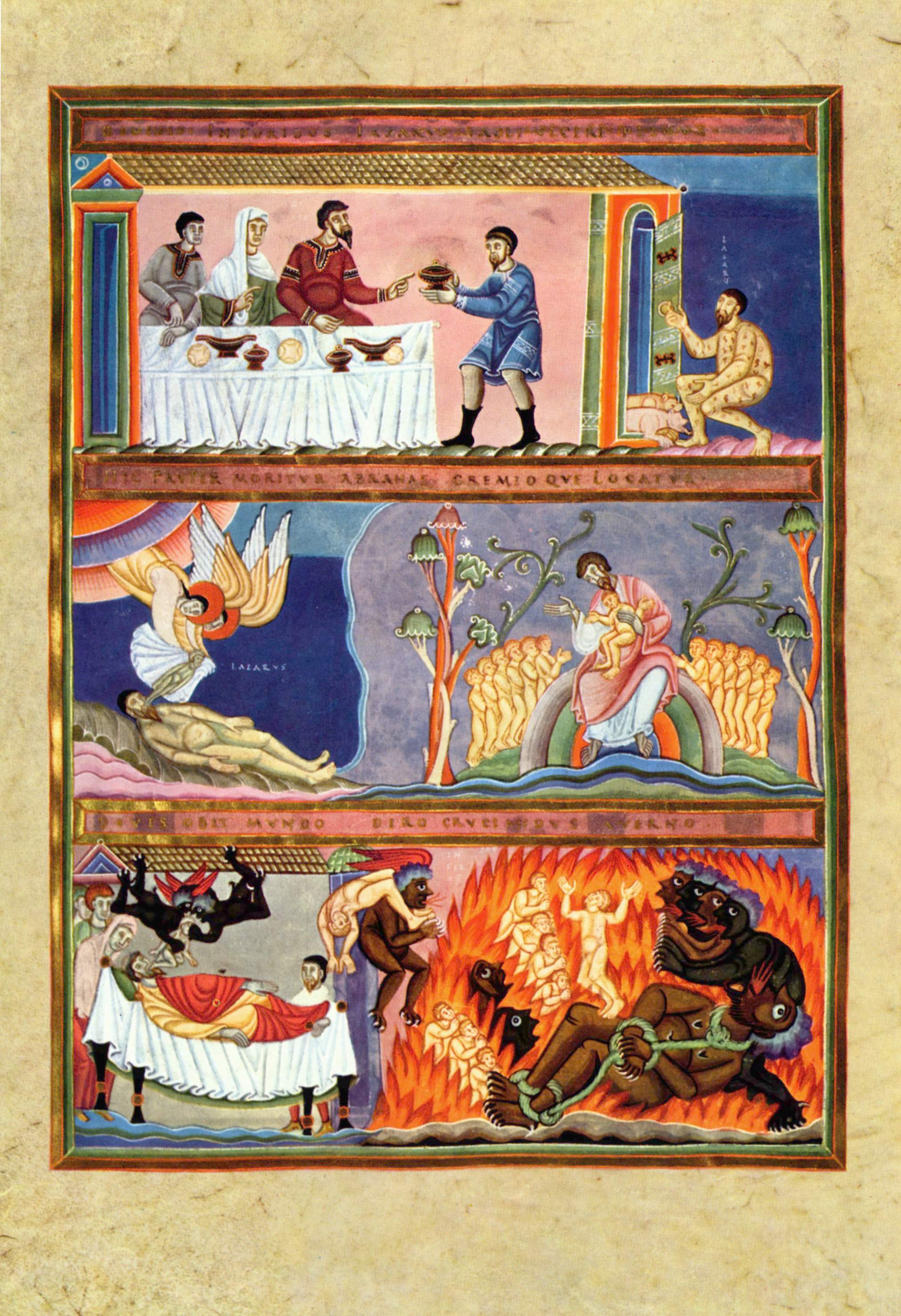 |
| Image: Illuminated manuscript, Germanisches Nationalmuseum, Nürnberg (via Wikimedia Commons) |
But we know that names matter. Naming someone in ancient times had real power, as it continues to in many ways. So often in the Bible, we’re told not just someone’s name but the meaning of that name. It continues today. We often close our prayers “we ask it in the name of Jesus”.
So for Jesus to give Lazarus a name in this parable is to make a very clear statement. This is not just some everyman. This is not just a poor man. This is a story about a real human being. Like Job, who he resembles in many ways, he was poor, he was sick, he was suffering, but he had a name. His name was Lazarus. That means ‘God has helped’, by the way. Giving Lazarus a name was part of Jesus’ way of giving him back his dignity, which must have been lost in all that suffering. In his life, he might well just have been known as ‘that poor soul who sits by the gate’. Perhaps his name was unknown to those nearby. Perhaps he was like the character in one of the Beatles’ saddest songs, Eleanor Rigby, who “died in the church and was buried along with her name. Nobody came.” But Lazarus got his name back. Jesus gave it to him.
The rich man, by contrast, doesn’t get a name. There are medieval traditions which call him Dives, that call this whole parable Dives and Lazarus, and that name appears in the folk song on which Ralph Vaughan Williams created his beautiful variations. But there’s no biblical basis for that name, it’s simply the Latin for ‘rich’. And to give the rich man a name is to miss the point, that Jesus is telling this story as part of the upside-down kingdom. In life, the poor man had no name, no power, no identity; while the rich man had a well-known name, with power in society, and a familiar identity. In death, just as their material circumstances are reversed, so are their identities. Lazarus is the one who has a name and a secure place resting against the chest of Abraham (the traditional word ‘bosom’ is a much better translation than ‘sitting at Abraham’s side’), while the rich man is stripped of his identity and become simply a suffering soul in Hades. Lazarus was held and cared for - cuddled even - in death as he wasn't in life.
And it was the rich man’s failure to do this, to recognise Lazarus as a real individual, a human being with a name, which is one of the worst things that the rich man did. He wasn’t cruel to Lazarus, he didn’t refuse him things, but to him Lazarus was a non-person. Even in his torment in Hell, he sees Lazarus as inferior, as somebody he can order around, first to bring him water, then to travel to earth to warn his siblings.
It’s that failure to recognise Lazarus as an individual which was the real sin of the rich man. And it goes on today in so many places. Some people may have heard the shocking words this week of Donald Trump Junior, comparing human beings seeking asylum to being like a bowl of Skittles, a few of which are poisonous. That’s precisely the rich man’s attitude, it is to condemn millions to death in Syria, and they have names and identities (like the little boy Alan Kurdi whose dead body on the shores of the Aegean Sea moved so many last year). Or the people of Aleppo, who are bombed by those who think of them not as human beings but as targets, faceless parts of the enemy. Or, nearer to home, those who are sanctioned and lose their benefits for minor or non-existent misbehaviours. This is all a failure to look upon the people as individuals.
In small ways, I’ve done this myself. I catch the train to Milton Keynes three days a week, and cycle to my office. My cycle route takes me through one of the town’s many underpasses, just near the train station, and recently a homeless person has started pitching a tent there. I’ve not stopped to do anything to help that person, I’ve never seen them. I know that they’re in suffering, but I’ve passed them by. Perhaps others here have done things like this too, out of fear or busyness or belief it wouldn’t help, but it’s not treating people in need as individuals.
There are alternatives to this behaviour. There are plenty of churches and church groups working with those in need, and seeing them as individuals, and loving them as individuals. To pick two examples. In a project in Northampton called Street Church, homeless people are provided with food and basic help such as haircuts and with a sense of community on a weekly basis – but just as importantly they’re known by name, and referred to not as ‘clients’ or ‘service users’ but simply as ‘friends’. Christian Aid do this really well – whenever they have campaigns, they take the stories of real people, and tell them vividly and powerfully, complete with names and a real sense of recognising them as individuals. At the Greenbelt Festival last month, Christian Aid had three rather lovely giant puppets, much bigger than life-size, walking around the site – each was based on a real person, with a name and a history, who Christian Aid had been able to help through their work. And their stories were told.
We’re not told that the rich man was condemned because of his wealth, but rather because of what he did with his wealth. I worked at Durham University for three years. It’s a beautiful city, but I lived in a former mining village and took driving lessons round a whole set of even poorer ex-mining villages. And the disparity of the wealth between the university and the cathedral, on the one hand, and the surrounding area on the other, really got to me. I’m sure the cathedral did its best, but it felt like an island of privilege simply ignoring the sea of poverty around it. More recently, visiting the United Arab Emirates and seeing the disparity between the wealth of the local people and Western workers on the one hand, and the slave-like conditions of the immigrant workers from Asia on the other, was really sickening to me.
There’s a link here to our second reading. Evil doesn’t come from money. It comes from the love of money, from its elevation to something disproportionately important. Paul is clear: “Command [the rich] to do good, to be rich in good works, to be generous and ready to share with others. In this way they will store up for themselves a treasure which will be a solid foundation for the future. And then they will be able to win the life which is true life.” Of course the rich man didn’t have that message, but it’s present in the words of the Torah and the Prophets in abundance, as Jesus has Abraham say towards the end of the parable.
This is not just an individual story. The parable condemns not just a lack of generosity, but implicitly condemns income inequality, that someone could be so much richer than another. This is a real problem in many Western countries, and it’s getting worse and worse. Supposedly in our society we’re ok with that. We should not be.
So let’s talk about heaven and hell. I think it’s a mistake to take this passage as a literal portrait of hell from Jesus’ mouth. As I said earlier, parables are seldom intended to be taken literally. And the images of hell in this passage are those from Greek culture rather than Jewish culture. Moreover the later parts of the parable have a close resemblance to the kind of writing, like the books of Daniel and Revelation, known as apocalyptic, and this kind of literature is always to be read symbolically and not literally.
To quote the American preacher Rob Bell: “What we see in Jesus’ story about the rich man and Lazarus is an affirmation that there are many kinds of hells, because there are all kinds of ways to resist and reject all that is good and true and beautiful and human now, in this life, and so we can only assume we can do the same in the next. … There is hell now, and there is hell later, and Jesus teaches us to take both seriously.”
The closest passage in the gospels to this one is perhaps the judgement of the sheep and the goats in Matthew 25, when the Son of Man separates out those who helped ‘the least of these, my brothers and sisters’ from those who didn’t help them. And of course the message of Matthew 25 and this parable are similar. They speak mostly to our actions in this world, and say very clearly that your actions in this world, the way you treat others, matters right now. To be a Christian, to follow Christ, is to be one who is on the side of justice rather injustice, in everyday ways and in big ways. And whatever you think about the life to come, and whatever you think about justification through faith, this might matter to your chances in heaven. Because, like Abraham said of the five siblings of the rich man, we have this message in abundance from the Law of Moses, from the witnesses of the prophets, and from the teachings of Jesus himself.
Those of us who are rich, in national or global terms, are confronted in this parable with a very strong question. Can we see the needs of others? Can we respond when they are sitting at our gates, under our noses? Or will we hide away from them? Jesus shows us clearly that there is only one answer to that question. May he give us the grace and the courage to respond to those in need, to treat them as individuals, and help them in the ways that we can.
Amen.
Subscribe to:
Posts (Atom)
The Year of Jane: or, a personal account of my first time reading through all the novels of one of the greatest novelists
I never read Jane Austen as a teenager. I was a voracious reader, but a lot of it was sci-fi & fantasy, I found nineteenth-century ficti...

-
 The song "Jonah and the Whale" is much beloved at Sunday Schools . It's jolly but (like lots of Sunday School versions of the ...
 -
[Sermon preached at Duston United Reformed Church, 30th March 2014, Mother's Day. Text: Luke 1:46-55 , The Magnificat. The sermon was im...
-
I attended my daughter Alice's school concert this afternoon - mostly recorders with a bit of singing by 6 and 7 year olds. Quite amazin...


