Monday, 19 March 2018

Lent & the USS strike

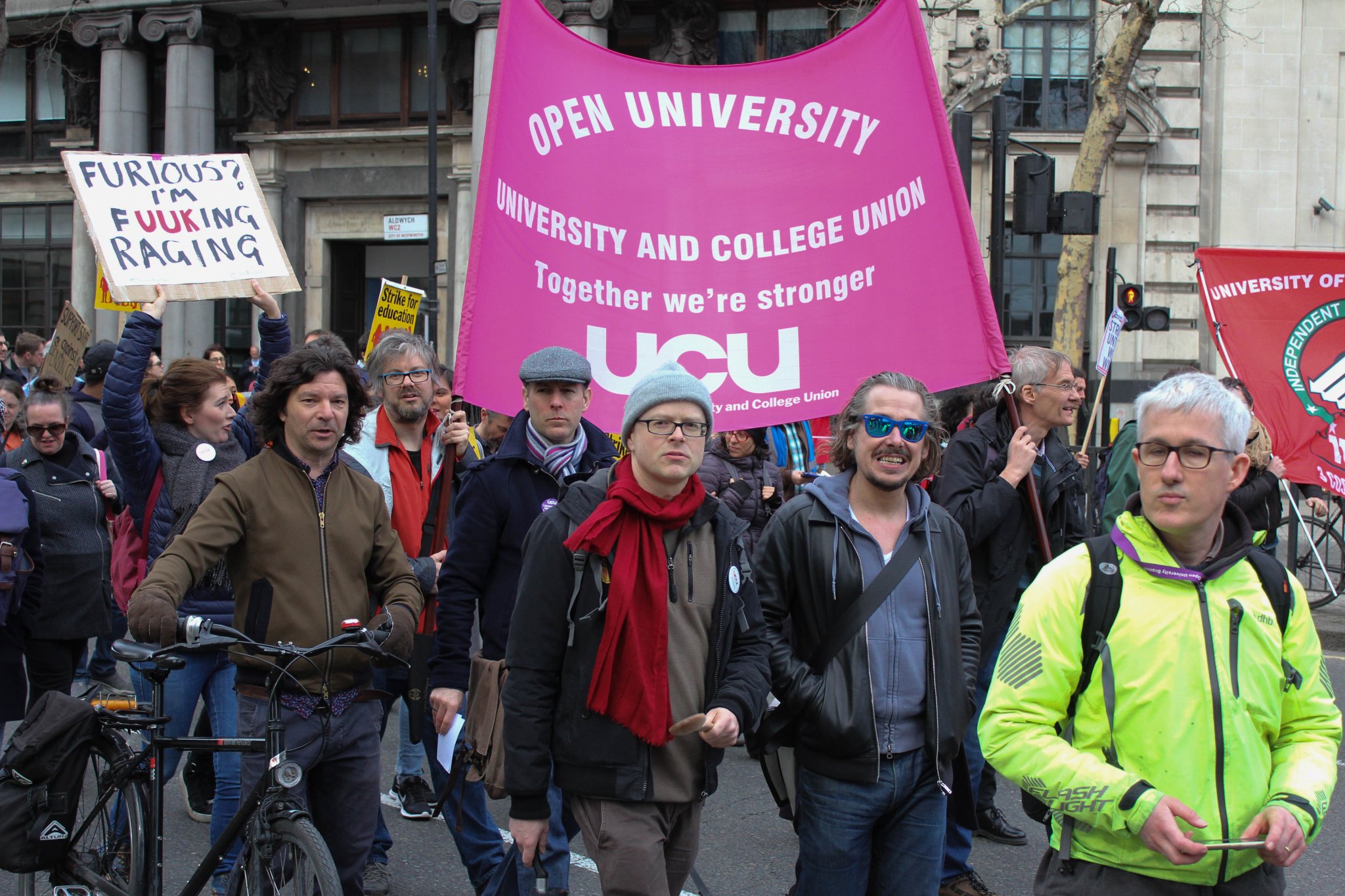
Today is my first day back at work following 14 days of strike action called by the Universities &
College Union in support of our pensions (held at the Universities Superannuation Scheme, USS). Very much can be found online about the rationale for the strike and I won't repeat it here.

I've been a member of the union, and its predecessor, for most of my academic career. I've not always taken strike action when called, and had reservations whether to do so this time (because 14 days striking is a big loss of pay), but I'm glad I did. Partly this is because I think the strike matters, but also because it's had a positive impact on me.

I commented to a few people before the start of the strike that it seemed appropriate that it was taking place during Lent. I mostly thought of this in terms of sacrifice - of giving up 14 days of salary, and indeed the community of colleagues.

Although the sacrifice element was true, it also reflected for me the frequent experience that Lenten 'sacrifice' can lead to a greater realisation of the things that matter. In the event I found it to be a positive experience.

First was the sense of stripping away, and a realisation of how much of my work time is taken up with ephemera:
  • I looked at no work email on strike days, and so my time was not absorbed in the constant streams of reading others' thoughts. Sometimes these are helpful, sometimes not, but they are often disruptive to deeper work.
  • I played no part in university administration during these days. As a member of Senate and a role-holder within my department, I spend quite a bit of my time worrying about how the university is run. Some of this matters, but huge amounts of the work is reactive.
  • I attended no meetings on these days. I like meetings in theory, but too many university meetings are over-long, badly-managed and without participation. It used to be the exception that people would sit in meetings with a laptop and do other things; now it's the rule.
In addition, I set aside my more fundamental work, of teaching and research, but I knew this would mostly be safely left for a little while so I could gently put it to one side. 

Now I understand that this is hardly an original list - all academics, and knowledge workers in many bureaucratised fields, would give a similar list of ephemera, of the things that get in the way of doing their job. But there was real power in stripping them away. In the process I came to realise that the important things in my work are not associated with much of what absorbs my time day-to-day. 

That doesn't stop the way that the university is run from mattering to me. We were, after all, on strike because of the way the sector as a whole is run (and underlying the pensions dispute is a wider question that relates to it, about university governance and its economic basis). And at various times I was able to discuss with various colleagues about better ways to organise the university. I didn't stand on any picket lines, which I gather was a source of such discussions. But I did take part in a march and rally in London, and I gave a talk as part of the Alternative University of the Air, our OU teach-out on Facebook Live.

And I'm left after returning to work with a residual sense of anger against the collective senior management of the HE sector and their distance from the real work and real conditions of their staff; a determination to help it to be better in the difficult times ahead at the OU; but a realisation that the things that matter in academia ultimately are not these, but are our students, our ideas, our research, and the change we make in the world. Not a bad realisation for Lent.

Monday, 12 March 2018

God’s generous love, our generous response: why John 3:16 can be good news after all

Sermon preached at Duston URC, 11 March 2018. Texts: Numbers 21:4-9 and John 3:14-21.

Image: imgflip.com
A couple of months ago, my son and I went to see the new Star Wars movie, The Last Jedi. Perhaps my favourite moment in the movie, and there are no spoilers ahead because it’s in the trailer, is where Luke Skywalker says, “this is not going to go the way you think”. Well the same is true with this passage.

There’s such a lot we could talk about here. I’m not going to spend time on the reading from Numbers, which is a very odd story indeed. It’s in the lectionary because it’s quoted by Jesus, and because there are parallels to Jesus’ story – of the people of God rescued from suffering by an intervention provided by God. The parallel to the snake on the pole, and the phrase about Jesus being lifted up, may make you think of the cross, and I think that’s part of the story but not the whole thing. Because Jesus was lifted up in other ways too – he was raised from death, which is the same word; and in later time he was lifted up to heaven in the event we call the ascension. It’s not enough to look just to the crucifixion – we have to look to the resurrection and the ascension as a package together to see the way in which Jesus was lifted up, the way he gave life to others.

But I want to spend most of this sermon unpacking one verse in the John reading. You may have noticed that the John passage contains one of the best-known verses in the New Testament – John 3:16, “For God so loved the world that he gave his only begotten Son that whoever believes in him may not die but have eternal life”. That’s one of those verses that appears everywhere, especially in the more evangelical parts of the church. It’s on adverts, T-shirts, tattoos. It’s a verse that a lot of people learn by heart. When you hear the 8 verses of this passage, or the 21 verses of Jesus’ dialogue with Nicodemus that this is part of – your eye, your ear, they just jump to this passage. It takes up all the oxygen in the room.

And it’s well-known for a good reason. It’s short, it’s apparently straightforward. Martin Luther described it as the gospel in a nutshell. But here’s the thing. It’s often really badly misinterpreted. The verse itself has many subtleties that make its meaning quite different from the way it’s often treated, and the passage as a whole shows those up even more clearly. So that’s why I’m agreeing with Luke Skywalker: John 3:16 is not going to go the way you think. And that’s good news, that’s gospel news.
Image: Biblia
The interpretation you’ll often here goes like this: because of God’s love, he sent Jesus to die on the cross. We must each respond individually, by taking up a set of intellectual opinions about Jesus and his nature. If we do that, we’ll go to heaven after we die; if we don’t, we won’t.

Now I want to be a little gentle with this interpretation, because it’s a source of hope for many people. But the good news is better than that. What we see in this interpretation is a God who is unable to forgive human beings, and has to be placated by an act of violence. We see a God who separates people into those who live and those who die. We see a God who requires an individual response, based on what you think about the world. It’s not a happy picture of God at all. It’s a picture of a God of fear, not a God of love. Sadly it’s a picture of God which is held by a lot of people, and it does them harm, because we have a God of fear and violence, then the universe is built on fear and violence, and human society needs to be built on fear and violence. And then you get war, gun crime, terrorism, and so on. And it’s also a picture of God which is driving people away from the church in droves – because if God’s like that, why does he deserve any worship?

But the good news is right here in the passage if you read it different. And I’m afraid that requires me to mention a few more Greek words than many sermons.

We’re told in verse 16 that God loved the world, and indeed the word is kosmos, so that’s the whole universe rather than just our little planet. God is a God of love for the entire universe, whatever their race or nationality or religion. Flag-waving nationalism and racism have no place in the love of God.
Image: Transforming Me

Then we’re told that God didn’t send his Son into the world to condemn the world, or to judge the world, but in order to save it. Now the word translated condemn or judge doesn’t really have the same negative connotation in Greek as in English, and so although we are told that people are condemned by their own actions, it’s perhaps better to say that by their own actions they are separated from God.

Specifically, we’re told in verse 19 that the light has come into the world and yet there are those who loved darkness rather than light. The gospel of John is full of images of light – recall that phrase in the prologue to the gospel that “the light shines in the darkness and the darkness did not overcome it” – and at several points describes Jesus as the light of the world. We all know of people who hate light and love darkness, who are dedicated to causing other people pain rather than giving them joy. [more on who] Yet they have not been forced away from the light – they have chosen to turn away from it, and thus have chosen to separate themselves from God.

Often in John’s gospel we see light and life twinned together. The gospel begins by saying that “in him was life and the life was the light of all people”. And elsewhere in John’s gospel Jesus says that “I came that they may have life, and have it in abundance”. So turning towards the light or away from the light is about choosing life. It’s about choosing the eternal life that Jesus mentions.

And now we need to look at that idea of eternal life. To our modern understanding, it’s about life that lasts for ever. But that’s not the way that Jewish people of Jesus’ time understood the phrase, and it’s not really what the Greek word aiōnion, which is translated as ‘eternal’ or ‘everlasting’, means. That word is related to the word ‘aeon’, or age. It’s not about a very long period of time, but is rather about a particular quality of time. It’s about life which exists outside of time and inside of time at once. Jesus said in many places that the Kingdom of Heaven is close at hand, or that it’s within you. The Kingdom of Heaven is not something you get when you die, if you’ve been good enough. That’s why Jesus’ promise is so important – the Kingdom of Heaven is something you can experience here on earth, right now. And there’s one more clue in the Greek to that point, which is the word ‘have’ in the phrase ‘have eternal life’ is in the present tense not the future tense as you might think for life after death. Eternal life, the life of Heaven, life lived in abundance, is something Jesus offers to us right here and right now.

Jesus is that generous. God is that generous. He came not to offer us some kind of future life after death. He came to offer us real, deep, life in communion with God right now.

And this is absolutely crucial for the way we live our lives. Because if we live in this kind of eternal life, if we choose life for ourselves, we surely can’t do anything other than choose it for others. And again I don’t mean this in an evangelical, convert-the-unbeliever, way. I mean it in the way that Jesus taught us: that the way to love God is to love our neighbour as ourselves. That if we choose life, we must choose to follow the path Jesus taught in the parable of the sheep and the goats, which also talks of eternal life: to feed the hungry, give drink to the thirsty, welcome the stranger, clothe the naked and visit those in prison.

Put another way: if God has been as generous with his love as to send his son to us, we too must be as generous with our love towards others. If God loved the whole universe, we too must love the whole universe. We must love all people as individuals, and we must love them as groups. We must be agents of God’s liberation, against the oppression of the world. I was reading recently an amazing article on black theology in the face of suffering and oppression, by the Reverend Allan Boesak who was deeply involved in the struggle against apartheid. Boesak writes that:
When we fail to stand with those who suffer, we fail to stand with God, because that is precisely where, and how, God stands, not just in front of the oppressed, in protection of them; not just alongside in solidarity with their struggle but in identification with them in their struggle for liberation.
God’s love for the world involves justice for the oppressed peoples of the world. We see that again and again throughout the scriptures. But this means that if we are following the love of God, we too must stand for justice for oppressed peoples. It’s shameful to the church when it supports oppression, when it reads the Bible in twisted ways that allow it to support slavery, or the subjugation of women, or treating same-sex relationships as less than equal. Some of this has gone from the church, some of it is still around. But it is not the love of God, or experience of eternal life.

There’s one more thing to say about this passage and our response to it. Jesus says that it’s those who believe in God’s son who’ll have eternal life. Except he does and he doesn’t. Because that word ‘believe’ is another wonderful Greek word, pisteuōn, which means believing in somebody in the sense of putting all your trust in them, putting your faith in them, putting your life into their hands. It’s precisely what people mean when they say “I believe in you”. When you fly on a plane or have a medical procedure, you believe in the pilot or the doctor. This means far more than believe that they exist, or some theoretical idea about who they are. It means that you have put your trust in them, in a very deep way. It’s profoundly about relationships. In the same way, Jesus expects his followers to put their trust in them. It has nothing to do with credal statements – it doesn’t matter whether you think he was born from a virgin, or your doctrine of the trinity, or your view on atonement theories. What matters is that you put your trust in Jesus, your life in his hands, and follow in his way.

This is a difficult passage, which is full of beauty and depth but equally has the potential for misuse and misunderstanding, in ways that cause harm to those in the church and to the world as a whole. But ultimately it really is about the most amazing good news: that God loves the entire world, that those who place their faith and trust in Jesus can find their way towards the life of the kingdom of God here on this earth, and that in placing their trust we enter into a calling to show God’s love towards others.

Moses was the great liberator of the people of Israel from oppression in the land of Egypt. He knew about God’s love and its relationship to liberation, and he knew about life. In one of his last sayings to the people of Israel, he said:
I have set before you life and death, blessings and curses. Choose life so that you and your descendants may live, loving the Lord your God, obeying him, and holding fast to him.
May we all choose life, and choose to have it in abundance and joy through trusting in Christ Jesus. Amen.

Friday, 2 February 2018

Race, gender and class: deeply intertwined with information

Our research group is increasingly focused on developing a discipline of critical information studies - exploring the social impact of information and information systems, in particular through examining the way they interact with, and strengthen, imbalances between different powerful groups. As part of this we're especially concerned with the ways that race, gender and class interact with each other, with power issues, and with informational phenomena.

My colleague on the group, Dr Mustafa Ali, is working hard on issues of decolonial computing, and we have been having many discussions about the interplay between race and gender in particular - the concept often called intersectionality, but which Mustafa prefers to call entanglement.

Mustafa pointed me to the work of Thomas Curry, who argues strongly against the concept of intersectionality as being inadequate to capture the lived-experience of black people and their relation to gender. In an essay entitled Ethnological Theories of Race/Sex in Nineteenth-Century Black Thought: Implications for the Race/Gender Debate of the Twenty-First Century [subscription], Curry argues that "In the nineteenth century, what we know as gender was believed to exist only among civilized races" and that "Under nineteenth-century ethnological thinking, races were gendered, rather than those bodies biologically designated as male or female by sex".

I find this very interesting, and it raises all sorts of questions. I doubt anyone would subscribe explicitly to a view like the 19th century approach to race & gender (though there’s probably a nastier sort of intersection between white supremacists and so-called men’s rights activists) but I can readily see how such a view was only widely-held and would persist in some kind of background form. All that said: it strengthens my view that race, gender and class issues are deeply intertwined and need to be considered together, and that in turn they’re intertwined with information. Because it seems to me that these views are deeply based on information - constructed narratives which put together half-selected 'facts' about the world, from a strong worldview, choosing those which fit and rejecting those which don't.

Two more thoughts about the intertwining of race, gender and class. Earlier this week I was reading about the Irish potato famine and specifically the Gregory Clause of 1847 which worsened the plight of the poor considerably (my eye lit on it because my son is called Gregory). Named after a Sir William Gregory MP, it restricted public assistance to those who possessed essentially no land, less than ¼ acre, to avoid ‘absorption by undeserving persons of a large portion of the public funds’. Interesting because of the entanglement here of class and race – the Irish of course are white but have always been treated as a sub-race by the British/English.

Second, in choir yesterday we were singing Heinrich Schütz’s St John Passion. Of all the gospel accounts, John’s is often said to be the most anti-semitic, and I’m finding the English translation here to be very starkly so (dated 1963 in the score but I think possibly a few years older). There are constant references to ‘the Jews’ saying nasty remarks, or asking for unpleasant actions. It reflects older Bible scholarship, and the translators (Imogen Holst and Peter Pears) were musicians not theologians, but no modern translations of John’s gospel would say ‘the Jews’ – they say ‘the Jewish leaders’ or a more specific term such as ‘the Sanhedrin’ (the ruling court of leaders). I’m wrestling with the text still, but in a way it gives me hope, that ideas do shift, and that contemporary Christians, however suffused with racism (and I can name plenty), are recognising our need to move away from our historic anti-Semitism and other forms of racism.

Lastly all this makes me uncomfortable about my own complicity as an affluent middle-class white male, but as I've written more than once on this blog, I'm used to that discomfort!

Monday, 15 January 2018

Being seen and being called

Sermon preached at Long Buckby URC on 14th January 2018. Texts: 1 Samuel 3:1-10, John 1:43-51.

Listen. Look. Be watchful. 

These two passages are often described as being about calling. The calling of Samuel. The calling of Philip and Nathanael. Now calling matters. We are called to all sorts of different things in this world, Some of us are called to parenthood. Others are called to teaching, or medicine, or creating art, or fixing problems. Others are called to care for others. Some are called to preach the gospel. But we’re all called to something. I believe that calling changes through life, and that part of our role in life is to discern what God is calling us to, and how that might be changing. 

But part of calling is about being authentic, true to ourselves, about accepting OUR call against the call that was given to others. There is a Hasidic tale told about a certain Rabbi Zusya, who said as an old man, ‘In the coming world, they will not ask me: ‘why were you not Moses?’ They will ask me, ‘Why were you not Zusya?’  We must all guard against not being ourselves. 

The American Quaker author Parker J. Palmer comments on the story of Rabbi Zusya and writes that:
Vocation does not come from a voice ‘out there’ calling me to become something I am not. It comes from a voice ‘in here’ calling me to be the person I was born to be, to fulfil the original selfhood given to me at birth by God.
So the calling of Samuel and Nathanael is important. But I think in lots of ways that those aren’t the main point of these passages. Rather, they’re about being able to listen and to see, to wait for the presence of God. 

We’re only a week on from the celebration of Epiphany, and in some churches the period between that festival and the start of Lent is referred to as the season of Epiphany. Now Epiphany is often associated with the Magi bringing their gifts to the Christ-child, but the Magi and gifts aren’t really the point. Epiphany is about an experience of the divine, breaking through suddenly like the rays of the sun through the clouds.

And to me the thing that’s so interesting is that both Samuel and Nathanael were experiencing the divine already, but they didn’t know it until they were able to see. 

Listen. Look. Be watchful. 

Samuel was being called by God, again and again. And yes he responds with ‘Here I am’, just as in the song we sang, but he’s responding to the wrong person. He thinks that Eli is the one calling him, and so he hears the calling in the light of that assumption, and he gets it wrong. Samuel’s call is genuine, but he needs to listen better. 

Nathanael had it differently. He had received witness from Philip that Jesus was the one they’d been waiting for. Yet Nathanael was prevented from seeing who Jesus really was, by his own prejudices and preconceptions.
Source: Interrupting the Silence
We don’t know a lot about Nathanael, beyond this story and his name, which means ‘gift of God’. However John tells us at the end of his gospel that Nathanael came from Cana in Galilee, the place where Jesus performed his miracle of turning water into wine at a wedding. This might explain Nathanael’s rather crass question as to whether anything good can come from Nazareth. You may have heard that Donald Trump made some recent remarks about immigrants from Africa that even by his standards look particularly unpleasant. Nathanael’s scepticism about Nazareth may not be quite so extreme, perhaps it was only founded on the kind of local rivalry. To pick a local example, it’s as if somebody here was told the Messiah was to come from Daventry or Rugby, and to respond with incredulity. 

Philip responds with an invitation. He doesn’t tell Nathanael he’s a small-minded fool, he instead gives Nathanael the offer to see for himself – he says ‘come and see’, the same invitation that a few verses earlier in John’s gospel, Jesus had given to Andrew, the first disciple to follow him.

But before Nathanael can see, he is seen. Jesus has already seen him under the fig tree. Nathanael’s calling is an act of pure grace on Jesus’ part – Jesus reaches out to him, and sees him as he truly is, an honest and decent man. Jesus looks inside Nathanael’s soul and sees good. 

And that’s the first message from this passage. We have to be ready to respond to God’s calling, to seeing Jesus, but it’s always possible because God always makes it possible. Because God looks inside each one of us and sees good. He sees past the uncertainty and doubt, past the weariness, past the wrongs we’ve done or think we’ve done, past our sense that we can’t cope – and he sees us as good, sees us as loved children of God. I know that’s something I need to hear, that however much I can’t believe it myself, I am called by God through the love of God, not through any action of my own.

Listen. Look. Be watchful. 

Now January can be an exciting time, with the new year and new life and new challenges. But it can also be a dark time, if you don’t know what the year will bring. It can literally be dark – the mornings continue to get darker not lighter for a few weeks after the winter solstice, and the Christmas lights and decorations have gone down at last. But sometimes it’s precisely in the dark times that God speaks to us. A couple of stories that I heard recently of God speaking into the darkness.

Tomorrow is the anniversary of the birth of Martin Luther King, celebrated as a holiday in the United States. Dr King was a great agent of change, a man of the gospel, and a powerful orator, but he too suffered doubts. In his book describing the Montgomery bus boycott, he writes of a moment of despair in his kitchen:
I was ready to give up. With my cup of coffee sitting untouched before me, I tried to think of a way to move out of the picture without appearing a coward. In this state of exhaustion, when my courage had all but gone, I decided to take my problem to God. With my head in my hands, I bowed over the kitchen table and prayed aloud.
The words I spoke to God that midnight are still vivid in my memory. "I am here taking a stand for what I believe is right. But now I am afraid. The people are looking to me for leadership, and if I stand before them without strength and courage, they too will falter. I am at the end of my powers. I have nothing left. I've come to the point where I can't face it alone.
At that moment, I experienced the presence of the Divine as I had never experienced God before. It seemed as though I could hear the quiet assurance of an inner voice saying: "Stand up for justice, stand up for truth; and God will be at your side forever." Almost at once my fears began to go. My uncertainty disappeared. I was ready to face anything.
If Martin Luther King could face that kind of despair, how can it be wrong for the rest of us to do so? Yet that kind of experience of God is just as much available to all of us as it was to Dr King. Sometimes it comes through others as much as well. Here is an example of this.

The BBC broadcaster Ernie Rea tells of attending an Easter Vigil in the night in a Catholic church in Derry during the Troubles. The church was in complete darkness, but not a peaceful darkness – on all sides he could hear the sounds of violence, of gunfire. And then the priest lit a single candle, and proclaimed the light of Christ, and the light spread through the church, bringing hope in the darkness. But then something else happened. Ernie Rea was the only Protestant in the church, so when all the rest of the congregation moved forward to take the Eucharist, he stayed seated – and again, he felt cast down into darkness. But having served the others, the priest walked all the way down the aisle, and served Ernie Rea the Eucharist at his seat. And he was lifted up, and it felt to him that light had returned to that place. Because the priest hadn’t tried to teach anything, he had simply shown by his actions that hope comes through relationship, that God acts through other people.

And that can be part of our response to God’s calling upon our lives. It’s partly about understanding what we’re being asked to do or be, about casting aside preconceptions and assumptions, about learning to listen to the still small voice of God which doesn’t for most of us come booming out of the sky but calmly chips away at what we thought we knew. But it’s also about building relationships, about demonstrating God’s love through our actions. It’s about inviting others to ‘come and see’, and it’s about living our lives so that people will see God’s love through us.

Listen. Look. Be watchful. 

Samuel eventually responds to God’s calling as you might expect a prophet to do – faithfully, carefully, preparing himself to listen and act. We’re not told in the reading today of the message God will give him, but it turns out to be unexpectedly powerful, one which “will make both ears of anyone who hears it tingle”. Because Eli’s sons are corrupt and violent, and Eli isn’t doing anything to stop them, and Samuel’s message from God is that he, Samuel, a boy, is to speak up against Eli the great prophet, a powerful figure, his own mentor. So Samuel’s message turns out to be a tough one. And sometimes we’re called to speak out against the powerful, to call out corruption or bad practice or sexual violence or a lack of compassion, and to say ‘no! this is wrong!’. And sometimes we’re given strength to do that speaking out, and we’re carried in the arms of God – and other times it’s much harder to do so, and we might suffer for it, as Martin Luther King suffered for his witness against oppression. 

Then we turn to Nathanael’s response. And that’s perhaps still more surprising. Because he turns 180 degrees, he suddenly goes from having no interest in Jesus to recognising him as the son of God and the king of Israel. In our world, 2000 years on, those are important but innocuous titles, common things to call Jesus. But in Roman-occupied Israel, they were revolutionary statements. Because the king of Israel was ultimately the Roman Emperor, and the Son of God was a title that the Emperor gave to himself. And if Jesus was those things, then the Emperor was either a liar or due to be deposed or set aside. Nathanael was not making a profession of faith, he was making a political statement. He was setting himself very clearly on one side rather than another. 

And Jesus promises Nathanael that this particular epiphany is just part of a much larger epiphany to come, when he will see the angels and the son of Man face to face, language to do with the end-times in Jewish thought. Nathanael’s experience and his statement will lead on to more and greater experiences of God.

And so at last we’re promised this too. That if we listen for our calling, if we build relationships and bring hope to others, if we challenge the powers of this world and put ourselves on the side of the powers of the kingdom of God. That if we do these things, we will see God and we will hear God and we will walk more deeply with God.

Listen. Look. Be watchful. And respond. 

Amen.

Monday, 13 November 2017

Coral spawning and the hope of resurrection

"It's like the coral is being blessed!" said my 8-year old, as we watched the latest episode of Blue Planet 2. Coral spawning. It happens once a year, when the moon is full in spring and when the coral is ready. It is synchronised across the reef, with all the coral spawning at once; and many of the other creatures that live on the reef spawn along with the coral.

That night, that holy night. Because I agree with my son - this is an act of blessing. It's a natural act, that happens annually. But it is an act of blessing and mystery, a gift from God. It has been laid into the coral's DNA to ensure new life and growth.

But there is more: it also ensures rebirth. The episode also talked movingly about the widespread bleaching of coral due to global rises in sea temperature (due to human-made climate change), leading to the coral being unable to grow. Many coral reefs around the world are suffering hugely - 2/3 of the Great Barrier Reef has become bleached - and it's possible there may not be any coral reefs by the end of the century.

But there is hope - slim but real. The spawning of the coral gives these complex ecosystems the chance to be renewed each year, creating a new community in a different place as the spawn sails through the ocean. And maybe, just maybe, coral reefs can be renewed and reborn in different places and in ways that can withstand the worst that humans are throwing at them. Because hope springs eternal, and resurrection happens everywhere. One day a year in spring can be Easter for the coral reefs - and hope is always and everywhere for the rest of the world also.

Sunday, 5 November 2017

What would Jesus do? Practising what we preach

Sermon preached at Duston URC on 5th November 2017. Main text: Matthew 23:1-12.

So this week I had a choir practice. We’re less than three weeks away from performing a brand-new piece, commissioned by the choir, and the conductor is getting a bit nervous. More than once during the rehearsal, he lost his temper – 0-60 in three seconds, from quiet and calm to BOOM. Justified enough since we don’t know the piece as well as we might, but all a bit scary. I do it myself with my children from time to time – that 0-60 in three seconds thing, and they find it alarming too.

And we know perfectly well that Jesus had a temper on him. The money-changers in the temple is the incident everyone remembers, but from time to time he got angry or grumpy or even sarcastic. Gentle Jesus meek and mild is not something you’ll find in the gospels. The sheer level of anger in this passage is something to behold, and the rest of the chapter gets even angrier – he uses the phrase “woe to you” no less than seven times. It’s the same sort of anger as Micah used against the ‘prophets who lead my people astray’.

So that’s the first important point to make about what Jesus says. This is one of a series of passages which on the face of it seem very hostile to the scribes and Pharisees, the interpreters and keepers of the Jewish law. And indeed this kind of passage fed the appalling history of Jewish persecution by the Christian world. But it’s not justified by the passage. This is not an anti-Jewish piece at all. These are words spoken from within the Jewish prophetic tradition of calling out bad practice by leaders and authorities. Jesus is speaking here with a strong prophetic voice. Notice also the respect to which he gives the teaching, although not the lifestyle, of the scribes and the Pharisees. And of course elsewhere he says more than once that he’s not come to abolish the laws or the prophets.

So this has to be understood in its Jewish context, but also in the context of when the gospel of Matthew was written. Most scholars believe this to have happened in the city of Antioch in Syria, in the years following the fall of Jerusalem in 70 AD. The Christian community in Antioch was largely Jewish, but straining to find its own identity and getting more separated from the Jewish people; and after the destruction of the temple, the Jewish people were looking for a new direction, and Christians and Pharisees were very much doing battle for who would take prominence. So the writer of the gospel wasn’t well-disposed towards Pharisees, and that needs to be borne in mind.

With that said, let’s look at the two models of discipleship that are presented here by Jesus. The first is based on law, on practice and on status. As I’ve said, as an observant Jew, Jesus had great respect for the law. The law was given to the Jewish people, starting with the ten commandments, not as a way to control them but as a way to lead them to a good life. They had come out of a place of chaos and control, with no ability to worship God in their own way and no power over their own lives. So the question during the Exodus from Egypt was: what does it mean to live under the power of God? And the answer was the Torah, the law. So respect for the Law was, and still is, at the very heart of what it means to be Jewish, the people set free from slavery in Egypt, the people of the Exodus and the people of the Torah. Listen, for example to a single verse of Psalm 119: “I will delight in your statutes; I will not forget your word”. That psalm runs to 176 verses, all in praise of the Law, and there’s plenty more like it in the Old Testament. And that’s the significance for me of Jesus talking of the scribes and Pharisees sitting on Moses’ seat, as Moses was one to whom the Law was given as well as the one who freed the Jewish people from slavery. So to sit on Moses’ seat is to carry on that tradition of Law.
Image: Wikipedia
But important as is their teaching, the scribes and Pharisees fall short in three important ways: in their showiness, in their expectations of others, and in their love of status. Here Jesus uses this mysterious phrase about making their phylacteries broad and their fringes long. This is a way of calling them spiritual show-offs. These are phylacteries, a Greek word – all Jewish people call them tefillin. They’re prayer cubes, which contain four small passages written on parchment. Observant Jews, only the men, wear them for morning prayer, a practice required by a few verses in the Torah; and it’s still something done today. They’re worn on the forehead and the arm, with leather straps wound around the arm. Along with the phylacteries is worn a prayer shawl with dangling fringes or tassles. Making these things especially prominent would be a way of saying: look at me! I’m really holy! Now plenty of that goes on among today’s religious leaders, among the higher echelons of the Catholic, Anglican and Orthodox traditions, but also in more subtle ways among Protestants, wearing black gowns or big crosses or headscarves or whatever. But Jesus is very clear that it’s not the right way – be faithful, he’s perhaps saying, but do it modestly and sensibly. That doesn’t mean that religious leaders, or Christians more generally, shouldn’t wear smart clothes to worship, even beautiful clothes, as they can be a celebration of God’s glory and the importance of the occasion, but it should be intended not to indicate the holiness of the wearer but rather the holiness of God.

The next is about overloading others with your burdens. This is a familiar refrain from the gospels. As Jesus says elsewhere, the Sabbath was made for man, not man for the Sabbath. As well as the many commandments of the Torah itself, by the time of Jesus there were centuries of interpretation and extra rules. Life for the Jewish people had become bound up in myriad different rules, and it was quite difficult to follow all the expectations. So what was designed as the final part of the Jewish people’s liberation from slavery had become its own sort of bondage. In addition to this was what we’d today call corruption – the scribes and the Pharisees were part of a religious and political elite which enriched itself through taking money from the people and by colluding with the occupying Roman authorities. They might themselves be holy men, but their effect on others was pretty negative.

And that takes me to Jesus’ last complaint, that all the actions of the scribes and Pharisees sought to increase their own status in the community. They wanted to receive titles, and places of honour, and to be greeted with respect. That’s a human response, and in some ways understandable, but it strips away from their dignity as religious figures. It’s inappropriate. The theologian Tom Wright observes that the people Jesus was taking about were social and political leaders as much as religious figures. He asks the question:
What are today’s equivalents? Some might be the leaders, whether elected or unelected, in our wider societies, who give themselves airs on the media, who rejoice in their ‘celebrity’ status, who make grand pronouncements about public values while running lucrative but shady businesses on the side, who use their position to gain influence for their families and friends, and who allow their private interests secretly to determine the public policy of their country.
This is highly applicable to today’s society. We see it in political figures such as Donald Trump, puffed up with their own self-importance; but also with the sexual abuse scandals around Harvey Weinstein and a growing band of politicians who think that their positions enable them to breach human decency. It’s horrible. Of course we’ve seen sexual abuse scandals in the church, all too frequently. These people think that their positions protect them, give them status. It must not do so.

In summary, as the Lutheran scholar Karoline Lewis puts it, “Jesus’ admonition here is a rephrasing, a re-languaging, if you will, of the Beatitudes. The behavior of the scribes and the Pharisees is what anti-Beatitude living looks like.”

Now, we need to be a little bit careful not to point the finger too readily at others, without looking at ourselves. These are messages for each of us as much as they are for others. Jesus is laying out a way of living which falls into the traps of the scribes and Pharisees, and an alternative view of discipleship, another way of living in the way of the gospel, one based on humility, equality, integrity and service to others.

Listen again to the way he lays out this way of living.
But you are not to be called rabbi, for you have one teacher, and you are all students. And call no one your father on earth, for you have one Father—the one in heaven. Nor are you to be called instructors, for you have one instructor, the Messiah. The greatest among you will be your servant. All who exalt themselves will be humbled, and all who humble themselves will be exalted.
There are echoes for me here of Jesus’ message throughout the gospels. We can see in these words his idea that ‘the last will be first’; where he says that ‘my yoke is easy & my burden is light’; where he washes the feet of the disciples; and even his urge to ‘pray to your Father in secret’.

Constantly through the New Testament we can see Jesus as a champion of humility – of taking risks, but for others’ gain not his own; of not just supporting the poor and downtrodden, but living and eating with them; never seeking status or power, and often explicitly rejecting those things. And he calls us to the same path of humility. He explicitly says that the greatest among his disciples shall be the servant of them all.

You’ve perhaps come across the phrase What Would Jesus Do? It was fashionable a few years back when lots of people in some Christian circles wore wristbands with WWJD on them. It’s sometimes had a rather questionable interpretation. But as an idea it goes back at least as far as a widely-read book called The Imitation of Christ, written about 600 years ago by Thomas à Kempis. How should we live our lives as Christians? It is by asking ourselves how Jesus lived, and seeking to follow his example as much as possible. And perhaps this applies more than anything else to humility. To be full of pride in our own achievements, to be focused on material possessions – we know perfectly well that this is not what Jesus did, and nor is it what he calls us to do.

Next we see Jesus championing equality. He says that nobody should be called Rabbi, that is to say teacher, or father, or instructors, because we have also those things through God and through Jesus. I don’t think we should read this as saying that teachers or spiritual guides or church leaders are worthless – Jesus doesn’t say that. Rather he’s saying that they’re important but they’re roles which exist equally to any other roles in the church community. To be the preacher is no less important than to be the cleaner – but it’s also no more important. But this also puts a responsibility on all of us, to take seriously the idea of the priesthood of all believers. We are all called to be priests, to be channels of God’s message and God’s grace, to ourselves and to the world.

Again we see Jesus as a champion of integrity. One of his great criticisms of the scribes and Pharisees is that they don’t practice what they teach. That phrase, sometimes rendered as practising what you preach is a clear call to integrity. It’s all very well to say fine words, even inspiring words, but do we actually follow the words that we say? This is a particular challenge to those of us who preach or teach, who claim to have some message that we think others should follow. But do we follow the message ourselves? Put another way, do we walk the talk? I find this a real challenge myself. For example: I talk a lot about social justice, about God’s preference for the poor and the oppressed. I preach on it often, I write blog posts about it, it’s an important part of my theology. But how much do I live out that social justice in my own life? I live comfortably, I don’t spend much time hanging out with very poor or homeless people. On the other hand, I do a day job which has an element of social justice, in the university where I work, and I try to make more of that aspect and encourage my colleagues, but not all my work helps the oppressed. But is that enough? Do I walk the talk? That’s my particular concern, which I’ve wrestled with for years, and I don’t have a good answer to it. You may well have your own questions around integrity, your own wrestling to ask whether you practice what you preach.
Image: Maximino Cerezo Barredo
So Jesus presents these two models in this final picture – the way of life of the scribes and Pharisees, who weigh others down with their piety, status and unachievable rules; or the way of Jesus himself, the way of humility, integrity and equality within a community of believers. The one brings frustration, the other life, and as Jesus said, he has come that we might have life, and have it to the full.

I want to close with the words of the preacher and author Brian Maclaren, writing about this passage, who draws together the implications for us all much better than I can do. He writes:
The Spirit of God leads downwards. Downwards in humility. Downwards in service. Downwards in solidarity. Downwards in risk and grace. You used to strive to be cool, but the Spirit makes you warm. You used to strive to climb over others, but the Spirit leads you to wash their feet. You used to strive to fit in among the inner circle, but the Spirit dares you to be different on behalf of the outcasts and outsiders. You don’t find God at the top of the ladder. No, you find God through descent. There is a trapdoor at the bottom, and when you fall through it, you fall into God. It happened to Jesus. It will happen to you too, if you follow the Spirit’s lead.

Amen.

Monday, 9 October 2017

Love is made the cornerstone

Sermon preached at Kilsby URC on 8th October 2017. Main text: Matthew 21:33-46.
Photo by Rebecca Calcraft
What do we found our lives upon? What is at the heart of our lives? How do we live out our relationship with God? In terms of practical day-to-day living that’s the subject of the Ten Commandments, and more figuratively it’s the subject of this extraordinary parable. Like all parables it has many layers and many meanings, and many possible interpretations – and this parable is especially complicated. But as American theologian Ched Myers said, “a parable is a way in which prophets speak to kings – reframing issues so the hearer is roped in, thinking it’s not about them, and then wham, it gets you”. And I think that’s how Jesus was talking, and I hope that’s how it’ll work for us.

I have one word of caution. One reading of this parable that has been popular in the past is that it’s about the unfaithfulness of the Jewish people, or perhaps the Jewish leaders, and their supplanting by Christians. I find this reading really objectionable. As well as being grossly anti-semitic, and having been a contributor to persecution of Jews by Christians over centuries, it’s a complete misreading of the text. Because Jesus was a pious Jew, deeply knowledgeable of the Hebrew Bible and of rabbinic thought – and this parable is absolutely full of deeply Jewish ideas. You can certainly say that he was arguing against a particular way of thinking, but he was speaking from and within the Jewish tradition.

When he was speaking is an interesting bit of context. In the gospel of Matthew, this parable occurs among a set of teachings that Jesus gave in Jerusalem between Palm Sunday and Good Friday. He had showed the form of king that he was, riding on a donkey to challenge the Roman authorities; had confronted the corruption of the Temple authorities in turning over the money-changers’ tables; and was challenging the ideas of the Pharisees and rabbis through his teaching. Jesus was not in a safe place, and the cross loomed as a very real possibility. And this is not a safe parable.

We hear it at harvest-time, with many churches observing harvest services. The full moon of the past few days has been the harvest moon, all wide and bright as the cold air comes. So the parable begins by talking about the harvest time for the vineyard. That’s the phrase in my translation but the literal phrase in Greek is ‘the time of the fruits’, and that word time is the unique Greek word Kairos. You might know that the Greeks had words for two kinds of time, the cyclical time which recurs again and again, like the seasons – that was Chronos. And the unique time when great events happen, when change occurs, the time above all times when only one thing could happen – and that’s Kairos. So the parable is set in a time of great significance, just as Jesus was talking in a time of great significance.

Now let’s look at those tenant farmers. At first glance the story is written hugely against them. They’re tenants, hired to do the work of looking after the vineyard and making it ready for production. And their treatment of the owners’ slaves and son are horrendous. But I think we have to read it as the reaction of an oppressed people against their circumstances. Jesus was talking in a place where the people were deeply oppressed – their land had been stolen by the Romans, who demanded huge taxes from them and had a whole series of unjust laws; but the local kings and religious authorities were also money-grabbing and unjust. And the result, as has happened throughout history, when people have been oppressed, was a series of rebellions and violent acts. That doesn’t make them right, it doesn’t make them justified by God as sometimes people try to make out, but it does explain them somewhat. And I think it’s part of the idea behind the parable.

I read this week an amazing poem by the African-American poet Langston Hughes, which he wrote in the 1950s at a time when the black people of the United States were treated horrendously by their governments. It captures that feeling of hopelessness and what can come out. It’s called Harlem and reads like this:
What happens to a dream deferred?
Does it dry up
like a raisin in the sun?
Or fester like a sore—
And then run?
Does it stink like rotten meat?
Or crust and sugar over—
like a syrupy sweet?
Maybe it just sags
like a heavy load.
Or does it explode?
Of course black people in the US achieved something like equality – though they have a long way to go for that – without mass violence, not least because of the power of Christian witness from preachers such as Martin Luther King, but only after great despair and hopelessness. The tenants’ scheme to kill the heir and take his inheritance sounds daft – wouldn’t the owner notice, or return violence with violence? – but it’s the kind of hard bargain that oppressed people try to make. In the days when this country had an empire, we oppressed people in so many countries – took their money and labour, mistreated them and gave them unjust laws and hierarchies – but just as bad was the legacy of colonialism, in setting one group against another, so that when the British left, the idea of conflict and scratching out a little advantage was left really entrenched. In biblical times, we can see an echo of this in the story of Jacob and Esau – the younger twin, less loved by his father, who found a way to weasel his way into the inheritance and created a huge rift with his brother as a result.

Not all violence that involves oppression comes from below. Just as bad can be the violence of the powerful upon the powerless. This week, look at the photos of the police in Catalonia beating people on the streets for coming out to vote – whatever the rights and wrong of the referendum, it’s a terrible sight of violent power exercised upon the powerless. Or the scenes from Las Vegas, of gun violence which is enabled by the Americans’ love of weaponry and inability to control their violence; and which as many commentators have said was also about race and thus about power – because if the murderer had been non-white, the response would have been hugely different.

And both kinds of violence were deeply present in the history of the people of Israel. There had been plenty of revolts and rebellions – the founding story of Israel was the escape from oppression in Egypt through God’s help; just 150 years before Jesus’ time there had been the rebellion of the Maccabees which is commemorated in Hannukah, and there were regular rebellions against the Romans. But likewise the people of Israel had perpetrated some horrendous crimes, of mass killings of their enemies, of keeping of slaves, and of oppression of their own peoples. It was the latter kind of violence which the prophets spoke against so often, and so powerfully, in their message that God seeks justice for all and mercy to everyone, rather than retribution and violence. And it was in that prophetic tradition – that in more modern times we call speaking truth to power – that Jesus was speaking so often, and I think including in this parable.

Because one of the key images for the prophets was the idea of Israel as a vineyard. Almost certainly Jesus’ listeners would think of an early part of the book of Isaiah, which parallels the start of this parable very clearly. It begins:
Let me sing for my beloved my love-song concerning his vineyard:
My beloved had a vineyard on a very fertile hill.
He dug it and cleared it of stones, planted it with choice vines;
he built a watch-tower in the midst of it, and hewed out a wine vat in it;
he expected it to yield grapes, but it yielded wild grapes.
After a few verses, the prophet talks of the injustice of God’s people in the vineyard:
For the vineyard of the Lord of hosts is the house of Israel,
and the people of Judah are his pleasant planting;
he expected justice, but saw bloodshed;
righteousness, but heard a cry!
Ah, you who join house to house, who add field to field,
until there is room for no one but you, and you are left to live alone
in the midst of the land!
This is pretty clear stuff. The people of Israel are likened to a vineyard, but their oppression of others, their injustice and mistreatments, are condemned utterly. And I repeat – this is not an anti-Jewish message. This is a message from within the Jewish tradition to the whole world. God is on the side of justice. God is on the side of mercy. God is NOT on the side of violence. God is NOT on the side of those who take others’ land and livelihoods, whether with weapons or with law-courts or with money-lending schemes or with slavery or with concentration of wealth in the hands of elites. That’s a message for the time of Isaiah, and for the time of Jesus, and it’s a message for today. Our God is a God of justice and of love.

Now as I said, all parables have layers and multiple meanings, but most people read the vineyard owner as God in this parable, and the son as Jesus. And there’s an important note here. Jesus asks his listeners how the owner might react, and they reckon he’ll do further violence. But there’s no evidence of that in the story – instead we see a vineyard owner, we see a God, who loves and loves and loves some more. He sends slave after slave, he sends his son. His goal is an extravagant wish to bring more love, and to give more and more chances. This story is sometimes called the parable of the wicked tenants, or in more old-fashioned terms the parable of the wicked husbandmen, but as some have said, we could call it the parable of the long-suffering God.

So instead of supporting more violence, Jesus quotes from Psalm 118, the culmination of the Hallel Psalms which give especial praise to God and which were and are recited on all great Jewish occasions. He alludes to the rejected stone and how it becomes the greatest of all stones. There was a story that would be known to all Jesus’ listeners, of the building of the temple in the time of King Solomon, which was linked to Psalm 118. It said that the temple was carefully planned, stone by stone, and each stone carved out in its right shape for the temple, some distance from the temple site. The first stone to be delivered but the last to be used was the capstone. So when it arrived, the builders didn’t know what to do with it, putting it to one side and forgetting about, as if they rejected it. And eventually the temple was all but finished so they sent to the quarry for the capstone and received back the word ‘we already did’ and only then did they remember that funny-shaped stone way over in one corner of the site.

And so in humility Jesus pointed out that God’s way of responding to violence is by love, and by picking out the most unlikely person from the most unlikely place. And his great intervention in the world came in the shape of a peasant born in a stable to an unmarried mother who had to flee as a refugee, who lived with people on the margins and died an enemy of the state on the town rubbish dump. But on that basis, on that wonderful marginal basis, God changed the world.

Because this is the message of the parable of the tenants in the vineyard. God is against oppression, and God is against the violence which comes against oppression. But God uses the most unlikely tools to change the world. And so he can use us, in the words of the first letter of Peter to become living stones, to let ourselves be built into a spiritual house and to be a holy priesthood. We won’t do this by perpetuating the cycle of violence, by retribution and punishment and war. We do this in the way that Jesus did – by coming from nowhere, but by being everything and by sacrificing everything. And in that way we overthrown the rule of domination, the rule of violence, and bring in the kingdom of God and the kingdom of peace. And in that way love is made the cornerstone of the temple of God, now and for ever.

Amen.


The Year of Jane: or, a personal account of my first time reading through all the novels of one of the greatest novelists

I never read Jane Austen as a teenager. I was a voracious reader, but a lot of it was sci-fi & fantasy, I found nineteenth-century ficti...