Sunday, 5 February 2017

Light matters: politics as Christian witness

Sermon preached at Long Buckby URC on 5th February 2017. Texts: Isaiah 58:1-9a; Matthew 5:13-20.

Light matters. We live in a world filled with electricity, where we can get light at the flick of a switch. This was not always the case, and was definitely not so in Jesus’ time. A few years ago, I had an experience which brought this home for me strongly. We spent a weekend as a family, along with some friends, at a cottage in Suffolk with no electricity. When darkness fell – about 5.30 at that time of year – the only light in the house came from low-powered gas lamps, the wood fire, or torches. Getting up in the night and hearing the noises of the night takes on a different dimension in that environment. And of course that was the lived experience of everyone in the ancient world. The rich had candles and torches; the poor maybe not even those. So darkness mattered – it was a thing of threat and danger and fear. And of course the scriptures are full of images of light and dark.

Well, we live in dark times. The United States, already riven with division between rich and poor, black and white, liberal and conservative, has elected a president who seems determined to divide things further. We all know the things he has started and is promising, perhaps especially his policy towards immigrants. In this country, we have divisions around nationality and identity caused by the European referendum and the way the government is handling Brexit. In France, Germany and even the Netherlands, extremist politicians have at least a good chance of success in elections this year.

It’s frightening. I’d quite like to hide my head under the duvet for the next few years, in the hope it all goes away. I understand entirely those who want to say it won’t be as bad as it seems, that the good sense and well-designed constitutions of these solid democracies will kick in and rescue us all. Or who want to find a way to accommodate the bullies, to tame the dragons. Or to retreat to safe churches and sing about the glory of God and the sacrifice of Jesus, all the while ignoring the world God created and for which Jesus sacrificed himself.
Source: Teepublic
But Jesus doesn’t give us a choice. We are to be salty, we are to be bringers of light. We are not permitted to hide our light. The passage we’ve heard from Matthew falls immediately after the Beatitudes, the list of people who Jesus calls blessed – the poor in spirit, the mourning, the meek, those hungering for righteousness, the merciful, the pure in heart, the peacemakers, the persecuted. Those are the people that Jesus is speaking to, that he is calling to himself.

It is by acting in these ways, in hungering for righteousness, in seeking peace, in being merciful, that we are part of the kingdom of heaven. At the end of Matthew’s text, Jesus says that our righteousness must exceed that of the scribes and the Pharisees. We might not think well of those kinds of people, because Jesus had some pretty earthy things to say against them, but they were holy people, clearly keeping the commands of God, and Jesus was setting a high bar in saying his followers needed to exceed their righteousness. But he showed the way in talking of being salt and light, of the blessedness of those who acting in the way of the Beatitudes. Righteousness comes not through the keeping of multiple laws, or the following of ritual actions, but in the way you turn your heart towards God, and in the ways you treat God’s people.

Isaiah knew this. He was inspired clearly by God to show the people of Israel that their rituals and fasting were not enough. Elsewhere in the book of Isaiah, the prophet has God say that “my soul hates your new moons and your appointed festivals, they have become a burden to me”. Here God’s people are called to loose the bonds of injustice, to let the oppressed go free, to share bread with the hungry, to bring the homeless into their own houses.

Jesus said he had come to fulfil rather than abolish the law and the prophets. We easily hear the bit about law, but it’s the two together that matter to me. The Torah, the five books of the law which form the first five books of our Old Testament, are full of commandments about ritual worship; but they’re just as full of statements about how to treat others. There are many occasions when the people of Israel are reminded that they were slaves and exiles in Egypt, and were badly mistreated, and that they must not treat foreigners in their own land in the same way. Just one can be found in the book of Leviticus: “When an alien resides with you in your land, you shall not oppress the alien. The alien who resides with you shall be to you as the citizen among you; you shall love the alien as yourself, for you were aliens in the land of Egypt: I am the Lord your God.” Likewise, there are multiple occasions when they are told to care for widows, for orphans, for the poor.

The people of Israel departed from these laws plenty of times and so God sent them the prophets such as Isaiah, who spoke in the way we’ve seen, or Ezekiel and Jeremiah, who mourned the faithlessness of God’s people, or Micah, who said that what God required was to do justice, and to love mercy, and to walk humbly with God. All these prophets sought to restore the basic truth of the law: God’s justice demands that God’s people treat everyone with care and compassion. God is a champion of the poor, the oppressed, the exiles everywhere.

And that is the message that Jesus came not to abolish but to fulfil. He came to instruct his disciples in how to do this, how to find their way to the kingdom of heaven – not by chanting empty slogans about his greatness and sacrifice, but by acting for God’s people, and by standing up as God’s people.

Because there are two important words in the salt & light verses, and they’re the same each time – the first two. YOU ARE the salt of the earth, YOU ARE the light of the world. I’ve been reflecting on those words ‘YOU ARE’, hymeis este in the Greek. In English we have mostly lost a distinction between the singular and plural ‘you’, except in a few dialects which have plural versions such as ‘youse’ that’s found in parts of Ireland, Scotland and north-east England, or ‘y’all’ in the southern part of the US. But ancient Greek mostly definitely did distinguish between singular and plural, and hymeis is clearly plural. Jesus is not speaking to us as individuals here, but to all of his followers – we are all salt and light to the earth.

Plurals matter. We live in a very individualistic society, and very often the words of the Bible are taken to refer to us as individuals. But most of the Old Testament and much of the New are addressed in the plural, to the people of God as a whole. We need each other for support and guidance, to lift each other up when we fall. There’s a great church in New York called Riverside, whose founding pastor was the preacher and hymn writer Harry Emerson Fosdick. Their current lead pastor is called Amy Butler, and she wrote recently about being part of the women’s march on Washington:
Almost immediately after I emerged from the Metro station onto the sidewalk in downtown D.C., in that mass of people stretching as far as I could see, I began to feel something I haven’t felt in some time: hope. I didn’t feel so alone or despairing anymore. I didn’t feel that our community was in the minority in our calls for the church to speak up. And I started to believe again that change might actually be a possibility, and that pushing back the darkness becomes a reality when all of us hold up our lights and raise our voices. Together.
The other important word in that YOU ARE is the second one, ARE. Jesus does not say: ‘you will be the light of the earth’, or ‘you will be the light of the earth’, or ‘under certain conditions, you have the capacity to become the light of the earth’. He says that, right here and now, his followers exist to bring light to the world, to bring flavour and taste to the earth. I find this is a great act of trust, a great promise, on Jesus’ part, given the motley band he had around him, and it’s no less an act of trust today. Each of us in this room, working together, are light and salt to the world. 

But to me this is a challenge as much as it is a promise. His imagery of hiding lamps under baskets and of salt losing its flavour is vivid and it challenges us not to hide our light away. Throughout the New Testament, Jesus is referred to as the light of the world, and our hymnbooks are full of songs about Jesus as light. But he puts it on to his followers here. He calls us to be the light for him. The Biblical scholar Matthew Skinner puts it like this: “the church isn't holding space for Jesus until he comes back - the church is making Christ present”. Isaiah put it that if God’s people feed the hungry, welcome in the homeless, clothe the naked and the rest, then “your light shall break forth like the dawn”.

And how do we do it? How do we act as salt and light for the world? In the same way that Isaiah says, in the way that Jesus said in the Beatitudes – we look for injustice in our society and we challenge it. Sometimes this means specific work to help those in immediate distress, like the work Christians and others do at food banks or to care for the homeless. But sometimes it means challenging the ways that injustice arises. There is an idea that the church should stay out of politics, that politics has no place in the pulpit. This is mostly said by those who are comfortable or in power.

Those who are suffering need the church to act on their behalf. They need Christians to confront laws which would bar refugees because they come from the wrong countries and to say: this is not found in the word of God. They need Christians to confront policies which shut down health care, or put people on benefit sanctions for trivial administrative errors, or close day centres for people with dementia and say: this is not found in the word of God. They need Christians to confront warmongers and environmental destroyers and robber-baron banks and say: this is not found in the word of God. None of this involves telling people how to vote, but it most certainly does involve politics.

And to return to American politics once more, this passage is really important. The first governor of Massachusetts, John Winthrop, talked of Boston as a shining city on a hill; and many American politicians have followed his example. Public life, the work of politics, can be give glory to God, in the way it is conducted and in its positive effects on the world. It is not something to be afraid of, but to be embraced as an act of Christian witness.

We have a huge privilege as Christians, of following the one who can transform lives, but he needs us to act as agents of that transformation. And we are given strength towards that transformation. A 19th century Quaker author by the name of Caroline Fox puts it beautifully. Suffering from great self-doubt and questioning one morning in a service of worship, she was given the words “live up to the light thou hast, and more will be granted thee”. If we are willing to act in the world, to take up the challenge of being the light of Christ, working together as a people of God, then he will give us the strength we need. And with that strength, we can let our light shine and all will see our works and give glory to our father in heaven.

Amen.

Thursday, 2 February 2017

Myth, class & morality: narratives and power

This week, three things have made me think hard about the ways in which groups and societies develop narratives to guide their collective thinking. That's a subject much on my mind anyway, as we prepare for DTMD 2017, our conference on information & narrative in Gothenberg this year (and also my colleague David Chapman and I have been finishing revisions on a paper about information). However, two podcasts (both based on books) and a blog post have concentrated my mind on the relationship between power and narrative.

First, the blog post. In an online Harvard Business Review piece, Joan Williams argues for a more nuanced understanding of the American class system, and especially the relationship between the (white) working class and what she calls the poor. The former are the ones who have been left behind by globalization and the shift of manufacturing jobs to China and elsewhere; however it is the latter towards whom leftish politicians have focused their policies, often for excellent reasons. This causes resentment among those white working class people, and it's precisely those people who have so disastrously voted for Trump. She also makes the interesting point that those white working class people frequently resent the professional classes, labelled by populists as 'elites', as they perceive professionals as bossing them around; but don't have the same resentment towards the super-rich.

I find this really helpful in making sense of the Trump victory. A very similar story could be told in the UK of the Brexit vote - of working-class voters, left behind by globalisation and a shift away from manufacturing, who became convinced by populist demagogues and the rightwing press that the problem was immigration and the EU.

But the reaction of the left has been unhelpful in both the US and UK. Faced with emotive campaigns full of falsehoods, their reaction too often has been fact-driven and lacking in an equivalent sense of emotion. I've written in a previous post about the selective information involved in the interpretation of the Brexit and US election campaign falsehoods.

A stronger alternative was presented in a talk at the Royal Society of Arts by Alex Evans who talked about a myth gap, based on his recent book. His argument was that progressives have a chronic problem in establishing good myths - large-scale stories based as much on feeling as fact - and that over a number of issues, they have instead tried to present facts without these myths. By contrast, he argues, the right is good at myth-making - creating and reinforcing a persuasive story which explains a deep concern, even if it is in the face of the facts. He says that "it is only by finding new myths, those that speak to us of renewal and restoration, that we will navigate our way to a better future".

These myths sound a lot like narratives. And like narratives, a key question is: how are they created? Who has the power to create them? Whose power do they reinforce?

And that takes me to one more idea from a podcast: a BBC In Our Time discussion of Nietzsche's The Genealogy of Morals. Nietzsche distinguished two forms of morality: one based on power and control, which he called 'master morality', and one based on subversion and service, which he called the 'slave morality'. The latter forms (if I understand it right) when certain groups in a society become powerless, and instead of seeking to overthrow the powerful, instead set up a worldview that says that power itself is a corrupting and wicked force, and service to others is preferable and morally right. This was the journey of the Jewish people in their exiles in Egypt and Babylon, and of the formation of Christian morality under Roman oppression. Nietzsche didn't think much of 'slave morality', being a bit keen on power himself, but to me it's admirable (whatever its name) and at the root of all positive value systems.

These two forms of morality are their own sort of myth, but it brings me to a thought: that it's really not possible for good people to change a bad system by taking it over and trying to make it better. That has been the attempt of the left for 20+ years, and it's not working well. I think instead that progressives have to subvert the value system, to build a wider grouping that encompasses working class people again, and to look towards service rather than power. Only then can will we have a narrative, a myth, that's big enough the counter the negative myths that have led us to the disasters of Brexit and the Trump presidency.

Sunday, 22 January 2017

To Live Together in Unity

Sermon preached at Castle Hill URC, 22 January 2017. Texts: 1 Corinthians 1:10-18; Matthew 4:12-23.

We are in the Week of Prayer for Christian Unity, when churches around the world work and pray together to heal divisions between them. We live in a divided world, which shows no signs of getting better despite victorious politicians calling for unity. So today seems a good occasion to look at the letter to the Corinthians and the calling of the disciples to think about division and unity.

It’s almost too easy to list church divisions. We can start with the big ones. I come from a city and a region, the west of Scotland, where church division has long been a problem. When I grew up in the 70s, divisions between Catholics and Protestants were very real indeed – the schools were segregated, the Orangemen marched in large numbers through the streets of Glasgow, and woe betide you if you showed any signs of supporting the wrong football team in the wrong part of the city. We didn’t have bombings and shootings as in Northern Ireland, but it was nasty and edgy. Some of that was tribal, but much of it was based on real church divisions. The Church of Scotland, the national denomination, has split and reunited many times over the centuries. In my town, there were three Churches of Scotland, and many people could remember which bit of the divided history each had come; down the road we had a United Free Church which was the residue of people who didn’t join in the past reunifications and in other parts of Scotland there are still more disunited Free Presbyterian groups. The Iona Community, a staunchly ecumenical body which was founded in Glasgow, had a working group to bring about intercommunion between Protestants and Catholics by the year 2000, something that was only partially achieved.

Going bigger still, this is the 500th anniversary of the Reformation, a wonderful event of religious freedom in so many ways, which liberated people from corrupt church leaders and enabled them to think in new ways – and yet one which caused massive disruption and wars across Europe for decades. And for almost a thousand years, the churches of the West and the East of Europe have been divided following the events of the Great Schism – and it’s worth saying that the word schism is precisely the Greek word St Paul used in the passage we heard, which is translated as division.

Local churches and whole denominations are split over a range of issues, from theological divides between liberals and evangelicals, to preferred styles of worship such as hymns on organs versus praise songs with worship bands, to social issues such as the welcoming of gay people and the celebration of their relationships in marriage. Paul wrote that some in Corinth said ‘I follow Paul’; others, ‘I follow Apollos’; others, ‘I follow Cephas’, which is to say Peter; others, ‘I follow Christ.’ In the same way, some today say ‘I follow Luther’, some ‘I follow the Pope’, others ‘I follow Calvin’, others even ‘I follow Philip Doddridge’. Same divisions, different times.

Or they split based on nationality and ethnicity. Martin Luther King said more than 50 years ago that “the most segregated hour of Christian America is eleven o'clock on Sunday morning”. It’s not much better in the US today, and in this country we see a fair amount of ethnic division in worship – in this town there are plenty of traditional white churches with scarcely a black or Asian face, while in other places there are burgeoning churches which are mostly black, or mostly from a particular national background.

Big divisions, big consequences. Nor are they only divisions that occur between big groups – they play out on a day-to-day basis between individuals. The American pastor and writer John Ortberg tells a story, which exists in various other versions I’m sure, but as he writes it goes as follows:
A man was walking along San Francisco's Golden Gate Bridge when he saw a woman standing by herself, obviously feeling lonely. He ran up to tell her God loved her. A tear came to her eye. Then he asked her, "Are you a Christian, Jew, Hindu, what?"
"I'm a Christian," she said.
He said, "Me too! Small world. Protestant or Catholic?"
"Protestant."
"Me too! What denomination?"
"Baptist."
"Me too! Northern Baptist or Southern Baptist?"
"Northern Baptist."
He said, "Me too! Northern Conservative Baptist, or Northern Liberal Baptist?"
"Northern Conservative Baptist."
"That's amazing! Me too! Northern Conservative Fundamentalist Baptist, or Northern Conservative Reformed Baptist?"
"Northern Conservative Fundamentalist Baptist."
"Remarkable! Me too! Northern Conservative Fundamentalist Baptist Great Lakes Region, or Northern Conservative Fundamentalist Baptist Eastern Region?"
She said, "Northern Conservative Fundamentalist Baptist Great Lakes Region."
"A miracle," he said, "Northern Conservative Fundamentalist Baptist Great Lakes Region Council of 1879, or Northern Conservative Fundamentalist Baptist Great Lakes Region Council of 1912?"
She said, "Northern Conservative Fundamentalist Baptist Great Lakes Region Council of 1912."
He shouted, "Die, heretic" and pushed her over the rail.
I hope nobody here would push someone off the rail of a bridge for their beliefs, but we all act in ways that are quite like it. Because as you might be now be saying, if you know the Corinthians passage well or were listening carefully, Paul isn’t just talking about big divisions. He’s also talking about the small disagreements within churches which fester over time. Ten years ago, Jackie didn’t consult Brian over the repainting of the social room; or twenty years ago, Bill had a spat with Jane about the new hymn books – and they’re still in the same church, and they’re still grumbling behind each other’s backs, and it’s still not healed. There are divisions like this in every church, even here at Castle Hill. Sometimes it leads to big splits and new congregations being set up which never come together, as happened when a group split from here in 1772 in a disagreement over money and leadership, set up a church across the road at King St that eventually moved to Abington Avenue and still exists today. Sometimes it sits within the same congregation and just leads to ongoing hurt and disagreement. But in either case – it’s corrosive. It breaks down church unity.

Let me say plainly: there are divisions in this church, as in all others. I’m not addressing those directly, nor am I implying that particular groups are right or wrong. Please don’t take anything I say this morning as directed at any one person or group in particular. And I’m not in the slightest suggesting that this congregation is worse than others in that regard. It’s something that happens everywhere. But in all places, we are called by St Paul to be ‘united in the same mind and the same purpose’.

So what is the nature of that unity? The first thing to say is that it’s not uniformity. It’s not everyone being the same. That idea of unity not being uniformity has long been a key part of the world ecumenical movement. Nor is about everyone pulling together behind a single cause or a single leader. We see that call in political life, from Theresa May over the Brexit vote, from Donald Trump following his inauguration, or to move across the political spectrum from Jeremy Corbyn after his re-election as Labour leader. Each would like to silence dissent, to encourage conformity. They are wrong – there is always a place for dissent and nonconformity within unity. Without dissent, without diversity, it is a false unity, and can’t last. The same is true in churches, whether it was the silencing of liberation theologians by the Vatican in the 1980s, or the expulsion by the Evangelical Alliance of churches such as Oasis Trust who support same-sex marriage, or the struggles of women to be accepted for ordination in so many denominations in the past.

What we can see instead is unity of purpose, of churches coming together to accept one another as brothers and sisters in Christ, to accept that they were baptised into one baptism, have one Lord and Saviour in Jesus, and one God as father and creator. In the midst of the religious wars of the early 17th century, a Lutheran theologian in Germany, Rupertus Meldenius wrote a phrase which later became widely used: “In Essentials Unity, In Non-Essentials Liberty, In All Things Charity”. We proclaim the faith of Christ crucified, and we follow his teaching, but there are many ways in which there is room for disagreement and for diversity. In the same Germany of today, the churches are beginning to accept one another, not as rivals and not as one being subordinate to another, but as sisters and brothers in Christ. To celebrate the 500th anniversary of the Reformation, both Protestant and Catholic churches in Germany will be having celebrations and services this year, which they are calling a Christusfest – a celebration of Christ. As Pope Francis wrote a few years ago, “if hearts are shattered in thousands of pieces, it is not easy to create authentic peace in society”. He also says that “unity brought by the Spirit can harmonize every diversity. It overcomes every conflict by creating a new and promising synthesis”.

Which brings me to our gospel reading, on the beginning of Jesus’ ministry and the calling of the disciples. The words “repent, for the kingdom of heaven has come near” are the first words of public teaching we hear from Jesus in Matthew’s gospel. They’re the same as John the Baptist’s message, but we see Jesus putting them into action. He goes throughout Galilee preaching, but also healing people of every kind of disease – which given the 1st century understanding of illness I guess today we would include counselling and pastoral care in the work he did, just as much as physical healing. Jesus came to give hope to the afflicted.

Notice that phrase, “the kingdom of heaven has come near”. One of the great themes of the New Testament is that the divide between God and his people has become less and that the kingdom of heaven is not a separate place but something we can experience here and now. God has come to earth in human flesh, to witness their oppression and to give hope and help to those who are suffering in myriad ways.

The gospel writer spends a while dwelling on the significance of Galilee, both in its geography and the words that Isaiah wrote about it. To summarise: Galilee was on the edge. It was the edge of the Roman world, the edge of the Jewish world. A bit of a backwater. And that was where Jesus chose to launch his ministry – not in Jerusalem, not in Rome, not even in Corinth, but in Galilee. It’s as if he came to the UK and decided to start with Slough, or Bolton. And he launched it with the most ordinary of people – fishermen, plain working folk, not anyone very special.

But he came to a place in need of care. People in Galilee were made poor by the weight of Roman taxes, were kept down by the weight of Roman rule, were left feeling bereft as if God has deserted them. This is why healing mattered – poor people get sick very easily, and it wasn’t a time of affordable healthcare. Jesus came to take that burden, and to show a different way. The Scottish Biblical scholar Leith Fisher wrote that Jesus came to show the reality of the Kingdom of heaven, that “God is real, active, present, though hidden in the day-to-day life of the world. God is not remote, indifferent, uncaring, inactive, God is here and God is now.” 

James Tissot, The Calling of
Saint Peter and Saint Andrew,
via Wikimedia Commons
Jesus came not to offer us heaven after we die, but to offer us heaven here on earth, and to offer us a chance to build heaven here.

And Jesus calls these fishermen, two sets of brothers, to be part of that care, to help him to show the nearness of God, to help bring about this new kingdom. He said they were going to stick with what they knew, the process of fishing, but with a new kind of catch – for people instead of fish. Simon and Andrew and James and John were being drawn into Jesus’ care and interest for people, into his mission to the people of Galilee. But he asked them to follow him, to learn from his teaching and example. A couple of verses after the end of this reading, we see them called disciples for the first time – that is to say, learners, students, apprentices to this new master. They would draw on their past experience, to make use of their existing skills as fishermen – but in a new way and with a new care for God’s people. We care for people in whatever ways we can, and wherever we are able to do so, but we are called by Jesus to care for people. This church shows care to people in so many ways here in Spring Boroughs – through contact centre, the brigades, mums & tots, work with the homeless and many other ways. Today is Homelessness Sunday, and we’ll pray for that in the intercessions later.

As we know it was Peter and the others who went on to found a church to carry on Jesus’ work after his death. To quote Leith Fisher again, “The church only exists to be an instrument, a source of mediation, a conduit, between the great realities of God, and the rule and presence of God, and his world. So often we make the church an end in itself, and we end up thinking in ways which are fundamentally and small-mindedly selfish.”

And that’s why the divisions in the church are so unhelpful. We exist as a body of Christ, to carry on his witness, of teaching and action. If we are divided, we are weak, squabbling with each other instead of looking outwards. If we are united, we can respect each other’s diversity and look outwards in different ways and in different places. We can prophetically proclaim to those who would seek to create false unity and even to wrap it in the name of God that we will only find unity when we care for others and celebrate diversity. And in that way we can serve the kingdom, we can serve others in the world, we can proclaim the gospel, we can show people everywhere that the kingdom of heaven has come near.

May God give us the strength that this be so. Amen.

Tuesday, 17 January 2017

There's no such thing as the perfect church

Book review – Searching for Sunday: Loving, Leaving, and Finding the Church by Rachel Held Evans (Nelson Books, 2015)

Rachel Held Evans is an American Christian blogger, author and speaker. She is a member of the generation often known as the millennials – those who came of age around the millennium and in the decade or so afterwards. Definitions vary, but roughly speaking this group is currently aged 20-35; Evans is 35 so at the upper end of the generation. Her book begins with the question of why people of her generation are leaving church in such large numbers. She is clear that any solution is not to be found through glitz or marketing, as her generation has spent its life being marketing towards and so “can smell b.s. from a mile away”. Rather, she argues, “millennials aren’t looking for a hipper Christianity – we’re looking for a truer Christianity, a more authentic Christianity”.

However, the book is not principally a how-to guide for churches that want to attract younger people, important as that is. Instead, this is a book that is part spiritual autobiography, part meditation on the nature of faith, part discussion on what it means to be church. It is perfect reading for anyone who struggles, or has struggled, with what it means to be church in the 21st century. It’s definitely not just for millennials - I’m at least a decade older than that generation and my copy is full of underlined passages which resonated for me.

Evans’ book is punctuated by accounts of her church journey: she grew up in a large independent evangelical church, which she loved as a community but ultimately left (along with her husband) because of its intolerance towards women in leadership, towards gay people, and its unwillingness to accept any but a single doctrinal position. She then was involved in founding a church plant which failed, spent long periods where she couldn’t face attending church at all, and tried various other denominations, before settling in the Episcopal Church – although as she says early in the book, “I didn’t want to put my church story in print because, the truth is, I still don’t know the ending – I am in the adolescence of my faith”. The title of the book only partly refers to her search for a church community – it also refers to her search for the resurrection of Sunday morning, “about all the strange ways God brings dead things back to life again”.

The book is structured around the seven traditional (Catholic) sacraments – baptism, where the church tells us we are beloved; confession, where we’re told we are broken; holy orders, where we are commissioned (all of us, not just clergy); communion, where we are fed; confirmation, where we are welcomed; anointing of the sick, where we are made holy; and marriage, where we are united with another. This structure is said to be a literary device, but clearly also reflects the author’s attraction to liturgical worship and her present affiliation to the Episcopal Church. Each section takes one of these sacraments, opening and closing with biblical mediations on key words and concepts relating to that sacrament. So for baptism, we have water & rivers; for confession, ash & dust; for holy orders, hands & feet; for communion, bread & wine; for confirmation, breath & wind; for anointing of the sick, oil & perfume; for marriage, crowns & kingdom.

The importance of these sacraments is stressed throughout the book, but so is the sacramental nature of all life. Evans talks near the end of the book about the difference between the church and the kingdom of God, saying that “the purpose of the church, and of the sacraments, is to give the world a glimpse of the kingdom, to point it in its direction … we make something sacramental when we make it like the kingdom”. These sacramental acts, these kingdom glimpses, can be seen in the ordinary things of life – food, relationships, friendship, forgiveness – and they can be seen in churches of all kinds when they are places “where the last are first and the first are last and those who hunger and thirst are fed”.

These kingdom glimpses bring us the hope of resurrection, whatever the darkness of our lives or the difficulties of our church experiences. When Evans writes of baptism, she observes that “baptism declares that God is in the business of bringing dead things back to life … we are people who stand totally exposed before evil and death and declare them powerless against love”. Time and again, she writes, Sunday morning (and especially Easter morning), “sneaks up on us – like dawn, like resurrection, like the sun that rises a ribbon at a time; we expect a trumpet and a triumphal entry, but as always, God surprises us by showing up in ordinary things”.

Throughout the book she writes about the nature of church, about the fallibility but the necessity of human communities. Being a follower of Jesus is not something we can do alone, but need one another to help with. It’s a flawed institution – if the church is the body of Christ, she writes, we have to tell the truth about it, “acknowledging the scars, staring down the ugly bits, marvelling at its resiliency, and believing that this flawed and magnificent body is enough, for now, to carry us through the world and into the arms of Christ”. She has often felt, she says, that if only she could find the right church or denomination, then all would be well – but “right’s got nothing to do with it; waiting around for right will leave you waiting around forever”.
Image: Nathan Bingham, The Perfect Church
Church life – in all churches – can be frustrating at times. And the right church for one person may be wrong, even toxic, for another. Finding that place may be an instant click for one, a lifetime search for another. But ultimately the church as a whole is the best thing we have to enable and nurture us to serve others and to serve Christ. Rachel Held Evans presents a rich and powerful account of church life as it moves forward into the future. I recommend her book highly.

(Review originally written for Abington Avenue URC church magazine)

Sunday, 8 January 2017

Commitment, manifestation and mission: a sermon on the baptism of Jesus

Sermon preached at Duston URC on 8th January 2017. Main texts: Matthew 3:13-17, Isaiah 42:1-9.

As a family we’ve been a number of times to a set of gardens in Devon by the name of Escot, complete with family-friendly animals and play equipment. One of their attractions is a birds of prey display – hawks, owls and the like. They care for and handle their birds well, but at one point in the display they’ve trained the hawks to fly out from the keeper and then swoop in low, just above the visitors’ heads, before coming back to the keeper. A few years ago we were there and they had a young bird doing this, and it came in very close to the top of my wife Becky’s head, almost touching her. None of us have seen birds of prey quite the same way since.

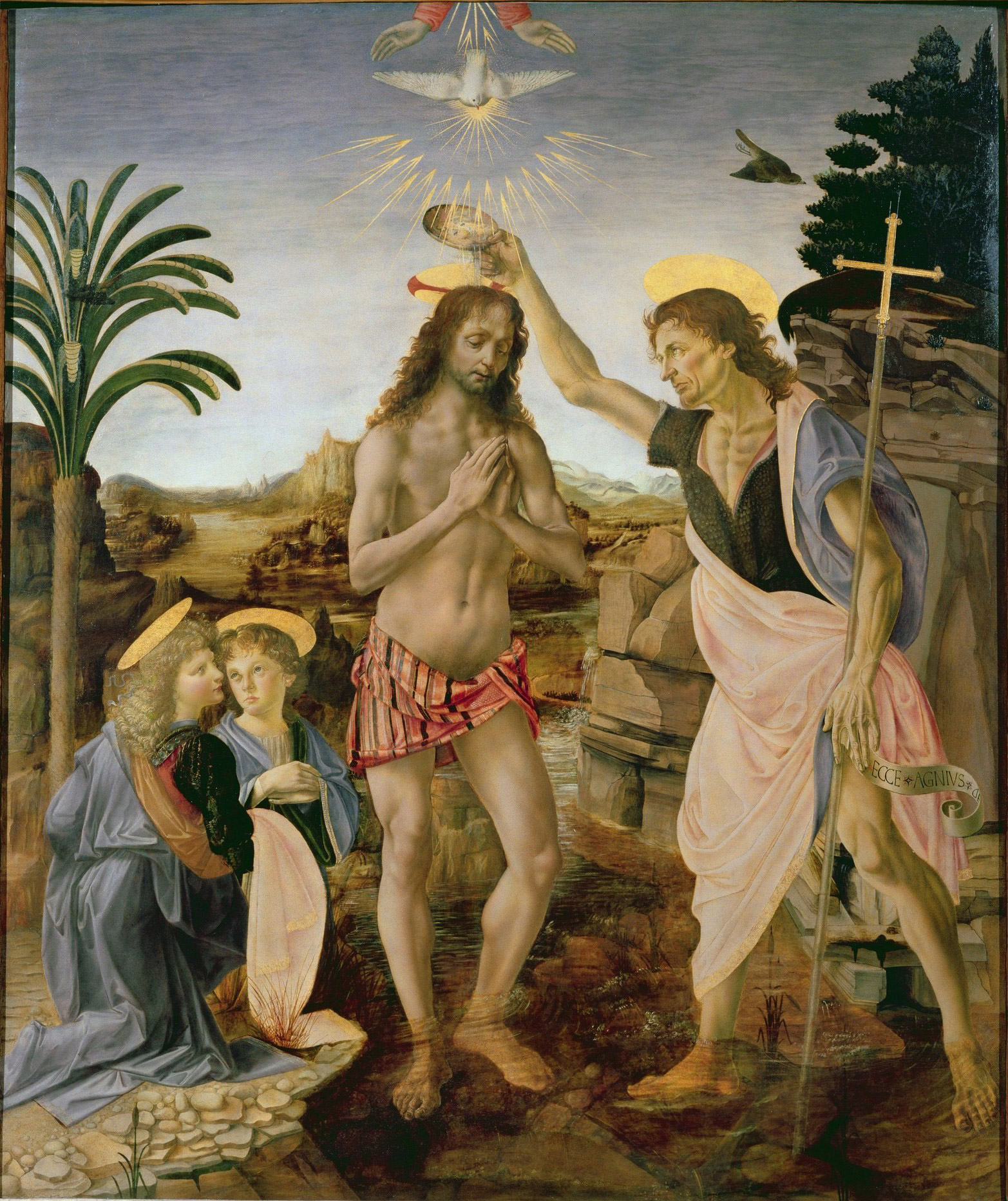
I tell this story not just as an easy introduction, but because it comes close to part of Jesus’ experience at his baptism. Given the long history of doves as a symbol of peace and of the spirit of God, it’s easy to think of their flight as something soft and calm. But their landing is not [see Anna Carter Florence, Preaching Year A]. Doves aren’t birds of prey, but they swoop down and land with a bump, rather like birds of prey. So the dove of the Spirit would have landed on Jesus’ head quite hard.
The experience of being baptised, of being named publically as God’s son, of becoming committed to a mission that would inevitably put him up against the state and would ultimately lead to his death, was not a comfortable one for Jesus. He was marked. He was chosen, and he had little choice in the matter. His calling landed on him with a bump.
Image: The Baptism of Christ, Andrea del Verrocchio
Two days ago was the festival of Epiphany, and in many ways this is a story about epiphany. The day is often associated with wise men and gifts, but the word simply means manifestation – of God being made known. The heavens are opened, which is a poetic way of saying that the gap between the earthly realm and the divine realm was reduced to nothing. God was experienced in that place on that river-bank. As the Biblical commentator Karoline Lewis puts it, “Epiphanies are not subtle. We can look for God in all kinds of people and places, but sometimes God comes crashing through the clouds and stops you dead in your tracks.”

This doesn’t mean we can’t experience God in other ways. When we pray, when we sing in worship, when we live out the gospel through serving others, when we see the works of God in nature, or in music, or through the love of others – these are all ways of experiencing God, among many others. But a sudden breaking-through of the gap between earth and heaven, a sudden and complete experience of God – that comes as more of a surprise.

This kind of epiphany, this experience of God’s complete love and presence, is an act of grace. It seeks us out, and is freely given to us. But we can make ourselves ready and available for it. That’s the nature of grace – it’s a two-way process, something offered that has to be accepted willingly.

And we see Jesus willingly going to his baptism here, freely taking up the offer of God’s grace, and freely taking on the mission which followed from it. One of the great questions that people have asked about Jesus’ baptism was why it was necessary. John baptised for repentance, for people to confess their wrong-doing and be transformed through the water into a new life. But Jesus was without sin, the eternal word of the Father made into a human being. And he chose to go into a muddy pool by the Jordan river to accept repentance and washing-away of sins from a radical preacher living on the edge of society. As some commentators have observed, it was something that the early church found really scandalous, almost embarrassing. Why did Jesus do it?

By the sounds of things, John the Baptist asked a similar question to Jesus. He was a bit scandalized at having the one he’d been preaching about coming to him to be baptised. But Jesus gives him a strong response. The language of the standard Bible translations here isn’t very helpful – the NIV says “it is proper for us to do this to fulfil all righteousness” which sounds like something from a legal contract or a memo by a particularly dull civil servant. The Message translation that I read at the start of the children’s talk is a lot livelier but not hugely more insightful: “God’s work, putting things right all these centuries, is coming together right now in this baptism”. The Greek word we have here as ‘righteousness’ appears a lot in the gospels, and it usually means ‘doing the right thing’, but specifically the right thing in God’s eyes. It’s about fulfilling God’s will.

So Jesus is saying: I need to be baptised, because it fulfils God’s will. It has long been the belief of the church that Jesus was both fully divine and fully human at once, though that is a sufficiently perplexing statement that trying to explain it rationally does your head in. How can someone be 100% of two things at once? Nonetheless that is what Jesus was. As one who was fully divine, he didn’t need baptism, but as one who was fully human, he needed to go through all the same things that we ordinary humans need to do.

Being baptised was a sign of Jesus’ commitment to humanity, just as much as was his birth and his death. It was also a very public way to make a commitment to his mission. There was no going back. The wonderful words that he heard, about being God’s son & beloved, were deeply affirming to Jesus. But here in the gospel of Matthew they are also a quotation, and they recur twice more in the gospel.

The words of God come from the passage we heard in Isaiah – “Here is my servant, whom I uphold, my chosen one in whom I delight”. They are the first of the four servant songs, written to the people of Israel to show their vocation as a people who exist to serve others, although they are read by Christians as referring to Jesus. Isaiah gives an amazing mission to the servant described here – to bring forth justice, to be a light to the nations, to open the eyes of the blind, to release prisoners from darkness.

That is the mission of Jesus – to bring justice to a world that sorely needs it, but in ways that they wouldn’t expect. Not through domination, but through service. Not through power, but through weakness. Not through violence, but through love. Matthew quotes a longer passage from Isaiah 42 when discussing the many people Jesus had cured, and the conflict which arose from it because it was seen as inappropriate by the religious establishment. And again we hear Isaiah in Matthew’s account of the scene on the mountaintop known as the Transfiguration, when Jesus shone like the sun and was joined by Moses and Elijah; then too the voice of God said “This is my Son, whom I love; with him I am well pleased”. These words from Isaiah echo throughout the gospel of Matthew, just as Jesus’ mission echoes through the gospel of Matthew.

Indeed, the gospel of Matthew ends with Jesus calling his disciples in turn to make disciples of all nations, to baptise them just as Jesus had been baptised, and to teach them to obey all of Jesus’ commandments. In other words, to take on the mission of being God’s beloved one, sent as a servant to bring forth justice and to be a light to a nations. And that call is passed down from one follower to another, so that we too are called to take on Jesus’ mission, to be ourselves a light to the nations and to be bringers of justice.

We might each of us bring light and justice in different ways – some of us through our work, some through our service to others, some in campaigning, some in charities, some in our families, some in the way we treat others around us. But the gospel is clear. If we are followers of Jesus, we are bringers of justice and light in everyday life.

Because there is one more thing to be said about epiphany. It’s something we can practice, and it’s something that breaks through in ordinary life. When people are baptised, whether as babies or adults, there’s nothing special about the water. It’s just the ordinary stuff from the tap. But it’s made sacred by it being the channel through which we are accepted by God. In the same way, when we celebrate communion, there’s nothing special about the bread and the wine (or grape juice). They are ordinary things made special by the way we encounter God through them.

As the American author Debie Thomas writes, “Epiphany is deep water — you can't stand on the shore and dip your toes in. You must take a breath and plunge.” We need to work at finding God, at hearing his voice, at encountering the divine presence. It reminds me of Peter walking on water. The bravest thing he did was not the walking, but leaving the boat and trusting Jesus that he would be ok.

Peter needed faith that if he let go, he would be ok. We all need faith that if we let go of our excuses, our world-weariness, our reluctance, then we will be ok, that we will then encounter God.

Because we have a mission, to follow Jesus in bringing forth justice and being a light to the nations. We can be reassured that we too are the beloved ones of God, given new life through his grace, but we need to be willing to accept that grace, to step forward in faith, and to follow Jesus in committing ourselves to God just as he did. Then truly we will fulfil the meaning of his and our baptisms.

Amen.

Tuesday, 20 December 2016

The Open University: institution or movement?

So I spent this morning at a meeting of the School of Computing & Communications (we no longer have departments at the OU, rather Schools). The improbable setting was a hotel that forms part of Stadium MK, the impressive football stadium built for the MK Dons, complete with a view straight from the meeting room over the pitch:
Our main topic was the OU's developing academic strategy, which depending on your perspective is either: a worthwhile & necessary response to an increasingly challenging external environment; or a power grab by senior management; or a well-intentioned attempt to build an overarching strategy albeit with some questionable details. Or perhaps a combination.

What it's not is exciting. Because strategy documents never are. It simultaneously says too much and not enough. No especial criticism there of the strategy's authors, who I'm sure in fact are doing their best; it's the nature of such documents.

But I got quite exercised during the meeting, as I have from time to time reading recent OU strategy documents, about whether it helps us to achieve our mission. The OU was established with a clear mission: "open as to people, open as to places, open as to methods, open as to ideas" (often referred to as the 'four opens'), an idea first formulated by Geoffrey Crowther in 1969 on his installation as OU Chancellor and retained ever since. That is, we are not established to make profit, to become the top university for research, or even necessarily to be the largest university in student numbers. But we are established with a cause of social justice: to bring education to people who wouldn't otherwise have it, in places that they wouldn't otherwise have it. The methods and ideas change with the times - the mission is an adapting one - but the openness and social justice remains in place.

However, on the train home I was reading a chapter of a fascinating new book by post-evangelical author and pastor, Brian Maclaren, The Great Spiritual Migration. Brian writes about social movement theory (drawing on the work of Greg Leffel), in the context of churches but the work has more general application. He distinguishes between three forms of human organisation: communities, groups of individuals and families with dependence on the same environment; institutions, which serve communities by seeking to preserve and enhance particular aspects of their lives; and movements, which 'organise people to articulate what's wrong with particular institutions and propose what should be done to make things right'. Others have made this distinction in a number of places; David Bosch (again from a church context) wrote that 'The difference between an institution and a movement is that one crosses boundaries the other guards them'.
Institutions are vital; they are needed for continuity, for getting things done, for giving people stable jobs. And movements are vital: they are needed for energy, for asking difficult questions, for challenging and changing the status quo. So which is the OU? I think it sits in tension between the two, of movement and institution. It has an excellent history as a movement - it's concerned with mission, with innovation, with challenging norms, with asking difficult questions. But it has achieved its impact through being an institution: having large module teams, media teams to shape academic work into attractive forms, processes to ensure high-quality materials, support structures for students.

Also today I listened to a podcast of a deeply inspiring speech by veteran LGBT and (other) human rights campaigner Peter Tatchell, on receiving an award from the Royal Society of Arts. He said two things I really liked. He described the goal of Outrage (the LGBT campaign group he led for years) as follows:
Our goal was nothing less than revolutionary - a peaceful, cultural revolution in values, laws and institutions.
And in conclusion he said that his guiding principle as a campaigner was:
Don't accept the world as it is - dream of what the world could be, and then help make it happen.
Peter Tatchell perfectly embodies the behaviour of people in movements - standing out, unafraid to challenge, with a clear goal in mind. He took many personal risks and made sacrifices (he has been beaten up many times). And the quotes from him are perfect descriptions of working within a movement.

The Open University is an institution, and it needs strategies. But it also needs to dream of what the world could be, and help make it happen. And for that it also needs to be a movement.

Monday, 28 November 2016

Waiting for the Lord, walking in the light

Sermon preached on 27th November 2016 (Advent Sunday), at Creaton URC. Texts: Matthew 24:36-44 and Isaiah 2:1-5. The sermon refers to my recent blog series on Revelation.
How long, O Lord? Will you forget me for ever? How long will you hide your face from me? That’s the beginning of Psalm 13. It’s a question that many people have asked. The world is in a terrible place, Lord – hunger and disaster and violence and economic crisis and political idiocy right and left. Or for other people: my life is in a terrible place, Lord – I have no direction, my beloved family members are suffering, I don’t know what to do. Or for others again: how long do I have to suffer for my faith Lord, being treated so badly by those around me simply because I want to worship you in ways that others don’t like? When Lord? When can we go up your holy mountain and see you turn swords in ploughshares? When will you return to give hope to your people?

And the answer of the gospel writer is: Wake up! Listen! Christ could be coming back at any moment! Be ready, for the Son of Man is returning – 3…2…1… NOW! Or if not now, it could be any time.

The reading from Matthew is powerful and rather disturbing. It clearly belongs to the form of writing that is called apocalyptic, concerned with the end of the world as we know it. Now, I have to tell you of the project I’ve been doing lately. Just over two weeks ago, I felt a strong leading to read through the book of Revelation prior to the start of Advent. There’s a certain church tradition in reading Revelation in the weeks leading up to Advent, and the way the past year has gone, culminating in Donald Trump’s election, it just felt really timely. So I’ve read through either one or two chapters per day, and written a blog post on each day. My wife describes it as “Magnus is reading Revelation, so you don’t have to”.

It’s a deeply weird book. But it’s taught me a lot about apocalyptic writing and about the many things people have written about the Son of Man. Earlier this year I preached on the coming of Son of Man in the book of Daniel, so my head’s been in the end times this year! Two things I want to say about apocalyptic writing.

First, it’s always written by people who are oppressed, and it’s always about their situation and God’s reaction to it. The reason why books like Daniel and Revelation, and passages like this one from Matthew, seem rather wild and over the top, is that the people writing them are hurting. They have great faith in God, but they have no power in the world, and they are being treated like dirt. And their reaction, sometimes, is to tell themselves and each other tales of God’s justice, of their persecutors being brought to book, and of a future time where righteousness prevails. Sometimes that’s for their own people, sometimes it’s for all people. But it’s always a reaction to being downtrodden. Be very suspicious indeed of apocalyptic literature written by those in powerful places – this is why the American evangelicals who obsess on Revelation and write ridiculous fantasies such as the Left Behind books, are so dangerous.

The second thing about apocalyptic literature is this: it’s deeply symbolic. It’s full of strange imagery, numbers, ideas. But it’s not intended to be taken literally. It’s a bit like an optical illusion or an Escher drawing – if you look at it straight on for too long, you go cross-eyed and start to feel a bit queasy. But if you look at it out of the corner of your eye, at an angle, then you can begin to see the point. I’ve spent the past fortnight with images of dragons, angels, lakes of fire, bowls with plagues, horsemen and many other things. They’re not predictive, they’re not literal; they show pictures, offer symbols.

So it is with this passage. I think it’s a mistake to focus on the details too literally. The discussion of Noah is clearly meant as a metaphor. Likewise the parts about one person being left & the other taken. Some take these phrase to suggest that one person will be taken to heaven and the other left on earth to face the coming wrath of God; but it’s just as possible to read them as saying that one will be taken away to some uncertain fate, while the other will continue to faithfully live out their life in God’s sight.

It’s not clear whether the coming of the Son of Man is intended to be a happy event. This is a figure who first appears in the book of Daniel, as one who came on clouds, and was given dominion by God. He pops up in a number of works written between the old and new testaments, appears a number of times in the gospels, and then makes a big appearance in Revelation.

In all these cases, the Son of Man is a figure of power and majesty. He’s a frightening figure. He’s not God-made-man, he’s not the Jesus who lived and walked round with his disciplines and ate fish in Galilee and spoke deep and wise words. The Son of Man is a totally different kind of figure. He’s a figure of great majesty. Jesus has a famous parable in the next chapter of Matthew where the Son of Man comes to judge the righteous from the unrighteous, favouring those who have helped people in need. In a different sort of judgement, Revelation has the Son of Man as a figure with a sword coming out of his mouth, destroying the armies of the beast; and holding a great sickle scything across the earth to destroy evildoers. Church tradition, to some extent backed up by the scriptures, equates the Son of Man with Jesus, but in a very complex way.

So for Jesus to say that the Son of Man will come at an unexpected hour is not a reassuring statement. The word of the year has been the Danish word ‘hygge’, which means warm, friendly, cosy, the feeling you get from low lighting and candles and warm fires against the cold fire, shared with good friends and good food and drink. There have been cookery books and lifestyle magazines and all sorts of bars and restaurants around this idea of hygge. Alas, Northampton’s Bar Hygge only lasted a year, but it’s a comforting concept for cold and dark nights. I like it.

But there is nothing in the least bit hygge about the coming of the Son of Man. It’s not cosy. It’s not comforting. It’s exactly the opposite of mulled wine and sentimental Christmas carols and a baby gurgling in a manger. Truth be told, there’s not much cosy about Jesus’ birth either – the baby born to refugee parents with a taint of immorality around them, in a dirty place surrounded by animals. Christmas carols and nativity scenes tell a lot of lies.

It’s often said that Advent is about both the first and the second coming of Christ, the second coming being the coming of the Son of Man. Neither of them is especially comforting or cosy. Jesus is giving us a warning as much as a promise. Beware! Things could happen very quickly that you don’t expect.

We’ve seen this happen again and again this year. There’s been terrible event upon terrible event – violent extremists with various agendas murdering tourists in Paris, Marseilles and Brussels; nightclubbers in Florida; a British MP in West Yorkshire. All of these came totally unexpectedly. I have my own views on the right and wrong of the EU referendum and the US elections, as I’m sure others do; but the result came as a surprise in both cases, to the groups who won and lost, and the public as a whole. Their effects will take a long time to be felt.

Image: Let Us Beat Swords Into Plowshares, statue at United Nations, New York (via Wikipedia)
The kind of change that Jesus tells us to be ready for, however, is a magnificent kind. It will come with great difficulty and danger. The transition could be unpleasant. But the results could be amazing. Because here is the promise – as Isaiah says,
He will settle disputes among great nations.
They will hammer their swords into plows and their spears into pruning knives.
Nations will never again go to war, never prepare for battle again.
How wonderful a promise that would be. War is a great crime against humanity. I believe with all my heart that war is never appropriate, never justified. We are a century on from the battle of the Somme, where a million died; and the battle of Verdun, where a million more died. Their deaths achieved essentially nothing. I know that some people will justify one war or another because of the actions of an evil general or dictator, and there may be times where it’s hard to see another way. But God can see other ways, and God knows that ultimately war has no purpose. So the promise, in the old song, that “I ain’t gonna study war no more”, is a great one. How we get there, I have no clue. It comes in God’s time, not in our time.

In the book of Revelation, the coming of the Son of Man, and his battles against the great beast and the devil, lead to terrible destruction and suffering on earth. But they ultimately lead to the creation of a new heaven & a new earth, and a holy city, a new Jerusalem, where heaven and earth come together, and God dwells with his people and sees them directly. In that place, we are told, God will wipe away all tears, and there shall be no pain and no death. It’s an amazing vision.

How do we get to that place? We can’t. It is in God’s time. But we are given two exhortations in these passages which show how we can be ready.

The first comes from Isaiah. The last version says of our reading urges the people of Israel: “let us walk in the light which the Lord gives us”. We must walk in God’s light. Do not be people of darkness. We have a God who lights the dark places, who gives sight to the blind, hope to the downtrodden. Israel’s God is the one who liberated them from slavery in Egypt, who liberates us from the things that enslave us. We must walk in that light, following that example, not in the darkness of prejudice and hatred. And we must follow that example, to liberate others and to give hope to this around us who are downtrodden. We are a people of hope.

The second is the urging of Jesus, to ‘stay awake’ or ‘be watchful’  or ‘watch out’. The word indicates alertness, readiness to take action – it’s the state of mind of a night watchman on the walls. In some of the versions of this story in other gospels, Jesus tells us to stay clothed, ready to go when needed.

And it’s this watchfulness that’s the key to Advent for me. It’s so easy to go through our lives being tired, slightly out of it, not fully engaged. Jesus came to shake us up, to wake us up. Imagine what we could do as individuals, as a community, if we were fully awake. If instead of being drugged by the rubbish of consumerism and trash telly and Christmas paraphernalia, we were able to say like Mary did: here I am, the servant of the Lord. Let it be according to your will. If we were able to be fully alive, to be fully present, to be fully part of our own lives, to be fully aware of the role of God in our lives, to be fully part of the relationships we have with others, to be fully part of the world around us. Think what an amazing thing that could be. Think how much that would let us walk in the light of the Lord.

So be ready. Be alert. Be awake. Because the Son of Man is coming at an hour we do not expect. And he will bring things we do not expect. And we can live in that power, in the wakefulness, in that light of the Lord, right now, in this Advent season, and in all our lives.

Amen.

The Year of Jane: or, a personal account of my first time reading through all the novels of one of the greatest novelists

I never read Jane Austen as a teenager. I was a voracious reader, but a lot of it was sci-fi & fantasy, I found nineteenth-century ficti...