Sunday, 8 January 2017

Commitment, manifestation and mission: a sermon on the baptism of Jesus

Sermon preached at Duston URC on 8th January 2017. Main texts: Matthew 3:13-17, Isaiah 42:1-9.

As a family we’ve been a number of times to a set of gardens in Devon by the name of Escot, complete with family-friendly animals and play equipment. One of their attractions is a birds of prey display – hawks, owls and the like. They care for and handle their birds well, but at one point in the display they’ve trained the hawks to fly out from the keeper and then swoop in low, just above the visitors’ heads, before coming back to the keeper. A few years ago we were there and they had a young bird doing this, and it came in very close to the top of my wife Becky’s head, almost touching her. None of us have seen birds of prey quite the same way since.

I tell this story not just as an easy introduction, but because it comes close to part of Jesus’ experience at his baptism. Given the long history of doves as a symbol of peace and of the spirit of God, it’s easy to think of their flight as something soft and calm. But their landing is not [see Anna Carter Florence, Preaching Year A]. Doves aren’t birds of prey, but they swoop down and land with a bump, rather like birds of prey. So the dove of the Spirit would have landed on Jesus’ head quite hard.
The experience of being baptised, of being named publically as God’s son, of becoming committed to a mission that would inevitably put him up against the state and would ultimately lead to his death, was not a comfortable one for Jesus. He was marked. He was chosen, and he had little choice in the matter. His calling landed on him with a bump.
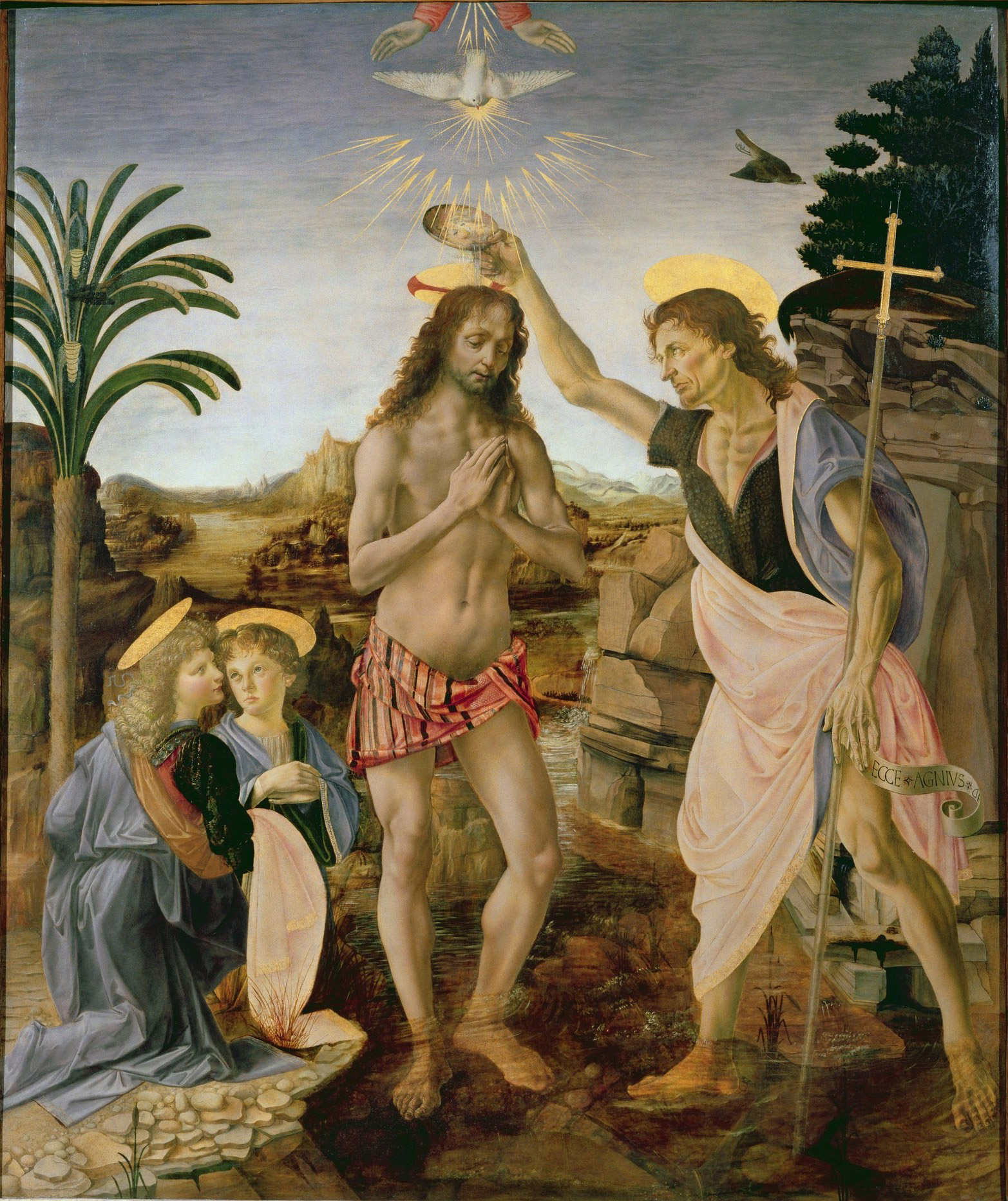
Image: The Baptism of Christ, Andrea del Verrocchio
Two days ago was the festival of Epiphany, and in many ways this is a story about epiphany. The day is often associated with wise men and gifts, but the word simply means manifestation – of God being made known. The heavens are opened, which is a poetic way of saying that the gap between the earthly realm and the divine realm was reduced to nothing. God was experienced in that place on that river-bank. As the Biblical commentator Karoline Lewis puts it, “Epiphanies are not subtle. We can look for God in all kinds of people and places, but sometimes God comes crashing through the clouds and stops you dead in your tracks.”

This doesn’t mean we can’t experience God in other ways. When we pray, when we sing in worship, when we live out the gospel through serving others, when we see the works of God in nature, or in music, or through the love of others – these are all ways of experiencing God, among many others. But a sudden breaking-through of the gap between earth and heaven, a sudden and complete experience of God – that comes as more of a surprise.

This kind of epiphany, this experience of God’s complete love and presence, is an act of grace. It seeks us out, and is freely given to us. But we can make ourselves ready and available for it. That’s the nature of grace – it’s a two-way process, something offered that has to be accepted willingly.

And we see Jesus willingly going to his baptism here, freely taking up the offer of God’s grace, and freely taking on the mission which followed from it. One of the great questions that people have asked about Jesus’ baptism was why it was necessary. John baptised for repentance, for people to confess their wrong-doing and be transformed through the water into a new life. But Jesus was without sin, the eternal word of the Father made into a human being. And he chose to go into a muddy pool by the Jordan river to accept repentance and washing-away of sins from a radical preacher living on the edge of society. As some commentators have observed, it was something that the early church found really scandalous, almost embarrassing. Why did Jesus do it?

By the sounds of things, John the Baptist asked a similar question to Jesus. He was a bit scandalized at having the one he’d been preaching about coming to him to be baptised. But Jesus gives him a strong response. The language of the standard Bible translations here isn’t very helpful – the NIV says “it is proper for us to do this to fulfil all righteousness” which sounds like something from a legal contract or a memo by a particularly dull civil servant. The Message translation that I read at the start of the children’s talk is a lot livelier but not hugely more insightful: “God’s work, putting things right all these centuries, is coming together right now in this baptism”. The Greek word we have here as ‘righteousness’ appears a lot in the gospels, and it usually means ‘doing the right thing’, but specifically the right thing in God’s eyes. It’s about fulfilling God’s will.

So Jesus is saying: I need to be baptised, because it fulfils God’s will. It has long been the belief of the church that Jesus was both fully divine and fully human at once, though that is a sufficiently perplexing statement that trying to explain it rationally does your head in. How can someone be 100% of two things at once? Nonetheless that is what Jesus was. As one who was fully divine, he didn’t need baptism, but as one who was fully human, he needed to go through all the same things that we ordinary humans need to do.

Being baptised was a sign of Jesus’ commitment to humanity, just as much as was his birth and his death. It was also a very public way to make a commitment to his mission. There was no going back. The wonderful words that he heard, about being God’s son & beloved, were deeply affirming to Jesus. But here in the gospel of Matthew they are also a quotation, and they recur twice more in the gospel.

The words of God come from the passage we heard in Isaiah – “Here is my servant, whom I uphold, my chosen one in whom I delight”. They are the first of the four servant songs, written to the people of Israel to show their vocation as a people who exist to serve others, although they are read by Christians as referring to Jesus. Isaiah gives an amazing mission to the servant described here – to bring forth justice, to be a light to the nations, to open the eyes of the blind, to release prisoners from darkness.

That is the mission of Jesus – to bring justice to a world that sorely needs it, but in ways that they wouldn’t expect. Not through domination, but through service. Not through power, but through weakness. Not through violence, but through love. Matthew quotes a longer passage from Isaiah 42 when discussing the many people Jesus had cured, and the conflict which arose from it because it was seen as inappropriate by the religious establishment. And again we hear Isaiah in Matthew’s account of the scene on the mountaintop known as the Transfiguration, when Jesus shone like the sun and was joined by Moses and Elijah; then too the voice of God said “This is my Son, whom I love; with him I am well pleased”. These words from Isaiah echo throughout the gospel of Matthew, just as Jesus’ mission echoes through the gospel of Matthew.

Indeed, the gospel of Matthew ends with Jesus calling his disciples in turn to make disciples of all nations, to baptise them just as Jesus had been baptised, and to teach them to obey all of Jesus’ commandments. In other words, to take on the mission of being God’s beloved one, sent as a servant to bring forth justice and to be a light to a nations. And that call is passed down from one follower to another, so that we too are called to take on Jesus’ mission, to be ourselves a light to the nations and to be bringers of justice.

We might each of us bring light and justice in different ways – some of us through our work, some through our service to others, some in campaigning, some in charities, some in our families, some in the way we treat others around us. But the gospel is clear. If we are followers of Jesus, we are bringers of justice and light in everyday life.

Because there is one more thing to be said about epiphany. It’s something we can practice, and it’s something that breaks through in ordinary life. When people are baptised, whether as babies or adults, there’s nothing special about the water. It’s just the ordinary stuff from the tap. But it’s made sacred by it being the channel through which we are accepted by God. In the same way, when we celebrate communion, there’s nothing special about the bread and the wine (or grape juice). They are ordinary things made special by the way we encounter God through them.

As the American author Debie Thomas writes, “Epiphany is deep water — you can't stand on the shore and dip your toes in. You must take a breath and plunge.” We need to work at finding God, at hearing his voice, at encountering the divine presence. It reminds me of Peter walking on water. The bravest thing he did was not the walking, but leaving the boat and trusting Jesus that he would be ok.

Peter needed faith that if he let go, he would be ok. We all need faith that if we let go of our excuses, our world-weariness, our reluctance, then we will be ok, that we will then encounter God.

Because we have a mission, to follow Jesus in bringing forth justice and being a light to the nations. We can be reassured that we too are the beloved ones of God, given new life through his grace, but we need to be willing to accept that grace, to step forward in faith, and to follow Jesus in committing ourselves to God just as he did. Then truly we will fulfil the meaning of his and our baptisms.

Amen.

Tuesday, 20 December 2016

The Open University: institution or movement?

So I spent this morning at a meeting of the School of Computing & Communications (we no longer have departments at the OU, rather Schools). The improbable setting was a hotel that forms part of Stadium MK, the impressive football stadium built for the MK Dons, complete with a view straight from the meeting room over the pitch:
Our main topic was the OU's developing academic strategy, which depending on your perspective is either: a worthwhile & necessary response to an increasingly challenging external environment; or a power grab by senior management; or a well-intentioned attempt to build an overarching strategy albeit with some questionable details. Or perhaps a combination.

What it's not is exciting. Because strategy documents never are. It simultaneously says too much and not enough. No especial criticism there of the strategy's authors, who I'm sure in fact are doing their best; it's the nature of such documents.

But I got quite exercised during the meeting, as I have from time to time reading recent OU strategy documents, about whether it helps us to achieve our mission. The OU was established with a clear mission: "open as to people, open as to places, open as to methods, open as to ideas" (often referred to as the 'four opens'), an idea first formulated by Geoffrey Crowther in 1969 on his installation as OU Chancellor and retained ever since. That is, we are not established to make profit, to become the top university for research, or even necessarily to be the largest university in student numbers. But we are established with a cause of social justice: to bring education to people who wouldn't otherwise have it, in places that they wouldn't otherwise have it. The methods and ideas change with the times - the mission is an adapting one - but the openness and social justice remains in place.

However, on the train home I was reading a chapter of a fascinating new book by post-evangelical author and pastor, Brian Maclaren, The Great Spiritual Migration. Brian writes about social movement theory (drawing on the work of Greg Leffel), in the context of churches but the work has more general application. He distinguishes between three forms of human organisation: communities, groups of individuals and families with dependence on the same environment; institutions, which serve communities by seeking to preserve and enhance particular aspects of their lives; and movements, which 'organise people to articulate what's wrong with particular institutions and propose what should be done to make things right'. Others have made this distinction in a number of places; David Bosch (again from a church context) wrote that 'The difference between an institution and a movement is that one crosses boundaries the other guards them'.
Institutions are vital; they are needed for continuity, for getting things done, for giving people stable jobs. And movements are vital: they are needed for energy, for asking difficult questions, for challenging and changing the status quo. So which is the OU? I think it sits in tension between the two, of movement and institution. It has an excellent history as a movement - it's concerned with mission, with innovation, with challenging norms, with asking difficult questions. But it has achieved its impact through being an institution: having large module teams, media teams to shape academic work into attractive forms, processes to ensure high-quality materials, support structures for students.

Also today I listened to a podcast of a deeply inspiring speech by veteran LGBT and (other) human rights campaigner Peter Tatchell, on receiving an award from the Royal Society of Arts. He said two things I really liked. He described the goal of Outrage (the LGBT campaign group he led for years) as follows:
Our goal was nothing less than revolutionary - a peaceful, cultural revolution in values, laws and institutions.
And in conclusion he said that his guiding principle as a campaigner was:
Don't accept the world as it is - dream of what the world could be, and then help make it happen.
Peter Tatchell perfectly embodies the behaviour of people in movements - standing out, unafraid to challenge, with a clear goal in mind. He took many personal risks and made sacrifices (he has been beaten up many times). And the quotes from him are perfect descriptions of working within a movement.

The Open University is an institution, and it needs strategies. But it also needs to dream of what the world could be, and help make it happen. And for that it also needs to be a movement.

Monday, 28 November 2016

Waiting for the Lord, walking in the light

Sermon preached on 27th November 2016 (Advent Sunday), at Creaton URC. Texts: Matthew 24:36-44 and Isaiah 2:1-5. The sermon refers to my recent blog series on Revelation.
How long, O Lord? Will you forget me for ever? How long will you hide your face from me? That’s the beginning of Psalm 13. It’s a question that many people have asked. The world is in a terrible place, Lord – hunger and disaster and violence and economic crisis and political idiocy right and left. Or for other people: my life is in a terrible place, Lord – I have no direction, my beloved family members are suffering, I don’t know what to do. Or for others again: how long do I have to suffer for my faith Lord, being treated so badly by those around me simply because I want to worship you in ways that others don’t like? When Lord? When can we go up your holy mountain and see you turn swords in ploughshares? When will you return to give hope to your people?

And the answer of the gospel writer is: Wake up! Listen! Christ could be coming back at any moment! Be ready, for the Son of Man is returning – 3…2…1… NOW! Or if not now, it could be any time.

The reading from Matthew is powerful and rather disturbing. It clearly belongs to the form of writing that is called apocalyptic, concerned with the end of the world as we know it. Now, I have to tell you of the project I’ve been doing lately. Just over two weeks ago, I felt a strong leading to read through the book of Revelation prior to the start of Advent. There’s a certain church tradition in reading Revelation in the weeks leading up to Advent, and the way the past year has gone, culminating in Donald Trump’s election, it just felt really timely. So I’ve read through either one or two chapters per day, and written a blog post on each day. My wife describes it as “Magnus is reading Revelation, so you don’t have to”.

It’s a deeply weird book. But it’s taught me a lot about apocalyptic writing and about the many things people have written about the Son of Man. Earlier this year I preached on the coming of Son of Man in the book of Daniel, so my head’s been in the end times this year! Two things I want to say about apocalyptic writing.

First, it’s always written by people who are oppressed, and it’s always about their situation and God’s reaction to it. The reason why books like Daniel and Revelation, and passages like this one from Matthew, seem rather wild and over the top, is that the people writing them are hurting. They have great faith in God, but they have no power in the world, and they are being treated like dirt. And their reaction, sometimes, is to tell themselves and each other tales of God’s justice, of their persecutors being brought to book, and of a future time where righteousness prevails. Sometimes that’s for their own people, sometimes it’s for all people. But it’s always a reaction to being downtrodden. Be very suspicious indeed of apocalyptic literature written by those in powerful places – this is why the American evangelicals who obsess on Revelation and write ridiculous fantasies such as the Left Behind books, are so dangerous.

The second thing about apocalyptic literature is this: it’s deeply symbolic. It’s full of strange imagery, numbers, ideas. But it’s not intended to be taken literally. It’s a bit like an optical illusion or an Escher drawing – if you look at it straight on for too long, you go cross-eyed and start to feel a bit queasy. But if you look at it out of the corner of your eye, at an angle, then you can begin to see the point. I’ve spent the past fortnight with images of dragons, angels, lakes of fire, bowls with plagues, horsemen and many other things. They’re not predictive, they’re not literal; they show pictures, offer symbols.

So it is with this passage. I think it’s a mistake to focus on the details too literally. The discussion of Noah is clearly meant as a metaphor. Likewise the parts about one person being left & the other taken. Some take these phrase to suggest that one person will be taken to heaven and the other left on earth to face the coming wrath of God; but it’s just as possible to read them as saying that one will be taken away to some uncertain fate, while the other will continue to faithfully live out their life in God’s sight.

It’s not clear whether the coming of the Son of Man is intended to be a happy event. This is a figure who first appears in the book of Daniel, as one who came on clouds, and was given dominion by God. He pops up in a number of works written between the old and new testaments, appears a number of times in the gospels, and then makes a big appearance in Revelation.

In all these cases, the Son of Man is a figure of power and majesty. He’s a frightening figure. He’s not God-made-man, he’s not the Jesus who lived and walked round with his disciplines and ate fish in Galilee and spoke deep and wise words. The Son of Man is a totally different kind of figure. He’s a figure of great majesty. Jesus has a famous parable in the next chapter of Matthew where the Son of Man comes to judge the righteous from the unrighteous, favouring those who have helped people in need. In a different sort of judgement, Revelation has the Son of Man as a figure with a sword coming out of his mouth, destroying the armies of the beast; and holding a great sickle scything across the earth to destroy evildoers. Church tradition, to some extent backed up by the scriptures, equates the Son of Man with Jesus, but in a very complex way.

So for Jesus to say that the Son of Man will come at an unexpected hour is not a reassuring statement. The word of the year has been the Danish word ‘hygge’, which means warm, friendly, cosy, the feeling you get from low lighting and candles and warm fires against the cold fire, shared with good friends and good food and drink. There have been cookery books and lifestyle magazines and all sorts of bars and restaurants around this idea of hygge. Alas, Northampton’s Bar Hygge only lasted a year, but it’s a comforting concept for cold and dark nights. I like it.

But there is nothing in the least bit hygge about the coming of the Son of Man. It’s not cosy. It’s not comforting. It’s exactly the opposite of mulled wine and sentimental Christmas carols and a baby gurgling in a manger. Truth be told, there’s not much cosy about Jesus’ birth either – the baby born to refugee parents with a taint of immorality around them, in a dirty place surrounded by animals. Christmas carols and nativity scenes tell a lot of lies.

It’s often said that Advent is about both the first and the second coming of Christ, the second coming being the coming of the Son of Man. Neither of them is especially comforting or cosy. Jesus is giving us a warning as much as a promise. Beware! Things could happen very quickly that you don’t expect.

We’ve seen this happen again and again this year. There’s been terrible event upon terrible event – violent extremists with various agendas murdering tourists in Paris, Marseilles and Brussels; nightclubbers in Florida; a British MP in West Yorkshire. All of these came totally unexpectedly. I have my own views on the right and wrong of the EU referendum and the US elections, as I’m sure others do; but the result came as a surprise in both cases, to the groups who won and lost, and the public as a whole. Their effects will take a long time to be felt.

Image: Let Us Beat Swords Into Plowshares, statue at United Nations, New York (via Wikipedia)
The kind of change that Jesus tells us to be ready for, however, is a magnificent kind. It will come with great difficulty and danger. The transition could be unpleasant. But the results could be amazing. Because here is the promise – as Isaiah says,
He will settle disputes among great nations.
They will hammer their swords into plows and their spears into pruning knives.
Nations will never again go to war, never prepare for battle again.
How wonderful a promise that would be. War is a great crime against humanity. I believe with all my heart that war is never appropriate, never justified. We are a century on from the battle of the Somme, where a million died; and the battle of Verdun, where a million more died. Their deaths achieved essentially nothing. I know that some people will justify one war or another because of the actions of an evil general or dictator, and there may be times where it’s hard to see another way. But God can see other ways, and God knows that ultimately war has no purpose. So the promise, in the old song, that “I ain’t gonna study war no more”, is a great one. How we get there, I have no clue. It comes in God’s time, not in our time.

In the book of Revelation, the coming of the Son of Man, and his battles against the great beast and the devil, lead to terrible destruction and suffering on earth. But they ultimately lead to the creation of a new heaven & a new earth, and a holy city, a new Jerusalem, where heaven and earth come together, and God dwells with his people and sees them directly. In that place, we are told, God will wipe away all tears, and there shall be no pain and no death. It’s an amazing vision.

How do we get to that place? We can’t. It is in God’s time. But we are given two exhortations in these passages which show how we can be ready.

The first comes from Isaiah. The last version says of our reading urges the people of Israel: “let us walk in the light which the Lord gives us”. We must walk in God’s light. Do not be people of darkness. We have a God who lights the dark places, who gives sight to the blind, hope to the downtrodden. Israel’s God is the one who liberated them from slavery in Egypt, who liberates us from the things that enslave us. We must walk in that light, following that example, not in the darkness of prejudice and hatred. And we must follow that example, to liberate others and to give hope to this around us who are downtrodden. We are a people of hope.

The second is the urging of Jesus, to ‘stay awake’ or ‘be watchful’  or ‘watch out’. The word indicates alertness, readiness to take action – it’s the state of mind of a night watchman on the walls. In some of the versions of this story in other gospels, Jesus tells us to stay clothed, ready to go when needed.

And it’s this watchfulness that’s the key to Advent for me. It’s so easy to go through our lives being tired, slightly out of it, not fully engaged. Jesus came to shake us up, to wake us up. Imagine what we could do as individuals, as a community, if we were fully awake. If instead of being drugged by the rubbish of consumerism and trash telly and Christmas paraphernalia, we were able to say like Mary did: here I am, the servant of the Lord. Let it be according to your will. If we were able to be fully alive, to be fully present, to be fully part of our own lives, to be fully aware of the role of God in our lives, to be fully part of the relationships we have with others, to be fully part of the world around us. Think what an amazing thing that could be. Think how much that would let us walk in the light of the Lord.

So be ready. Be alert. Be awake. Because the Son of Man is coming at an hour we do not expect. And he will bring things we do not expect. And we can live in that power, in the wakefulness, in that light of the Lord, right now, in this Advent season, and in all our lives.

Amen.

Sunday, 27 November 2016

Revelation before Advent 22: the healing of the nations and the inclusion of all

This is the sixteenth of a series of blog posts on the book of Revelation. There's an introduction to the series. Previous reading: ch 21, new heaven and new earth. Where I quote from the Bible, it's generally the New Revised Standard Version unless I say otherwise. The numbering covers the chapters of the book, not the days of the reading.

I've failed (though not by much) in my goal to read Revelation before the start of Advent. Today is Advent Sunday, and I preached a sermon which drew heavily on what I've learnt in the past two weeks. But writing the sermon (and the little matter of it being my birthday yesterday) meant I didn't get to read & blog the final chapter. So here goes, the end of Revelation... during Advent.

In fact, chapter 22 feels like a coda to the rest. We've had the rather gorgeous account of the new Jerusalem; we now get a few bits more detail, which close the book off nicely, and relate some of the themes back to past biblical imagery.

First the angel shows John the river of the water of life, and sitting on it the tree of life. This sense of life-giving contrasts well with the images of death and destruction earlier in the book. This new creation is one where life comes before death. The river flowing out of the city resembles the four rivers which flowed out of the garden of Eden (in some traditions with their source at Jerusalem); and also is close to the river flowing out of the temple in Ezekiel's vision.

The tree of life also recalls (for me) the tree of the knowledge of good & evil in the Garden of Eden, from which Adam and Eve ate with such catastrophic effect. (Perhaps a reminder about literalism here; for myself I believe Genesis to be a myth, a story with important lessons about the human condition but not to be read as literal truth - rather like Revelation in its own way. So when I write about Eden it's referring to the human lessons, and to its literary effect upon other books of the Bible.)
Image: Laurie Kathleen Clark, Heartitude=Art+Soul
Related to the tree of life is one of the last lovely phrases in Revelation: "the leaves of the tree are for the healing of the nations". Well, the nations need plenty of that, and always have done. It's quite an important phrase at this point of the chapter - it suggests that there still are many nations in the new creation (that is, not just the Christian & Jewish elect); and also that the process of healing is an ongoing one, after the founding of the new creation. This may be a world without death, but not all conflicts have been forgotten. And I think this is realistic - we can live with our former enemies in love, but it may take a long time to heal the hurts we caused each other.

One more important point in this first section of the chapter. We heard in the last chapter that the throne of God would be in the city, no separation by temple or heaven. Here we see an extension - God's servants will see his face. Throughout the Old Testament in particular, the idea of seeing God face to face was an impossibly daunting prospect - God is too powerful, too holy, for mortals to see directly. This is a signficant change from that idea.

The rest of the chapter is concerned with closing the book. First the angel warns that the book is not to be sealed up; John later warns scribes not to extend the book or remove parts of it. Then we have a final message from God as being the 'Alpha and the Omega, the beginning and the end' (also in the previous chapter), and a blessing on those who are able to enter the city.

Finally we have a closing message from Jesus to the churches in Asia, just as the book began with such a message. He reminds them that he is the descendant of David (that is, an anointed ruler in the traditions of Israel). And he says "come" to everyone who is thirsty, everyone who wishes to take the water of life. In the gospel of John, Jesus said: "let anyone who is thirsty come to me". As with the tree of life, there is a universality here. This is not just a message for the Jewish people, or the Christian people, or some kind of elect - the invitation to the new creation is for anyone. I find this a hopeful end to a book full of division into the righteous & unrighteous ones. This may have been so in the old world, but in the new creation, the invitation is for all to come.

And lastly the book ends with a promise from Jesus that he will come soon, and a response to Jesus urging him to do so (in Greek, but resembling the Aramic Maranatha). Very last of all, the standard message of grace that the New Testament letters end with, reminding us that this huge and sprawling book of bizarre imagery is, ultimately, a pastoral letter to a group of struggling churches.

And that is all (for now) that I have to say of Revelation.

Friday, 25 November 2016

Revelation before Advent 21: new heaven and new earth

This is the fifteenth of a series of blog posts on the book of Revelation. There's an introduction to the series. Previous reading: ch 20, The millennium, the lake of fire, and existential angst. Where I quote from the Bible, it's generally the New Revised Standard Version unless I say otherwise. The numbering covers the chapters of the book, not the days of the reading.

"Then I saw a new heaven and a new earth; for the first heaven and the first earth had passed away, and the sea was no more." So begins chapter 21. And as apocalyptic visions go, this is a pretty calm one. The conflict is over (we'll see no more violence now for the rest of the book), the old heaven and earth are finished with - and the sea, the realm of chaos and disorder - we're moving into a completely new realm.

The words are well-known, but it's a striking start to the penultimate chapter of the book. After the tumult and destruction of earlier books, we might expect to see a new earth, but this verse describes a new heaven as well - both have been lost and reshaped. Given the description (v2) of the new Jerusalem coming down from heaven, there still seems to be a separation of sorts between earth & heaven (in John's time the 'three-tier universe' idea was pretty widespread, but the lowest tier of the underworld has now disappeared), but the gap between earth and heaven is narrower than it was. 

A short poem tells us that "the home of God is among mortals ... he will dwell with them". The Greek word translated 'home', skÄ“nÄ“, is the word booth or tabernacle - the place where God dwells with his people; it appears a lot in the book of Exodus, first in the tent of meeting and later in the Temple. Jumping to near the end of the chapter, we're told that there was no Temple in the new Jerusalem, because God and the Lamb dwelt there and were themselves the Temple. George Macleod said that the isle of Iona is a thin place, where "the veil between things spiritual and things material is as thin as gossamer"; here we see the gap narrowed to nothing, the veil lifted or torn asunder.

One more thing from this short poem - God will wipe away all tears; death, mourning, crying and pain will come to an end. In this new earth, all the old griefs are lost. Many commentators have described this as a new creation, with a new Eden - in the first Eden, death came among humans, now in the second Eden, death has been lost. Karl Jenkins set this text beautifully as the culmination to his piece The Armed Man, about war and its losses, and the need for peace:
More vivid pictures: we hear directly from 'the one who was seated on the throne' - God speaks to John directly. He's told that "I am making all things new" and that "to the thirsty, I will give water from the spring of the water of life" (an echo perhaps of one of the beautitudes, promising that those who hunger and thirst after righteousness - or perhaps justice - will be filled). Those who 'conquer' (over temptation and sin, perhaps?) will live with God; but in one last appearance of the lake of fire, we're told that the faithless and various sinners will be thrown there.

And then we move to the next part of the chapter, which at length describes the new Jerusalem. At the start of the chapter, this city is described as the bride of the Lamb - a contrast with the depiction of Babylon as an impure woman. In later times, the church was to regard itself as the bride of Christ, and it's not too far-fetched to see a parallel: when the church is working at its best (which is by no means always) it serves as the body of Christ, a foreshadowing of this later bride of Christ.

Image: The New Jerusalem, 14th century tapestry (via Wikipedia)
We get a long description of the new Jerusalem. The details are argued over, and the numbers are surely as much symbolic as intended to be realistic, but it's clear it's enormous - a square plan of 12,000 stadia on either side (roughly 1380 miles on each side - some translations, including the NRSV, prefer 1500 miles). This is huge, much of the size of Europe (say from Paris to Kiev, west-east; and London to Malaga, north-south). The city is described as being the same height again (impossible on our earth - the International Space Station is at a height of 240 miles above the surface of the earth), although the walls are a much smaller 144 cubits high (clearly a symbolic number - about 65 metres, which is still pretty tall for walls). In the words of Douglas Adams about the equally-eschatological Restaurant at the End of the Universe, "this is of course impossible". Except it's not, though it may be symbolic.

The city's construction involves a lot of twelves - twelve gates, inscribed with the twelve tribes, with twelve angels at the gates; twelve foundation stones, inscribed with the names of the twelve apostles. Twelve squared is, of course, 144 (cf. the 144,000 sealed ones earlier in the book), which numerologically can be made from the Greek word angelos, messenger, the word from which we get angel. Some churches have said that these sealed ones are the only people able to live in the new city (and conveniently name themselves as the sealed ones), but there is no evidence for that view in this chapter. It is all the people of God who live here.

We also get a long rendition of the precious jewels from which the city is constructed - walls of jasper, streets of pure gold clear as glass, gates from a single pearl, and twelve foundation stones each a different jewel (the same jewels as on the high priest's breastplate). This is opulence and ostentation beyond the wildest dreams of the poverty-stricken Asian churches, but in a subtler and kinder form than the vulgar ostentation of Trump Tower or the palaces of middle-eastern emirs.

And last we're told that the city glows with its own light, needs no temple, and the gates are kept open always - for this is a city that is always at peace, and which is the dwelling-place of God. Unclean things (or people) simply cannot enter it.

It's really a rather lovely vision. As we'll see in the next (and final) chapter, the new Jerusalem is not the whole of the new creation, but it is at its heart. If the old Jerusalem was the centre of the world for the Jewish people, this new Jerusalem is the centre of the universe (earth and heaven) for all peoples; the real thing of which the old Jerusalem was just a shadowy early form (to paraphrase CS Lewis' description of the Narnia beyond the doors after the end of the old Narnia in The Last Battle). 

But let's be clear. This is not heaven. This is not some other-worldly realm. It occurs in a future time - it's not the kingdom of heaven which anyone can access here on earth, as Jesus taught. But this new Jerusalem, however much it looks impossible, exists on earth - a recreated earth, an earth stripped of pain and death, but nonetheless the earth. This is a vision of the earth as it could be, and in John's belief, as it will be.

Next (and final) reading: ch 22, the healing of the nations and the inclusion of all

Thursday, 24 November 2016

Revelation before Advent 20: The millennium, the lake of fire, and existential angst

This is the fourteenth of a series of blog posts on the book of Revelation. There's an introduction to the series. Previous reading: ch 19, Hallelujah, and a white horse. Where I quote from the Bible, it's generally the New Revised Standard Version unless I say otherwise. The numbering covers the chapters of the book, not the days of the reading.

This chapter (20) is the last one where we'll see the reign of evil forces on the earth. It begins with another big event, following the battle of the previous chapter - an angel comes along captures the dragon (Satan), binds him for a thousand years and throws him into the bottomless pit. Hooray for the angel! And it reminds me of the binding of Loki in Norse mythology (very possibly reformulated in the light of Christian theology, as was the case with various Norse tales).

Image: William Blake, Angel Michael binding Satan (Harvard Art Museums)
However, as with Loki, there's a snag - it's not for ever. After a thousand years "he must be let out for a little while". Because, erm, John's not saying. Presumably it's a mystery. Or a necessary force of nature. (Loki escaped through cunning - Satan seems just to have been released.)

But until that time: those who were "beheaded for their testimony to Jesus" will come to live and reign with him for a thousand years. I've been reading NT Wright's commentary on this piece, and he observes that beheading was considered a kind death in the ancient world, one given to citizens of Rome being executed, while others who were condemned had nastier deaths. So maybe the beheading is metaphorical - but it's not wholly clear of what it's a metaphor.

The thousand years (as Wright goes on to say) is probably also a symbolic figure. Most other numbers in Revelation are symbolic (seven, three and a half etc). I'd be inclined to agree, rather than treating it as an accurate round number, for whatever we're supposed to do with it. This needs care: for much of church history, this idea of the millennium has been a captivating one. Many para-Christian groups (variously called sects or cults in their time, sometimes ruder names) have sought to establish the time when the reign of Christ for those thousand years (whether literal or symbolic) would begin. Evangelicals have desperate debates over the time of the millennium and its sequencing.

This might sound like the worst sort of obscure logic-chopping, and it resembles it. But it derives from a real existential fear: the text says that "blessed and holy are those who share in the first resurrection; over these the second death has no power". The question of when & how this will happen is really, in my view, hiding a deeper question: will I be part of this resurrection? Will my loved ones be part of this resurrection? Or put more crudely, am I going to be ok?

Revelation is frustratingly obscure on this subject. It tells us that Christ will reign over the earth for a long time, with the help of those who have suffered for their faith; but that's about all. If one cares about one's ultimate future, that's a big worry. There's a respectable alternative, which is not to worry - but people do worry, that's human nature. I did enjoy the start of the Inter Varsity Press commentary - a generally evangelical publisher whose readers care about these things - which begins: "Nine times out of ten, when people ask, 'How do you interpret the book of Revelation?' what they mean is, 'How do you interpret Revelation 20:1-10?'"

On with the story. The thousand years are up, Satan-the-dragon is out. He goes off on a recruitment drive, with deception (that's Satan the subtle tempter not the dragon) to bring the nations of the earth on his side, and gather them into a great army. When I was a student in Cambridge I used to wonder about the sole hills thereabouts, the Gog and Magog hills - they're named after this passage, and in turn after king Gog of the land of Magog, who fought the armies of God in a story in the book of Ezekiel. As with that story, fire comes from heaven and destroys the armies.

Satan is at last in turn destroyed, thrown into the same lake of fire where the beast & prophet met their fate in the previous chapter. No way out for him, "and they will be tormented day and night for ever and ever". Nice. Something to avoid.

Except that, to add to that existential angst, we have a scene of great judgement to come. God comes to his throne and in the process "earth and heaven fled from his presence" - anything left is finally wiped out. But the dead come before the throne in turn to "be judged according to their works" according to records in "the book of life". If you're in the book of life, you're ok, if you're not, you get thrown into the same lake of fire, presumably with the same eternal torment. There's plenty of other parts of the New Testament about what these works are, their relationship to grace, faith etc (though sufficiently much that there is room for much argument, as the history of the church over 2000 years have proved, perhaps especially the past 500 years since the Protestant Reformation).

But still - lake of fire, eternal torment, the second death - we don't want that, no thank you. Please tell us, church people, how to avoid this. Me? As a follower of the words of Jesus, I might gently point to a not dissimilar symbolic tale of judgement that he told, where those judged favourably had helped "the least of these who are members of my family" who were hungry, thirsty, naked, in prison etc.

But with the strength of this chapter, I really can understand the level of angst and sheer panic they create, especially if taken even slightly literally.

Next reading: ch 21, new heaven and new earth

Wednesday, 23 November 2016

Revelation before Advent 19: Hallelujah, and a white horse

This is the thirteenth of a series of blog posts on the book of Revelation. There's an introduction to the series. Previous reading: ch 17+18, the fall of Babylon (and Rome). Where I quote from the Bible, it's generally the New Revised Standard Version unless I say otherwise. The numbering covers the chapters of the book, not the days of the reading.

So here's one for the Bible trivia buffs. Which well-known worshipful word is common throughout the Old Testament, but only appears four times in the New Testament, all in one single chapter of one book? Hallelujah! It's such a familiar word (it means 'praise God' or 'praise the Lord'), but it's a really strange thing that it doesn't appear otherwise in the New Testament - except here in chapter 19 of Revelation.

Last chapter, Babylon had fallen, and the throngs appear before the throne of God to sing praises. There are four different songs of praise, all beginning with the word Hallelujah - three times from a 'great multitude', once from the twenty-four elders and four living creatures that we saw a while back. And talking of songs, as well as its Bible trivia status, this chapter is the source of the text of what this month (after the death of Leonard Cohen) we might call the second best-known song called Hallelujah:
Now we move briefly on a nice bit of symbolism, the marriage of the Lamb to his bride - the church, clothed in fine linen (which John editorialises by reminding us is the 'righteous deeds of the saints'). The angel tells John to write that "blessed are those who are invited to the marriage supper of the Lamb" and that "these are the true words of God". There's a clear contrast with the scarlet and promiscuity of the whore of Babylon - the church is robed in white. And these are words of comfort for the church of John's day & its persecuted members, rather than the defiant and angry images we've seen earlier.

One interesting vignette from this encounter with the angel (I say vignette, though it could be the basis of a whole sermon). John is really struck by what the angel says, and falls down at his feet to worship the angel. No, he's told, don't do that - the angel is a "fellow-servant" (interesting phrase, but a pretty exact translation of the Greek 'syndoulous') of John. After a book full of worship of God, but also of the people of the earth worshipping the beast, we have a clear reminder here that only God is to be worshipped. We're also told that the "testimony of Jesus is the spirit of prophecy" - Jesus' words matters. (Trinity fans fear not - worship of Jesus as part of the Godhead is mentioned elsewhere in Revelation, and the imagery of the Lamb and the Son of Man are everywhere in the book; although this is kind of a unitarian verse, in no way is Revelation a unitarian book.)

On to the last battle, which forms the culmination of this chapter. The heavens open, and a rider on a white horse comes out. He is named as Faithful and True and the Word of God, and has the name 'King of Kings and Lord of Lords' (Handel again!) on his thigh. Oh, and he's wearing a robe dipped in blood. There are plenty of signs to link this with Jesus, but a military and warlike Jesus. There's even a link back to chapter 1: when John first encounters the Son of Man, he has a two-edged sword coming out of his mouth. The same is true of this rider.
Image: Annie Vallotton

The rider (whatever his identity) has two roles: to judge and to make war. He rides off to battle, followed by the armies of heaven wearing the same fine white linen we saw at the Lamb's wedding feast (though not very practical battle clothes). They confront the beast and the kings of the earth with their armies. The beast and the false prophet with him (the first beast) are captured and thrown into a lake of fire. The armies are killed, by the rider with his sword coming out his mouth (so not by the white-robed heavenly armies), and the birds of the air are "gorged with their flesh".

This is the battle of Armageddon, the great battle at the end of the world - it's not named as such here but in chapter 16 the kings of the earth are assembled for battle at the place called Harmagedon or Armageddon, and this battle has long been considered the one that occurs here. Battles are bloody and gruesome and horrible. Only a fool or a monster seeks out war. This battle description is actually quite brief for those of us brought up on Tolkein, and even shorter than CS Lewis' battle descriptions in his refiguring of Revelation, The Last Battle (his battles aren't up to much, but his account of the stars falling and darkness coming is eerily good). Still, it's a pretty gruesome set of images, especially the bit about the birds. Yay to the end of the beast, a thoroughly bad sort, but otherwise not a lot to celebrate.

A closing thought for tonight, based on something I heard today - a podcast about the Epic of Gilgamesh. In lots of ways, it seems to me, Revelation resembles one of the poetic epics of the ancient world - Gilgamesh was the first, but the Iliad and Aeneid would be other examples; or in medieval times, the Eddas of Norse myth or the poem Beowulf. All are written in a poetic form, as much of Revelation is; all tell of grand tales of heroes and gods and demons; and all of them are stuffed full of amazing imagery, very little of which is intended to be taken literally. So: Revelation as poetry? There are worse things for it to be.

Next reading: chapter 20, the millennium, the lake of fire, and existential angst

The Year of Jane: or, a personal account of my first time reading through all the novels of one of the greatest novelists

I never read Jane Austen as a teenager. I was a voracious reader, but a lot of it was sci-fi & fantasy, I found nineteenth-century ficti...