Monday, 22 September 2014

The Unbreakable Vow: on Death Eaters and political promises

One of the great things about being the parent of an almost nine year old is that you get to read (or re-read) children's classics along with them rather than to them. My daughter is reading the Harry Potter series for the first time, and I'm re-reading them in turn after she finishes each volume, so we have something to talk about. She's reading the last one just now, so I've been reading the sixth, Harry Potter and the Half-Blood Prince. Which contains an interesting commentary on current political events...

Early in the book, the evil sisters Narcissa Malfoy and Bellatrix Lestrange (say what you like about Rowling's ability to write dialogue, but she has a great way with names) visit Severus Snape to enlist his help in assist the former's son, Draco Malfoy, in the task that Voldemort has set him. (We later find out that this is to kill Professor Dumbledore.)  Snape swears a mighty vow, magically sealed to be an Unbreakable Vow, and with Bellatrix as the 'Binder' (magical guarantor) that he will protect Draco and if needed carry out the deed himself. I've not seen the movie from this book but clips are available of the vow-casting online - they make for a chilling scene.

The point about an unbreakable vow is that it's (doh) unbreakable. If you break it, you die. It's a big undertaking. Not to be taken lightly. Not to be used as a bargaining chip in an argument you're afraid you might be losing.

And so to politics. A vow was solemnly made this week by three political parties leaders, sealed not by a magical spell but by their own reputations, and guaranteed not by a wizard but by a former Prime Minister of the UK. But they did promise faithfully that "all three main parties will deliver change for Scotland".

Such a vow is not unbreakable in quite the same way as Snape's vow. Cameron, Miliband and Clegg will not die if they renege on this vow but their reputations will be in tatters if they do. Moreover, the whole basis on which they finally turned around the referendum, persuaded the Scottish people that voting No wasn't just a resumption of the status quo, would be in tatters. Moreover, it would fuel the cynical belief across the whole UK that You Can't Trust Politicians. And fuelling that belief doesn't just threaten the Scotland-England relationship, it risks letting in the anti-politicians, the populists like Nigel Farage and worse ones further right than him, who currently are just a nuisance but given a measure of power could be extremely dangerous.

So in a way this vow is just as unbreakable as Snape's vow. Except that if they break this, what they risk destroying isn't just their own reputations - it's the future of the United Kingdom as a viable polity, and even of democracy itself within these isles.

The vow must be kept.

Sunday, 7 September 2014

Conflict in our midst & Christ among us

Sermon preached at Creaton URC on 7th September 2014. Text: Matthew 18:15-22


I hate you!
If he tells that story again, I shall hit him, I swear it.
If she says one more thing about my flowers, I’ll tell her what I think of her.


Conflict. It’s a part of any human community. John doesn’t like what Rosemary said, and he’s in a huff about it. John’s friend Bill gets drawn in, and Bill’s wife Jane, except that Rosemary’s sister Judith is already in an argument with Jane. And ten years later, the arguments remain, the hurts stay. The community is diminished, but nobody can quite address it.

And in churches, conflict can simmer and remain around for many years, because people stay in the same churches for many years, even sometimes generations. I was part of a church once where thirty years earlier there’d been a big argument over the use of the building, a group of people had left to worship in another part of town, and progressively the people who had left got old and died off, with just a small number of them remaining. But the rift hadn’t healed. And it was still a hurt that people didn’t want to talk about. That was in a town far from here, but I know of similar stories of churches in this area, where splits haven’t healed after years, or where people carry on together in the same church community but are unreconciled to each other.

If conflict isn’t addressed, it can get worse and worse. I’m reminded of William Blake’s poem “A Poison Tree”. The first verse is quite well known. It runs:
I was angry with my friend;
I told my wrath, my wrath did end.
I was angry with my foe:
I told it not, my wrath did grow.

However, the poem gets darker and darker. The unquenched anger becomes something real and tangible. Eventually the poet kills his foe.

So what do we do about this kind of conflict? That’s the subject of the reading from Matthew today. It’s not a cheery topic, not one many of us would like to think about, but really important. I need to say something directly before I continue. As someone who’s not been to this church before, let alone preached in it, I want to emphasise that what I have to say today is not loaded, it’s not based on particular conflicts between people here. I’m sure there are some, but I don’t know about them. So rest assured that any anecdotes aren’t aimed at specific people here – though that does mean I might unintentionally hit on a raw nerve or two.

And Jesus presents us with a solution of sorts, though it’s an odd kind of solution. The process Jesus outlines can sound incredibly harsh, like a recipe for a disciplinary committee of the sort practised by our Reformed forebears in places like Geneva and Edinburgh in the days when these were far from cosy places if you stepped out of line with the community. In fact it’s such a difficult passage, and so oddly out of joint with Jesus’ style (not to mention its use of the term ‘church’ when no such thing existed) that the great Scottish biblical scholar William Barclay argued that it couldn’t possibly be the authentic words of Jesus. And there’s the frankly quite odd statement that if the offender should be treated like the pagans or tax collectors, who elsewhere in the gospels Jesus is very welcoming towards. So is there really anything to be taken from this? Well (deep breath), I do believe it’s a passage that sits alongside Jesus’ other teaching, if you look at where he’s saying it.

First of all, the immediately preceding passage is Matthew’s version of the parable of the lost sheep and the shepherd’s joy in finding it. And then the passage is followed with two verses which aren’t linked with this passage in the lectionary, but I thought were so helpful that we needed to hear them today: Jesus’ statement to Peter that we should forgive something not just seven times but seventy-seven times, or in some versions seventy times seven times. That’s a lot of forgiveness. And it chimes in with a saying of Jesus in the Sermon on Mount, that:
“if you are offering your gift at the altar and there remember that your brother or sister has something against you, leave your gift there in front of the altar. First go and be reconciled to them; then come and offer your gift.” (Matthew 5:23-24, NRSV)

So to me the passage needs to be seen in the context of forgiveness, and of St Paul’s statement in our reading from Romans, saying “to love is to obey the whole Law”.

If someone does wrong to you, you don’t kick back, you don’t nurse a grudge. First thing, you go and talk to them. You need to say straight out “you’ve hurt me, you’ve done me wrong”. That’s a shockingly difficult thing in itself to do. Very often I don’t have the courage to do it myself if someone has done me wrong. But it’s a necessary first step. And it acknowledges the other person’s humanity, that they too are a child of God whatever wrong they’ve done you. So there’s a lot of forgiveness needed in being willing to do that. And it may be sufficient by itself.

But it may not be enough, and in that case we’re presented with a couple of further steps: to bring along a couple of others to talk it through with the wrong-doer, and then to take it to the whole community. That last step is incredibly difficult – to tell everyone what has happened. And this isn’t about gossiping, it’s about openly stating the issue. Imagine raising a long-standing personal dispute as an item at the next church meeting. It’s would be tough, unpleasant. But if it was done in the right way, in a spirit of openness and loving forgiveness, and if the other person could hear it in that spirit, and if the church could support you both through the process – that could be the sort of thing that really heals wounds that fester over decades within a community.

And if it still doesn’t work, Jesus advises, we are best to openly acknowledge that the community is broken, to be public about it. It has to be done in love and care. Religious communities have treated transgressors really badly in the past, calling them excommunicated or expelled. But if we can openly acknowledge that the person who has done wrong is looking in a different direction from the rest of the community, perhaps with fault on all sides, then that’s perhaps another way towards eventual healing. And it’s a way to avoid blaming the victim, which I’ve not mentioned but can be a real risk in some cases – where wrong is done to someone, but the community closes ranks to support the wrongdoer and it’s the victim who is driven out of the community. That’s happened far too often to women who have been raped, it’s happened far too often to children who have been abused by people they trusted. What Jesus is talking about is a way to love everyone and forgive everything, but to trust the victim of wrong rather than blaming them.

Now I’m going to pass over the bits about permitting and prohibiting in heaven and on earth, which
are a whole different sermon, because I want to talk about this wonderful statement, that “where two or three come together in my name, I am there with them”.  There’s such a lot of richness in that statement. Does he mean us? This group of people gathered today in Jesus’ name? Yes he does. And he means every church everywhere worshipping today, wherever in the world in whatever ways. He promises us that he is there with us, holding our community together. And that brings me to discernment.

What the sequence of steps that Jesus describes reminds me of, is the process of discernment. I was a Quaker for fifteen years, and Quakers have long talked about an individual having a ‘concern’ – a matter that presses deeply on their heart. Often that’s the way that real change begins, from one individual’s concern. Among Quakers, it’s how the campaign against slavery began, how many peace-making efforts began, and how their current witness for same-sex marriage equality began. If such a concern is really strong, you might believe that it’s God telling you to do something. But how do you know it’s from God? You pray about it individually, deeply, at length. Then you bring together a small group to pray together and to discern the leadings of the Holy Spirit on the topic. If that group believes that this is something coming from God, you take it to the whole church to seek their discernment. You might even go to another level within the denomination to seek further discernment – in the URC that would be synods and the general assembly. And what Jesus is saying here is a similar thing, but about handling conflict.

If we want to restore community, if we want to restore wholeness to our broken relationships, we have to seek the will of God together, in wider and wider groups. We have to listen prayerfully to the still small voice of the Spirit, and we have to be prepared to forgive each other and to rejoice in the return of the lost one to our community.

We live in a world where the word community has become grossly over-used. We hear talk of online communities, of communities based around identity, communities based around lifestyle, even communities based around what kind of gadgets you buy (the iPhone community or the Android community). Yet we’re also in a world where community feels quite a long way from many people’s lives. And we’re in a world where conflict and separation are everywhere. Tensions may have reduced slightly in Ukraine, but they could start up again any time. Syria is a constant sea of conflict and division, likewise Israel and Palestine. So many of these sores are to do with ancient hatreds that never healed, because nobody put in the work to make them heal. What Jesus offers us here is a way of doing that, which if we practice it in our own local hurts and conflicts just might offer a beacon of hope to a world that is suffering so much from conflict.

One example of this working out in practice is the Truth and Reconciliation Commission in South Africa, which practiced forgiveness on a daily basis as it sought to bring out into the open the many terrible acts committed during the apartheid years. Desmond Tutu, who chaired the commission, says that “forgiving is not forgetting; it's actually remembering and not using your right to hit back”. I heard his daughter Mpho Tutu, herself an Episcopal priest in South Africa, speak last month at Greenbelt. She spoke very powerfully about forgiveness. There is no one, she said, who cannot be forgiven – nobody is beyond forgiveness. Moreover, it is possible to forgive someone even if they show no remorse, and indeed by not forgiving someone you allow the one who injured you to dictate who you are. This fits so well with the compassionate as well as the uncompromising nature of Jesus’ teaching.

Sticking with the wisdom found through injustice in southern Africa as we come to an end, there’s a song from Zimbabwe, brought to this country by the Iona Community, which is based on today’s passage. It runs:
If you believe and I believe
And we together pray
the Holy Spirit shall come down
and set God’s people free.
And set God’s people free, and set God’s people free,
The Holy Spirit shall come down and set God’s people free.

If we gather authentically in the name of Jesus, if we are able to forgive one another, if we can rebuild relationships that are bruised and battered – then the Holy Spirit will move among us, and God’s people will be set free. Amen.

Tuesday, 1 July 2014

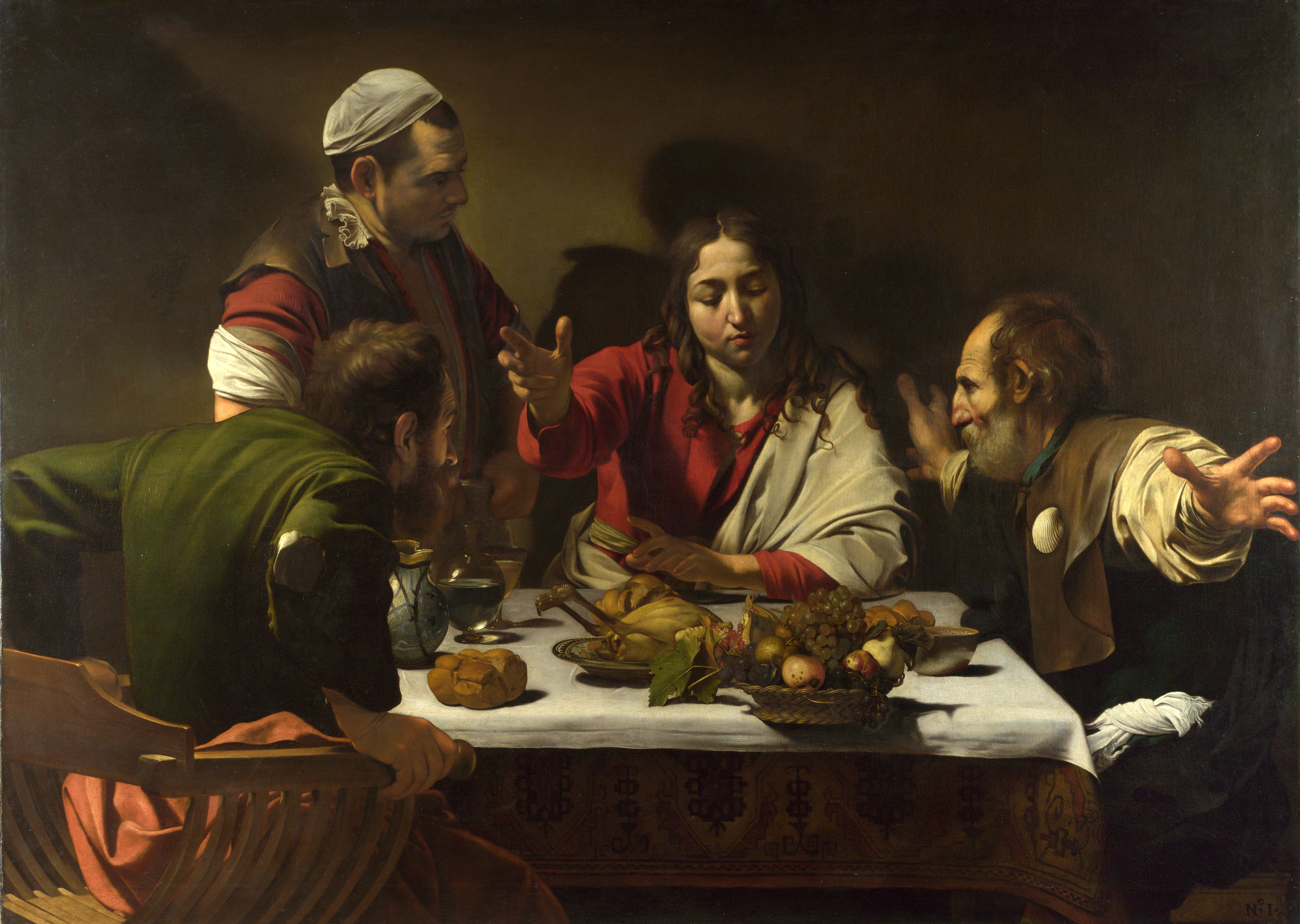
Thoughts on Caravaggio's Supper at Emmaus

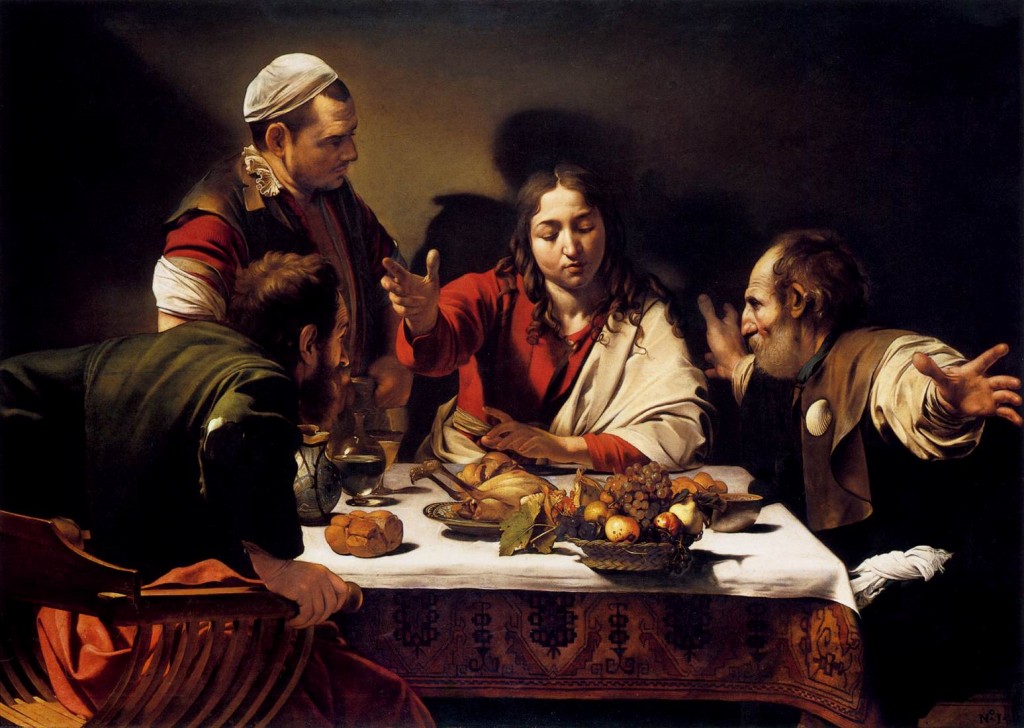
I’ve talked and thought and heard a lot lately about Caravaggio’s Supper at Emmaus, but never actually seen the real picture. As I’m in London for a meeting, I thought I’d make a trip to the National Gallery where it hangs, and take a look. Here are my thoughts while I was in front of it. (I've deliberately not looked at any art history websites to see how they compare to others' views.)

It’s a very physical picture. The light and the shadows behind Jesus are often remarked upon, and they’re stunning, but equally obvious is the food on the table – chicken and fruit and water, portrayed in great detail, as well as bread and wine. This is not a ritual re-enactment of the Last Supper with cubes of white sliced bread or tasteless little wafers. This is real food, a real meal.

Then there’s the people. They are not picture postcard people. They are not symbols or abstractions. They’re real, grounded people.

There’s Jesus. He’s strikingly pretty, a young girlish face. Composed yet tender, flowing locks. Yet he’s not the tender-Jesus-meek-and-mild of Victoriana. There’s power in him, and a really strong sense of sadness.
The two disciples are much older than him, a whole generation older. The gospel names one as Cleopas, and while modern biblical scholarship suggests that the other might be Cleopas’ wife, both figures are male in this picture, both with ample beards (Jesus is clean-shaven).

One has arms stretched wide, a gesture which the National Gallery interpretation sign suggests is astonishment, but is also an echo of Christ’s arms outstretched on the cross. He’s wearing a scallop shell, later the symbol of pilgrims. He could be about to pronounce a blessing himself, or to emulate Christ’s sacrifice (as so many of the disciples did). Flippantly, his gesture also reminds of the fisherman showing how big was his fish that got away – though of course Jesus’ disciples knew a thing or two about fish.

The other disciple has his back to us, and is rising from his chair. Not so much to say about him. He looks more dishevelled than his friend – his clothes are slightly torn, he has a sense of disorder about him. The troubles of the past few days must weigh heavy on him.

And then there’s a third man, standing behind Jesus. He’s younger, wears a cap, with just a small beard. He’s listening just as intently as the other two, though gives the impression of not being so much part of the meal, if only because he’s not sitting at the table. Perhaps he is the innkeeper, a sudden extra witness to the teaching and the blessing and the revelation?

I don’t know which of the three figures are actually intended to be the two disciples mentioned in the gospel story, and why Caravaggio portrayed three figures. But the gospel story is never complete. There were always things going on not discussed in the story. Why should there not be a third figure?

Caravaggio shows us an ordinary scene, with ordinary food being eaten by ordinary people in an extraordinary situation. Emmaus was a revelation, but it was a revelation within the everyday, that happened to people who had other lives and other stories. Life continues, and the amazing things happen in its midst.

Tuesday, 3 June 2014

Jonah and the Whale song - an extended version

The song "Jonah and the Whale" is much beloved at Sunday Schools. It's jolly but (like lots of Sunday School versions of the Jonah story) ends when Jonah came out of the fish, and misses out most of the interesting parts of the book of Jonah. In particular, there's no mention of the tree that Jonah shades under and is subsequently eaten by a worm, a strange little parable wrapped inside the whole strange parable that is the book of Jonah.

Here's the original song (written by Hugh Mitchell in 1957 - it's often uncredited but is listed by the Churches Copyright Licensing Authority). The tune can be found in various places online and in an organ version by Canon Quentin Bellamy:
Come listen to my tale
Of Jonah and the whale
Way down in the middle of the ocean.
Now how did he get there
Whatever did he wear
Way down in the middle of the ocean
A-preaching he should be
At Nineveh, you see -
To disobeys a very foolish notion.
But God forgave his sin
Salvation entered in
Way down in the middle of the ocean.
And here's our second verse (written by myself and my daughter):
God sent Jonah a tree
He said hip-hip-hooree
He sheltered neath its broad and shady branches.
But God sent down a worm
It wriggled and it squirmed
Deep down in the middle of the desert.
The worm ate up the tree
Near Nineveh you see
And Jonah got all hot and tired and bothered.
But God said to Jonah,
Dont you be a moaner,
Deep down in the middle of the desert. 
Original - copyright Hugh Mitchell, 1957; second verse copyright Magnus Ramage & Alice Calcraft, 2014. (Images: Jonah Journal by Rabbi David Paskin)


Friday, 23 May 2014

Living the Way of Jesus

Sermon preached on 18 May 2014 at Duston URC. Text: John 14:1-14. See also my blog post from 2013 on John 14:6.
So I began talking with the children about what it means to walk along with Jesus, and I want to go into that a bit more – about what it means to live in the way of Jesus. This is a long and quite complex passage, rich with imagery and ideas. There’s material for a whole series of sermons in these 14 verses. So as I did earlier, I’m going to mostly focus on one single verse – though drawing on ideas from the rest of the passage.


Now there are probably bits of the Bible you like more than others. Some parts really hit the spot for you, other parts make you much more uncomfortable. And for me, verse 6 of this passage – “I am the way, the truth and the life, no-one comes to the father except through me” – puts me straight into the discomfort zone. I’ve carried this verse with me for perhaps twenty years, looked at it again and again from different angles. I find it really fascinating but also quite disquieting, with this sense of exclusivity in the second half. It’s a verse beloved of tracts and those posters you used to see at railway stations. It could be seen as closed-minded, creating an in-group and an out-group, rather self-satisfied. Does that mean all the Muslims and the Hindus and Jews, not to mention the atheists, have no chance of finding their way to God? Some Christians would say yes, that’s exactly what it means; others would want to interpret it differently and point to the fact that Jesus said that there are many dwelling places in his father’s house. I’m not sure what I think about this subject, but I think the verse as a whole and indeed the passage as a whole is so rich and interesting that it’s worth working with it for a while to see where it takes us.

Let’s step back a moment. This passage is part of John’s gospel in what’s sometimes called the farewell discourses. It happens at the Last Supper, soon after Judas leaves the others to go and betray Jesus. Before the events of the Passion unfold, Jesus gives his disciples a long set of final teachings, interspersed with dialogue from the disciples. They begin with Peter’s declaration that he would lay down his life for Jesus, and Jesus’ prophecy that Peter will betray him three times. And immediately follows the passage we’ve just heard. Jesus says he’s going to his Father, that there’s plenty of space for the disciples to come too, and that they should put their trust in him.

And then comes Thomas, the original TomTom. Good old Thomas, just as much of a believer and a follower of Jesus as the other disciples, but who was always keen to have things nailed down and certain. The man who’s become known in history as Doubting Thomas, but really was just a bit too keen on clear evidence. Here he’d like a satnav please, telling him the way and when he’ll reach his destination. And in response, Jesus speaks two words, which for a Jewish ear are incredibly resonant.


What Jesus says is “I AM”. John’s gospel has several of these I AM sayings – I AM the light of the world, I AM the bread of life and so on. In Greek, the phrase is particularly emphatic, a strong way of saying who you are; but for Jews it’s dynamite, because it’s exactly God said to Moses from the burning bush in the book of Exodus. When Moses asked God his name, God said “I am who I am” and to tell the Israelites that “I AM has sent you”. It’s the basis for the Hebrew name of God, Yahweh, so holy that to this day devout Jews won’t say it aloud. So in using this phrase, Jesus was making a really strong claim about himself, and his connection to God.

And then he goes into more detail about what he’s saying about himself, in these three words. He says that he is the way, that he is the truth, and that he is the life. I’m not entirely convinced these are separate ideas, or even that they’re meant to be. But they’re individually very interesting, and so I want to look at each in turn and what they can tell us about being a follower of Jesus.

So the first thing he calls himself is the Way – the path, the road. He doesn’t say he’ll tell people the way to where he’s going, he doesn’t say he’ll show it to them. He says that he himself is the way. The first Christians were known as the people of the way, and the idea of the ‘way’ was a familiar one in Jewish thought; Moses used it, as did the prophet Jeremiah when he said “Stand at the crossroads, and look, and ask for the ancient paths, where the good way lies; and walk in it,  and find rest for your souls”. As I said to the kids, choosing the right path is very important. But these are all about the way as something external, something physical. By saying that he himself is the way, Jesus makes the idea very personal. We will know the way to the Father by following his example, by living our lives as he did. It’s not about what you believe, or pious statements of faith. It’s about how you live your life.

There’s a wonderful poem by a Spanish poet, Antonio Machado, who wrote: “Traveller, there is no road. We make the road by walking.” Paths are fragile, like the one across these sand-dunes I saw once in California. And Jesus tells us that the only path that matters is one that we can’t see, that we make ourselves by the way we lead our lives. So how do we live our lives? Another quote from a traveller, this time the founder of the Quakers, George Fox, a travelling preacher who did a lot of walking, and told said that we should: “Be patterns, be examples in all countries, places, islands, nations, wherever you come, that your carriage and life may preach among all sorts of people, and to them; then you will come to walk cheerfully over the world, answering that of God in every one.”

And then we move on to Jesus’ second word. He says he is the Truth. Now we live in a postmodern world where truth is a slippery concept, where my version of the truth is just as good as your version of the truth. We have more information than ever before in history, and that information sometimes clouds what is the truth. But in the past, uncovering the truth about something has always been important. And again Jesus doesn’t say he’s going to show us the truth, or bring us the truth, or lead us to the truth. He says he is the truth. Many people proclaim that they have a message of some sort which is true for the world, and yet they live quite a life which shows that is not true within their own lives. It’s something we’re all guilty of at times. But Jesus proclaimed that he was the truth, and he lived a life of truth and integrity. And he said something else amazing about truth: “you will know the truth, and the truth will set you free”. So much that goes wrong in the world comes from half-truths, rumours and outright lies that people tell each other or we tell ourselves. But truth brings freedom in it, and by following the one who embodies truth, we find freedom.

The third of Jesus’ words is my favourite of all. He says he is the Life. Again, not that he shows us life, or tells us about life, but that he himself is Life. The word ‘life’ is absolutely central to John’s gospel. It opens with the statement that “In him was life, and the life was the light of all people”. Jesus tells us that he is the bread of life, that those who follow him will have the light of life, that those who believe in him will have eternal life. And it’s in what to me is perhaps the most important verse of the whole Bible [slide 12], also in John’s gospel, where Jesus says “I have come that they may have life, and have it abundantly”. Jesus didn’t come to bring us rules, he hasn’t come to convince us of our sin, to rub our unworthiness in our faces. He has come to bring us LIFE.

But this is not just any old life. This is not the boring and mundane life, the grey life of the 9-5 drudge with little sense of life. This is life in abundance, life lived to the full. Nor is it about greed or excess. It’s not about taking from others. It’s about living a life that is full of joy, that is suffused with an awareness of God’s love. The American preacher and author John Ortberg talks about becoming the people God created us to be. He asks the question: “what do you do that makes you feel fully alive?” This isn’t about momentary pleasure, the sort of kick you get from eating chocolate or drinking your favourite tipple or watching a mindless but fun television programme. It’s about deep satisfaction. What makes us feel fully alive differs for each of us, but I believe that Jesus came to show us that this kind of life, and richer and deeper, is possible right here and right now.

So Jesus tells us that he is the way, the truth and the life. He is the one who in his own person embodies the generosity, abundance and integrity that he promises to the disciples and to any who are prepared to follow him. Because he asks us at the start of the passage to put our trust in him. Sometimes that verse is translated as “believe in me”, but really it’s better seen as putting our trust in Jesus, like one of those trust exercises where you lean backwards and let go and trust that someone will catch you.

So how can we live like this? How can we put our trust in Jesus as the way, the truth and the life? How can we really be followers of Jesus? Isn’t it rather presumptuous of us? Well, I think we need to start by remembering who we are. We are creatures who are made in the image of God. George Fox talked about answering that of God in everyone, which to me means loving each person we encounter and working for their good, as well as for the good of all others around the world. But it also means seeing that of God in ourselves, of recognising the image of God inside ourselves, of being prepared to be called into that abundant life which awaits all of us who choose it.

The Protestant reformers talked about the priesthood of all believers. They believed passionately that we don’t need intermediaries between us and God, that every Christian is able to find their way to the father through following the way of Jesus and with the assistance of the Holy Spirit. We started the service with the words of Peter that “you are a chosen race, a royal priesthood, a holy nation, God’s own people”. This is an amazing promise, but it’s also a bit scary and I think we often dodge around it and don’t take it quite seriously. If we are made in the image of God, if we are followers of the way of Jesus, then we really can trust that it is possible for us all to be priests. And Jesus promises us that if that happens, then we will do the works that he did, and even more.

To follow Jesus is to be in relationship with the one who in himself personified the way, and the truth, and the life; and who calls us to have those things now with him and for ever more.

Amen.



Sunday, 11 May 2014

Life in abundance – now and for ever

Sermon preached on 9th May 2014 at a residential weekend of Gateways into Worship, part of the Training for Learning & Serving programme of the United Reformed Church. Text: John 10:1-10
I listened to a talk earlier in the week by someone who works for Google. He recounts that the software engineers there, in the plain-speaking way of engineers everywhere, have what they call the “WTF question”. If someone presents an interesting but obscure idea, then they’re presented with the WTF question. Jesus could be disarmingly direct and to-the-point, but he also had a liking for parables and complex images, and his disciples seem to have done a fair bit of asking of the WTF question, including in this passage. And as I read on a blog recently, explaining a parable is like explaining a joke: even if you do it really well, you’ve still missed the point.

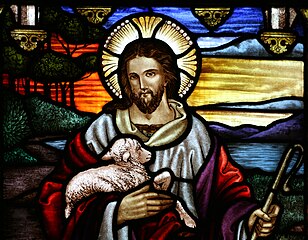
So it is here. The image of Jesus as a good shepherd is found in all four gospels, and the fourth Sunday after Easter is often called Good Shepherd Sunday. It’s a well-loved image, much preached on and much portrayed in art. The people of Jesus’ time knew about sheep and shepherds, so Jesus kept coming back to stories about shepherds.

Like most of the rest of the gospel of John, this passage is rich in imagery. There are sheep, a shepherd and his voice, gates and sheepfolds, thieves and bandits, strangers. It’s a strange cast of characters. And when we’re told that the disciples didn’t understand it, Jesus introduces another layer of images. What are we to make of it all?

I don’t intend a full verse-by-verse exegesis of this passage. I have two observations to make about the context of the piece, and then I want to skip ahead to the end, the final verse which is the one that really fascinates me. On the context, then. Sheep in 1st century Judaea were mostly kept for wool, not meat – so that the shepherd kept a herd together and developed a close bond with the sheep over a number of years. So Jesus is describing a long-term relationship, not a short bit of guarding then off to the slaughterhouse. The second bit of context concerns gates and sheep-folds. In the town, sheep were guarded with a proper locked gate. But when out in the country, sheep were kept in a simple pen with walls and one entrance. It didn’t have a gate – instead the shepherd sat or lay across the entrance to keep the sheep in and the predators out. So in saying he is the gate, Jesus is being less obscure than you might think – it was what shepherds did. He knows his flock, he protects his flock.

But on to that final verse, or indeed its second half. “I have come that they may have life, and have it abundantly” – or have it to the full, in some translations. I genuinely believe that this may be the most important sentence in the entire gospel. Elsewhere we are told of Jesus’ actions, of his preaching and life and death. But here he sums up for himself the core of his purpose. He hasn’t come to bring us rules, he hasn’t come to convince us of our sin, to rub our unworthiness in our faces. He has come to bring us LIFE. It’s the great theme that runs throughout John’s gospel. It opens with the statement that “In him was life, and the life was the light of all people”. Jesus tells us that he is the bread of life, that those who follow him will have the light of life, that those who believe in him will have eternal life.

But this is not just any old life. This is not the boring and mundane life, the grey life of the 9-5 drudge with little sense of life. This is life in abundance, life lived to the full. The word in Greek, perissos, has a sense of surplus, of something that is more than enough. My cup overflows. This is not about greed or excess. It’s not about taking from others. It’s about living a life that is full of joy, that is suffused with an awareness of God’s love. The American preacher and author John Ortberg talks about becoming the people God created us to be. He asks the question: “what do you do that makes you feel fully alive?” This isn’t about momentary pleasure, the sort of kick you get from eating chocolate or drinking your favourite tipple or watching a mindless but fun television programme. It’s about deep satisfaction.

What do you do that makes you feel fully alive? It differs for each of us. For me, I feel at my most fulfilled when I’m really properly spending time with my wife and children; when I’m singing a complex piece of music in a choir that I’ve got to know really well and which engages my soul as much as my voice; when I’m writing (whether it’s a sermon, a blog post or an academic paper) surrounded by books and websites and full of ideas in all directions which somehow come together; or when I’m worshipping and totally carried along by the experience. For other people it’s a different combination.

These things are a tiny taste of heaven. But I believe that Jesus came to show us that this kind of life, and richer and deeper, is possible right here and right now. Now the church hasn’t always been very good at recognising this. To paraphrase St Paul, I stand before you as a Presbyterian and the son of Presbyterians. My people are famously dour and joyless. There is a wonderful photo in the biography of John Reith who founded the BBC, and in late life was the Queen’s commissioner to the Church of Scotland general assembly. Reith was a serious man, and he’s shown processing in solemnity into the assembly, under a statue of John Knox looking even more serious. Not much sense of life in abundance. And in their own ways, other churches have been just as bad about denying life. For centuries decent Christian folk supported slavery and persecuted members of other faiths, or the wrong branch of their own faith. There are many churches today who still think it’s acceptable to deny acceptance of those in a loving relationship simply because their partner is the same gender. I believe that Jesus would stand against all these denials of life and lovingly affirm that he has come into the world that all may have life, and live it to the full.

To follow in this abundant life is not to be selfish or materialist. On the contrary. It includes enabling others to have life in abundance. It is focused on others, outward-looking and generous. Jesus’ words here closely follows a healing he conducted of a man who was blind from birth, to whom he gave sight. We are likewise called to heal and help those in all sorts of need. We are participants in bringing about the kingdom of God here on earth, the upside-down kingdom where the last shall be first, where the mighty shall be humbled, and where the meek shall inherit the earth. You may remember the Christian Aid slogan from a couple of years ago which read “we believe in life before death”. That’s the kind of life we’re called to lead and to help others to lead.

And to me, this is our role as preachers – to bring life and hope to those we lead in worship, to show them the way to find abundant life through a relationship with Jesus. To show them that however difficult is their life today, there is a way into a life of joy and satisfaction. Rob Bell writes: “God is love, and love is a relationship. This relationship is one of joy, and it can’t be contained. Jesus invites us into that relationship, the one at the centre of the universe. He insists that he’s one with God, that we can be one with him, and that life is a generous, abundant reality.”

In him was life, and the life was the light of all people. He came to bring that life to the world. He came to bring that life to us, to offer us the chance to live in abundance – right here, right now, and then for ever more.

Amen.

Tuesday, 29 April 2014

In praise of doubt

At our church, we're doing a study course during the liturgical season of Easter - from Easter Sunday to Ascension Day. That's 40 days, and the course is entitled 40 Days with Jesus. It's very good - written by Dave Smith, founder and pastor of an independent church in Peterborough. The author is clearly evangelical in his background, but manages to present an open-minded account of some of the people Jesus met and interacted with in the 40 days we are told (Acts 1:3) that he spent on earth after his resurrection. (The book is published by CWR.)

I really like the idea of taking the season of Easter seriously. In our society we have a problem with over-preparation for events which are then over in a moment. Of these, the most notable is Christmas, where "Christmastime" or the "festive season" takes up most of December, sometimes spilling out to November, but more or less ends on 25th December. In many Protestant churches, we follow this trend in society with Christmas, for which our celebrations are great on 25th Dec but end there. It's even more so with Easter. Many of us have started to follow Lent quite arduously, giving things up and following study courses and the like. And many Reformed churches are taking Maundy Thursday and Good Friday quite seriously (much more so than a generation ago when celebrating either would have been considered 'Papist'). And of course Easter Sunday is the great celebration in all churches everywhere. But afterwards - nothing. Nada. Back to normal life.

The Catholics do these things better, taking the liturgical year much more seriously, and this is something the Anglicans kept when the Church of England had its partial Reformation, and have nurtured well for the past several hundred years. But in other Protestant traditions, not a lot happens between Easter Sunday and Ascension (perhaps even skipping that one and going straight to Pentecost). So I really welcome Forty Days with Jesus.

We're on Day 10 of the course. It takes one encounter with the risen Christ each week, and has daily study material for each encounter (supported by other resources). This week, it's the meeting of Jesus with the disciples on the road to Emmaus. It's a great story, and one which has teased and intrigued Christians throughout history. Why didn't the disciples recognise Jesus? What kept them from realising who he was? What did he tell them on the road? How did it feel when they realised who he was? Why did he disappear after they realised this? It's been the subject of many artworks as well as scholarly works - this is Caravaggio's version, one of my favourites.

Today's reading is entitled "Vision blurred by doubt". Dave Smith writes: "[I]t is worth being alert to how doubt can prevent us from 'seeing' Jesus, wherever we are in our spiritual journey. It seems as if the main reasons why the disciples failed to recognise Jesus on the Emmaus Road, even though He was standing right there with them, was because of their unbelief" (p.40 of the book). The experience of Thomas, often called the doubter, follows next week - we'll see what Dave Smith has to say then.

I really don't agree with him on this one, either in the case of Emmaus or generally about doubt. Here's what I'd say about Emmaus. It was the third day after Jesus had been executed. The disciples were bewildered, depressed and fearful. And then there were these strange stories that he had been spotted. Cleopas and his companion must have been besides themselves, unable to recognise anything much going on. And they knew Jesus was dead, so why would they expect him to be there? It wasn't a matter of doubt or unbelief but simply normal expectation.

But what if it was about doubt? Is that so wrong? Oliver Cromwell, not a man we associate with doubt or a lack of self-esteem, famously said: "I beseech you, in the bowels of Christ, think it possible that you may be mistaken", which minus the bowels bit has been preserved to this day in British Quakers' Advices and Queries. And a bit of healthy uncertainty is extremely important. It's the basis of the scientific method and the Enlightenment - Immanuel Kant summed up the entire thesis of the Enlightenment in two words, Sapere aude (loosely translated, 'dare to question').

Those who are certain about the truth of something are the most dangerous people in the world. It's that certainty which causes wars, conflict, persecutions. The cause might be an excellent one, or it might be a repellent one, but if you believe it with no room for doubt, you're left with no room to change, and no room to compromise with those you meet.

We might have excellent reasons for believing something. I have excellent reasons for believing, variously, that: the sun will rise tomorrow; if you hit yourself with a large object it hurts; I will die within the next century; we were created by a loving God. My reasons for believing these are different kinds of knowledge. Nonetheless, it is appropriate to doubt each of them.

But this kind of doubt is essentially about intellectual belief in the truth of abstract propositions. Faith is a different matter. As has been written by various Biblical scholars, the Greek word "pistuein", often translated as "to believe", really means more like "to trust". Faith is about relationship, it's not about believing intellectually that your partner will come home to you each night but rather trusting it with all your heart. And that's the kind of thing we can do without doubting.

Shakespeare discussed doubt and trust as follows (in Hamlet):
Doubt thou the stars are fire;
Doubt that the sun doth move;
Doubt truth to be a liar;
But never doubt I love.
The disciples on the road to Emmaus were right to doubt that the person they met on the road was Jesus. It didn't come from lack of faith in him. But they were equally right, once their eyes had been opened, to put their full trust in what they had seen and experienced - the risen Christ.

The Year of Jane: or, a personal account of my first time reading through all the novels of one of the greatest novelists

I never read Jane Austen as a teenager. I was a voracious reader, but a lot of it was sci-fi & fantasy, I found nineteenth-century ficti...